Home / Texas / Austin, San Marcos & the Lost Pines / Barton Springs Pool
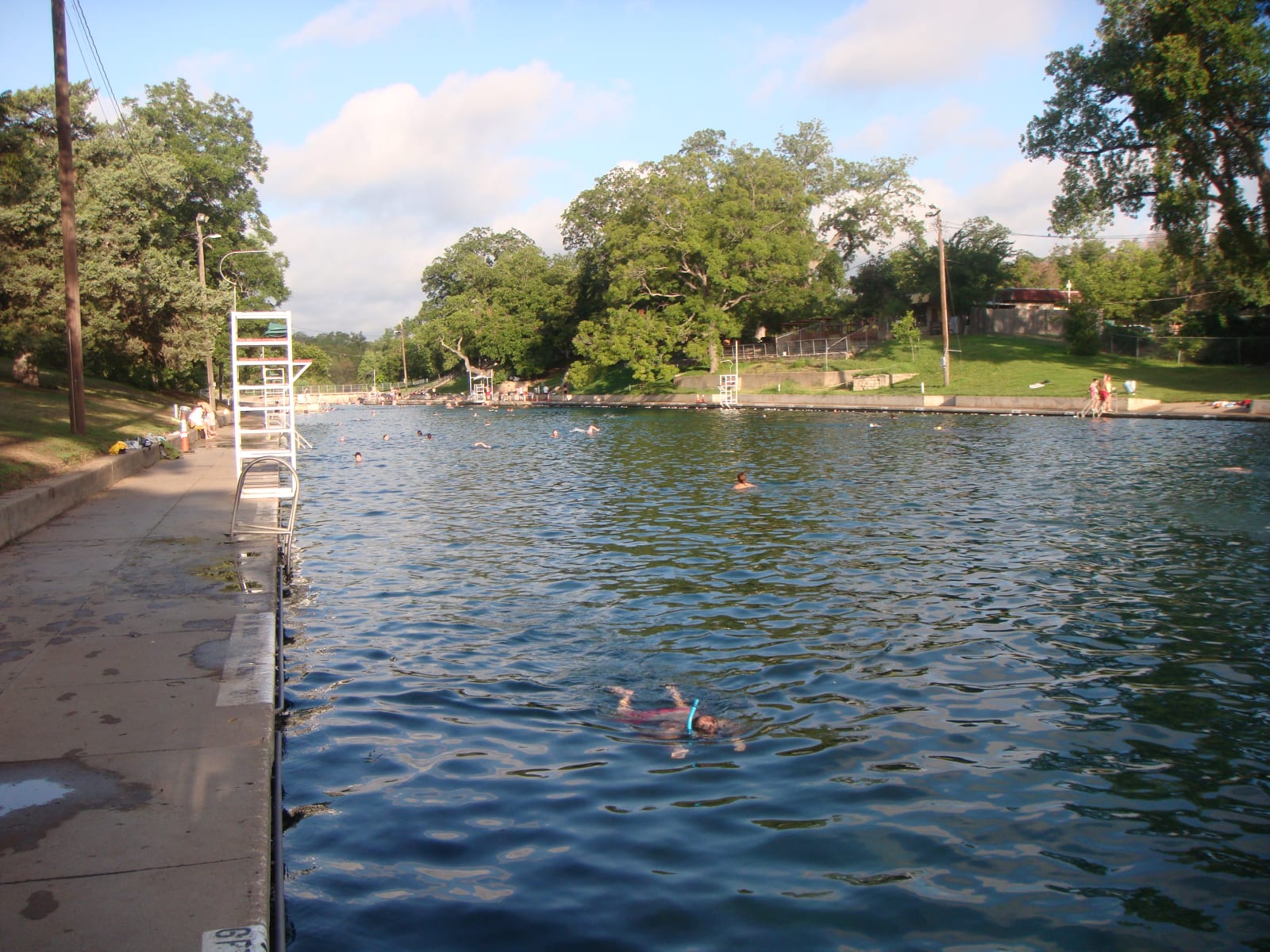
The long clear pool at Barton Springs in Austin, with a few swimmers, a diving board and trees along the far bank.Todd Dwyer / CC BY-SA 2.0 via Flickr
🌲Natural

Barton Springs Pool

Part ofAustin, San Marcos & the Lost Pines

A three-acre pool in the bed of Barton Creek, fed by the fourth-largest spring in Texas at 68 to 70 degrees, and shared with an endangered salamander found almost nowhere else.

⏱
Duration
One to three hours.
🎟
Admission
Adults 18 to 62: $5 Austin residents, $9 nonresidents; juniors 12 to 17 $3 and $5; children 1 to 11 $2 and $4; seniors $2 and $5; veterans and infants free. Weekend and holiday parking $3 an hour from March 1 to Labor Day.
📅
Best Season
Year round, at about 68 to 70 degrees. Open 5 a.m. to 10 p.m. except Thursday, when it closes 9 a.m. to 7 p.m. for cleaning; guarded swim from 8 a.m.

The Story

Barton Springs is the fourth-largest spring system in Texas. Water from the Edwards Aquifer rises here through cavernous limestone in the Balcones fault zone, and from 1895 to 1978 it averaged nearly 370 gallons a second. For thousands of years the springs were a gathering place for Native peoples, Spanish explorers noted in 1714 that wild horses were plentiful, and the springs took the name of William Barton, an early settler. Saw, flour and grist mills and ice machines later ran on their flow.

The pool sits in the channel of Barton Creek inside Zilker Park. Andrew Jackson Zilker, the last private owner, deeded the land to Austin in 1918, and in the 1920s the city dammed the springs and built walks to make a larger swimming area. Today it covers three acres, runs from 0 to 18 feet deep and stays at about 68 to 70 degrees, so people swim year round. Dan Driscoll and Delmar Groos designed the Streamline Moderne bathhouse in 1947, and Robert Redford learned to swim here at five.

The springs are also habitat. The Barton Springs salamander, a federally listed endangered species, lives only in the pool and a few nearby springs, and the pool closes for cleaning on Thursday mornings partly to protect it. From the 1980s, runoff from subdivisions over the recharge zone fouled the water after heavy rains, and the fight to protect it produced the Save Our Springs Alliance and, in 1992, a campaign for stricter water rules. The Splash! exhibit beside the bathhouse explains the aquifer and its animals.

Visitor Info

⏱
Time Needed
One to three hours.
🎟
Admission
Adults 18 to 62: $5 Austin residents, $9 nonresidents; juniors 12 to 17 $3 and $5; children 1 to 11 $2 and $4; seniors $2 and $5; veterans and infants free. Weekend and holiday parking $3 an hour from March 1 to Labor Day.
📅
Best Season
Year round, at about 68 to 70 degrees. Open 5 a.m. to 10 p.m. except Thursday, when it closes 9 a.m. to 7 p.m. for cleaning; guarded swim from 8 a.m.
🛣️
Highway
Loop 1 (MoPac) / Barton Springs Road

On the Map

Nearby

The closest stops worth working into your route

architectural1.9 mi away
Texas State Capitol
Austin's fourth statehouse, a Renaissance Revival capitol of 1888 that stands 311 feet to its Goddess of Liberty and was restored after the 1983 fire.
historical2.2 mi away
Bullock Texas State History Museum
The state's history museum at the head of Congress Avenue, built around the hull of La Salle's ship La Belle, raised from Matagorda Bay with 1.8 million artifacts.
cultural2.2 mi away
Harry Ransom Center
The University of Texas archive where a Gutenberg Bible and the earliest surviving camera photograph are always on view, free, beside the papers of Watergate and the movies.
historical2.3 mi away
French Legation State Historic Site
A raised pine house built in 1840 and 1841 for France's envoy to the Republic of Texas, who left Austin in a rage over a neighbor's pigs before it was finished.
historical2.6 mi away
Texas State Cemetery
A hill east of the Capitol that began with one general's grave in 1851 and now holds Stephen F. Austin, governors, Barbara Jordan and more than 2,000 Confederate veterans and widows.
cultural2.8 mi away
George Washington Carver Museum
East Austin's museum of Black history and culture, grown from a segregated branch library moved across town in 1933, with a permanent exhibit on Juneteenth at its core.

Historical markers nearby

Roadside plaques and monuments within a short detour

Marker0.1 mi away
Barton Springs
Austin
Marker0.4 mi away
Swedes of Texas
Austin
Marker0.8 mi away
Travis County
Austin
Marker0.9 mi away
Michael Butler and Butler Brick Company
Austin
Marker1.2 mi away
Wood Street Settlement at Shoal Creek
Austin
Marker1.3 mi away
Clarksville
Austin