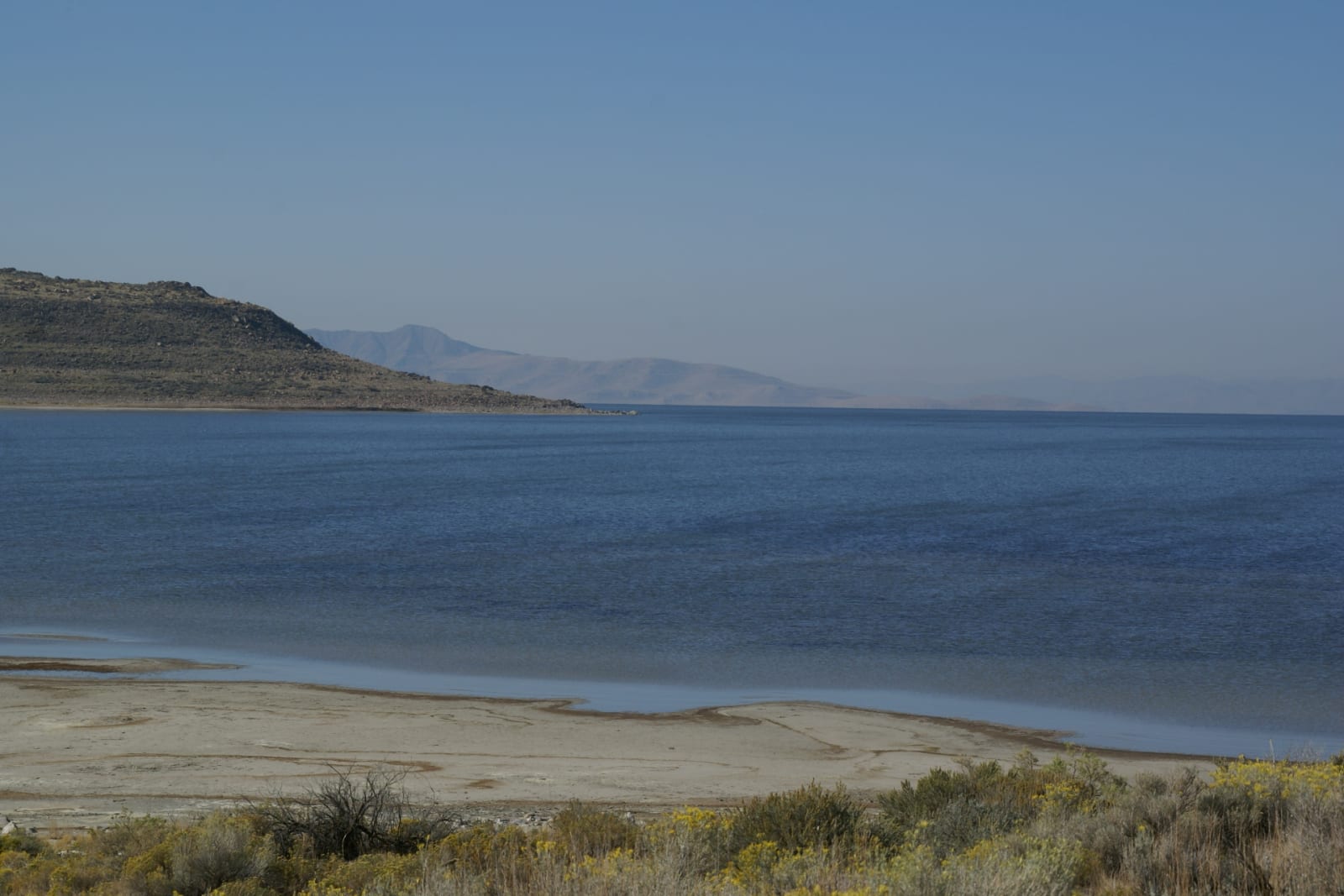
Nothing about the surface of the Great Salt Lake suggests life. It has no fish. It smells of sulfur and brine. Wade in and the water holds you up like a hand — too dense to sink in, salty enough to sting a shaving cut from a foot away — and the shore is as often as not a crust of white salt and the drift of a billion dead flies. People have called it America's Dead Sea for a century and a half, and standing on the wrong stretch of it, you would believe them. They are wrong. This is one of the most alive places on the continent, and it is disappearing.
The lake with no exit
The lake is salty for the same reason it exists at all: nothing leaves it but water vapor. Three rivers — the Bear, the Weber, and the Jordan — run off the mountains into a basin with no drain, and the only way out is straight up, into the air. Every grain of salt and mineral those rivers carry down stays behind, and over thousands of years it has concentrated into a brine several times saltier than the sea. What you float in is essentially every rainstorm that ever fell on northern Utah, boiled down. The lake is the shrunken remnant of Ice Age Lake Bonneville, whose old shorelines are cut into the benches the cities stand on. What is left is shallow, enormous, and getting more concentrated every year.
The dead sea that isn't
Nothing with a backbone can live in that brine, and that is exactly the point. With the fish shut out, the few things that can take the salt have the entire lake to themselves, in numbers that stagger. Mats of microbes build low, rocky reefs called microbialites across the lakebed. Those feed brine shrimp and brine flies, which hatch in clouds thick enough to darken the shallows. And the shrimp and flies feed birds — something like ten million of them, from hundreds of species, dropping onto the lake as they cross between the Arctic and South America. Eared grebes stage here by the million to fatten before the next leg; Wilson's phalaropes and a long list of shorebirds time their whole migration to this one salty pantry. To a passing traveler it can read as wasteland. To the hemisphere's birds it is a filling station with no substitute for a thousand miles in any direction — best seen from Antelope Island, a whaleback of rock with its own herd of bison and more birds around it than most people see in a lifetime.
The pink half
From the air the lake is two colors, split by a dead-straight line. In 1959 a railroad laid a rock causeway clear across the water to carry its tracks, and the wall cut the lake in two. The southern half still takes in the rivers and stays a normal blue-green. The northern half, cut off from fresh water, turned so salty it passed the point almost anything can bear — and the few microbes that hang on there dye it a startling tomato pink, a color you can pick out from a passing plane. It was into this dead north arm, at a bare shore called Rozel Point, that the artist Robert Smithson built Spiral Jetty in 1970 — a fifteen-hundred-foot coil of black basalt curling out into the pink. For thirty years the risen lake kept it drowned. You can walk it now, high and dry above the waterline, which tells you most of what you need to know about where the lake has gone.
What it is worth
For a body of water most Utahns never touch, the lake works hard. Its brine shrimp lay tough little eggs — cysts — that are skimmed off by the boatload each winter and shipped around the world to feed the fish and shrimp of the global aquaculture trade; a surprising share of the farmed seafood on earth begins life eating Great Salt Lake. Its water is mined for magnesium, potash, and common salt. Its shallows and flyways draw hunters and birders, and its density still draws the curious out to the old pavilion at Saltair to bob upright, cork-like, in the heaviest water they will ever swim in. All told the lake feeds something like two and a half billion dollars a year into Utah's economy and holds up thousands of jobs — most of it unseen, none of it easily replaced.
The drying
And it is going. The lake has always risen and fallen with wet years and dry, but the run of the last few decades points one way. In November 2022 it dropped to 4,188 feet, the lowest level ever measured — down roughly seventy-three percent by volume and sixty percent by surface from its modern high. More than eight hundred square miles of old lakebed now lie bare to the wind. The cause is less the drought, damaging as that is, than plain arithmetic: cities and farms upstream now take close to half of the water the three rivers would otherwise carry down, so even in ordinary years too little reaches the lake. Two wet winters bought a brief reprieve — and then the winter of 2026 brought the warmest season and the thinnest snowpack in the state's records, a "no-pack" year that shoved the lake back toward its all-time low and the governor back to declaring a drought emergency.
The dust downwind
A drying salt lake does not vanish and leave a meadow. It leaves a floor. The exposed lakebed holds more than a century of settled runoff — arsenic, lead, mercury, and other metals — and when the wind gets under it, that dust blows onto the two and a half million people crowded along the mountain front, most of Utah's population. Scientists are only now pinning down how much of it reaches the neighborhoods, but the arsenic is not in question, and the same dust dulls the mountain snow and hurries the melt. The living lake is on a shorter clock still: as the water drops, the salt climbs, and in 2022 the south arm crept toward the level where even brine shrimp begin to fail. Push it past that line and the shrimp go, then the flies, then the ten million birds that fly thousands of miles expecting a meal. The dead north arm, behind its causeway, is the preview.
The reckoning
Utah has, late, begun to move. It created a Great Salt Lake commissioner, started paying farmers and cities to leave water in the rivers, built a berm to hold the salinity of the living south arm in check, and in 2025 moved to take back the water rights of the lake's biggest industrial user. The stated goal is to make it the first great saline lake anywhere pulled back from collapse — restored to health by 2034, when the Winter Olympics return to Salt Lake City. Whether the water can be found is the open question, and it turns on the oldest argument in the West: what a river is for. The lake is the one claimant that gets only what everyone upstream chooses not to take. For most of its life the Great Salt Lake made a marvel out of evaporation — a dead-looking sea that quietly fed the sky. That same evaporation is unmaking it now, one held-back river at a time, and the whole of northern Utah is standing downwind to see how it ends.