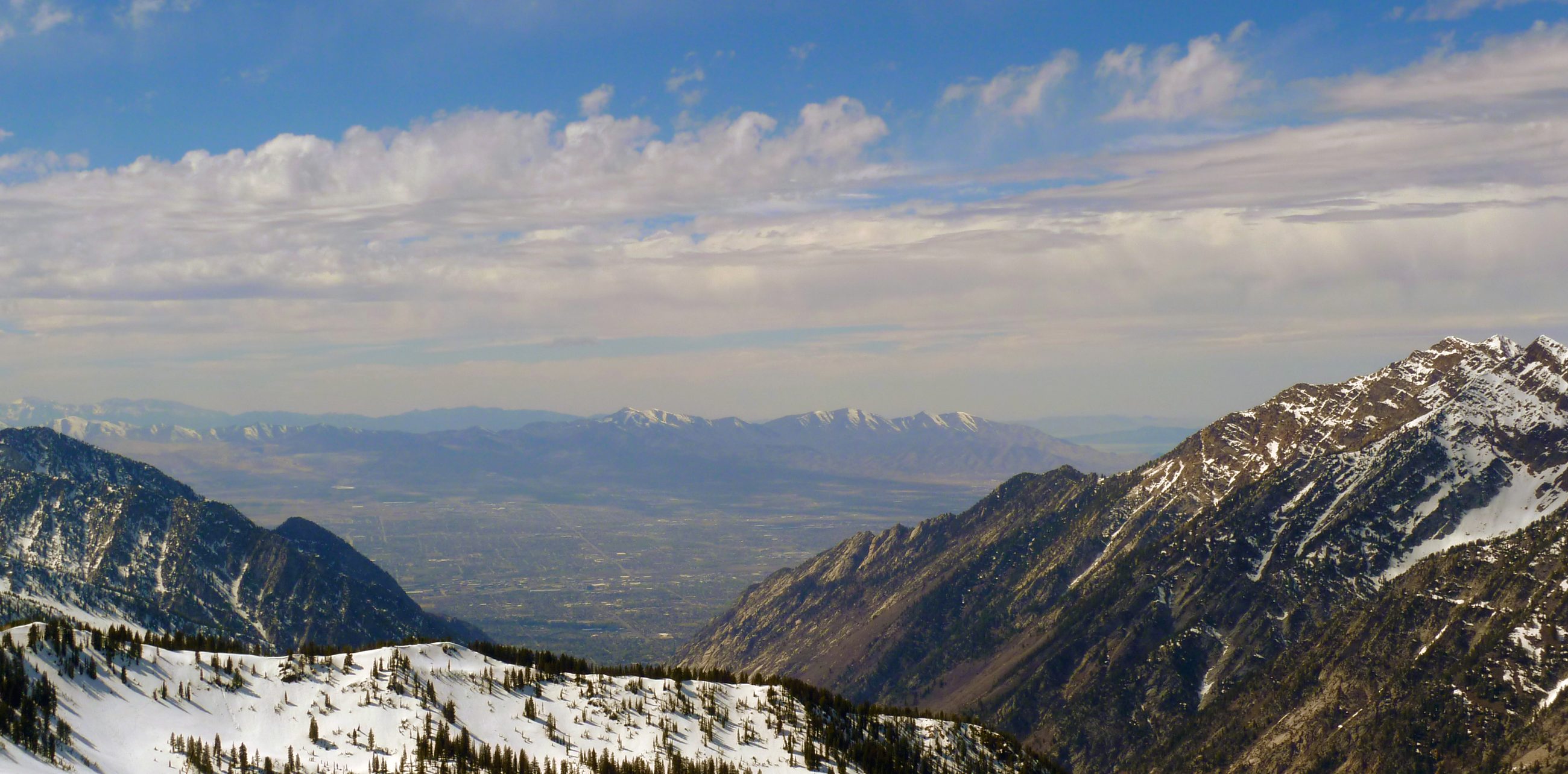
In the parking lot at the bottom of Alta, half the license plates carry the same four words: Greatest Snow on Earth. It is a marketing line — Utah trademarked it, and it has ridden the state's plates since the nineteen-eighties — but it is also, by most honest measures, true. Ask a skier stamping the snow off their boots why it is true, though, and most will give you the same wrong answer: the lake. The story goes that storms cross the Great Salt Lake and pick up something — moisture, or salt, depending on who is telling it — that makes Wasatch snow uniquely light. It is a good story. It is mostly a myth. The lake adds, by the careful accounting of the scientists who actually measure it, something like five or six percent of the snow that falls on the canyons above the city. The real reasons are stranger, more specific, and a great deal more fragile.
It isn't even the driest
Start by giving up the thing everyone is proudest of. Utah does not have the lightest, driest snow in the country — mountains in Montana, Idaho, and western Colorado routinely catch snow with lower water content. The one old folk explanation with real truth in it is the simplest: storms roll in off the Pacific, drop their wettest, heaviest snow on California's Sierra — the dense stuff skiers there call Sierra Cement — and arrive over Utah already wrung out and cold. That genuinely helps. It is still not the main event. Wasatch powder runs around eight percent water by weight, which is dry, but not record-dry, and that single number is not what makes it feel bottomless. "Greatest" was never a claim about one superlative. The phrase itself was an accident of newspapering — a Salt Lake Tribune ski writer coined it in a nineteen-sixty headline, the winter the circus came through town promising the Greatest Show on Earth — and what it actually describes is not the driest snow or the most snow but the best combination of them. Jim Steenburgh, the University of Utah atmospheric scientist who wrote the book on Wasatch weather, lays the thing out as a recipe, and only when the ingredients line up at once do you get a powder day worth the legend.
The recipe
The first ingredient is the wall. The Wasatch rises abruptly off the valley floor, and when a storm is shoved up its face the air cools and wrings itself out, so snowfall climbs steeply with elevation — by something like a hundred inches a year for every thousand feet you gain. Drive from the mouth of Little Cottonwood Canyon up to Snowbird, three thousand feet higher, and the average annual snowfall grows by roughly three hundred inches on the way — up around five hundred inches a year by the time you reach the high lifts. The canyon that holds Alta and Snowbird is the sweet spot: glacier-carved, ringed by peaks near eleven thousand feet, and broad enough up high to catch storms blowing in from almost any direction. Locals have a line about it that is only half a joke — it doesn't need a reason to snow in Little Cottonwood Canyon; it needs a reason to stop.
The second ingredient is the shape of the storm. The best Wasatch storms come in warm and leave cold, which sounds like a footnote and is in fact the whole secret. Warmer snow is denser, so it falls first and packs into a supportive base; as the storm cools the snow turns lighter and drier and settles on top. Skiers call this right-side-up snow, and it is what lets a ski float instead of plow — the fluff on top, the body underneath. Get it backward, dense snow piling onto fluff, and the same ten inches ski like wet concrete. The flakes themselves are nothing like the paper snowflakes of grade school; most Wasatch crystals are broken, lopsided, half-melted, or crusted with frozen droplets, a kind of Frankenstein snow that has no business skiing as well as it does.
The last ingredient is simply how often it comes. A great snow climate needs storms that arrive on a schedule, and through a good winter the Wasatch obliges — a fresh one rolling through about every ten days, often enough that the powder seldom gets old before the next storm buries it.
Not everywhere
Here is the part the license plates leave off: almost none of this is spread evenly. The legend belongs to the Cottonwoods, on the western, storm-facing edge of the range above Salt Lake — Brighton and its neighbor in Big Cottonwood, Alta and Snowbird in Little Cottonwood. Cross the crest to the drier back side and the arithmetic changes. Park City Mountain, in the lee of the range, gets the same storms with much of their snow already wrung out of them — fine skiing, fewer true powder days. An hour to the north, the family-run hill at Beaver Mountain in Cache Valley catches its own honest four hundred inches a year. The snow is good up and down the Wasatch. But the specific, improbable thing the plates are bragging about — that combination, falling that often, stacking that perfectly — comes together in a couple of canyons on the east edge of one city, and almost nowhere else on the continent.
The recipe is changing
None of the ingredients is guaranteed. The Wasatch is warming, and warmer storms make heavier snow: more of the winter's water is falling as valley rain rather than mountain powder, the season is contracting at both ends, and the snow is trending, slowly, toward concrete. There is a second insult layered on the first. As drought shrinks the Great Salt Lake, and as the desert's living soil crust breaks down under boots and tires, more dust lifts into the air and settles on the snowpack — a dirty film locals have taken to calling "snirt" — and darkened snow drinks in sunlight and melts weeks ahead of schedule. The same lake that gets too much credit for the snow may, as it dries, end up helping to take it away.
The slogan, in the end, may outlast the thing it names. It is a good slogan; it was true the day it was coined and it is true now. But it was never true for the reason on the bumper sticker, and "true now" is not the same as "true for good." The Greatest Snow on Earth is a recipe — written in cold air, steep rock, and lucky timing — and the recipe is being quietly rewritten while everyone argues about the lake.