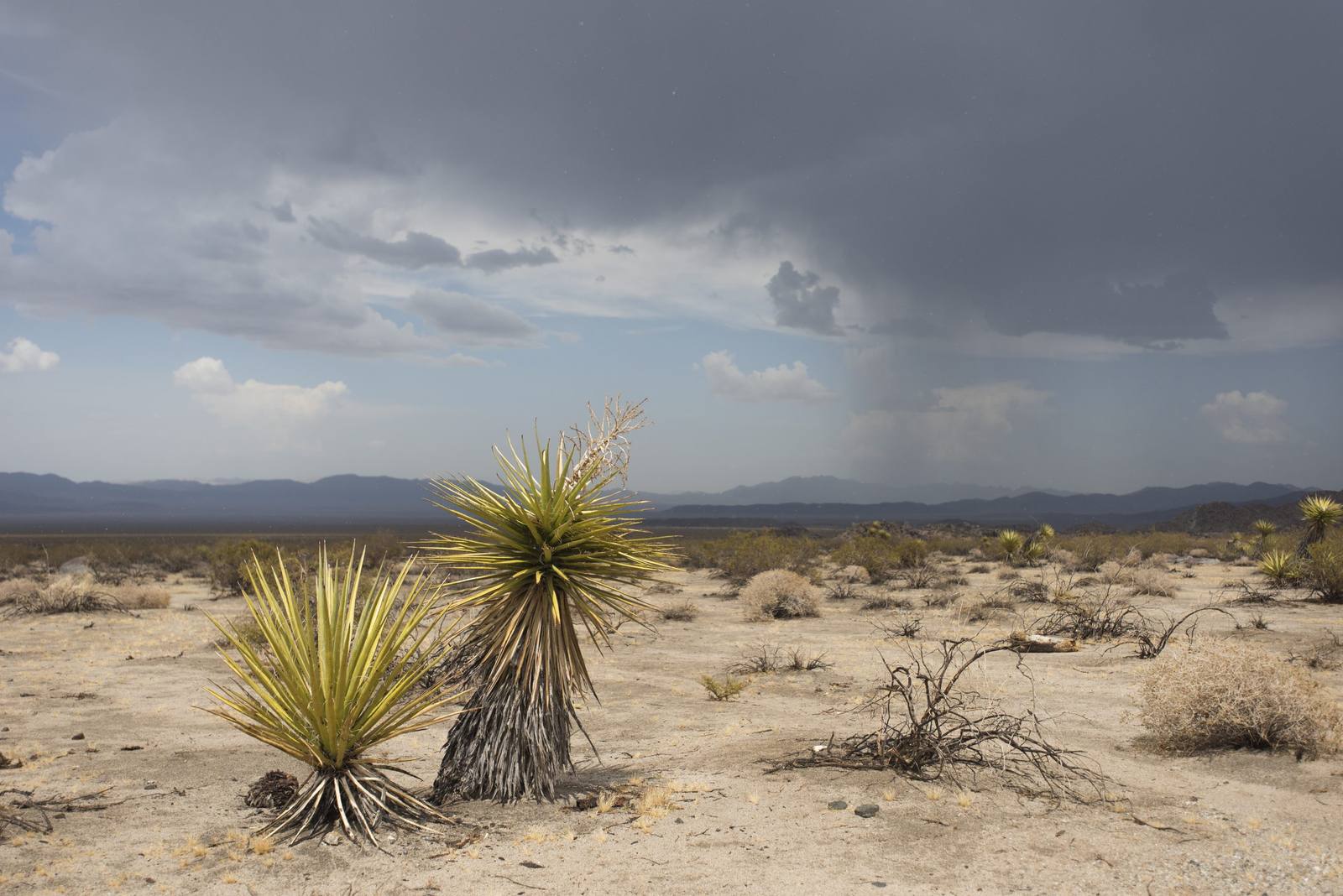
A yucca on the open floor of the Pinto Basin in Joshua Tree National Park, with monsoon rain falling in grey curtains over the low desert and distant mountains.
NPS Photo / public domain via Wikimedia Commons
California · Region

Joshua Tree & the Southern Deserts

Two deserts meet at Joshua Tree — Mojave high, Colorado low — with Pioneertown's film-set main street, the accidental Salton Sea, Salvation Mountain, and the badlands and dark skies of Anza-Borrego.

9 places to explore

Joshua Tree National Park sits on the homelands of the Maara'yam, the Serrano, and the Kawiya, the Cahuilla, with the Nüwü, the Chemehuevi, and the 'Aha Makhav using and crossing this country long before it had a boundary — fifteen federally recognized tribal nations are associated with the park today. What the boundary encloses is a meeting of two deserts: the high Mojave, where the Joshua trees grow among heaped monzogranite domes, and the low Colorado, dropping east through the Cholla Cactus Garden into creosote and ocotillo, with Keys View looking clear across the Coachella Valley to the Salton Sea. Climb into the Wonderland of Rocks at golden hour and the place explains its own fame.

The country around the park runs from the sublime to the gloriously strange. Pioneertown, up the hill from Yucca Valley, was built by Hollywood in the 1940s as a permanently standing Western set — people live on Mane Street now, and the honky-tonk at Pappy and Harriet's draws acts far bigger than the room. South and east lies the Salton Sea, California's accidental inland sea, made when the Colorado River burst its irrigation works early in the twentieth century and poured into the basin for two years. It boomed as a resort, then shrank and soured; what remains — the ruins and art of Bombay Beach, the painted folk-art hill of Salvation Mountain at the edge of Slab City — makes one of the strangest drives in the West.

Farther south, Anza-Borrego Desert State Park spreads across badlands, slot canyons, and palm oases, with wildflower springs that can carpet the desert floor and night skies dark enough to navigate by. Winter and spring are this region's season; summer is for the brave and the air-conditioned.

What to See in Joshua Tree & the Southern Deserts

9 places across the region, grouped by what they are.

Natural Areas
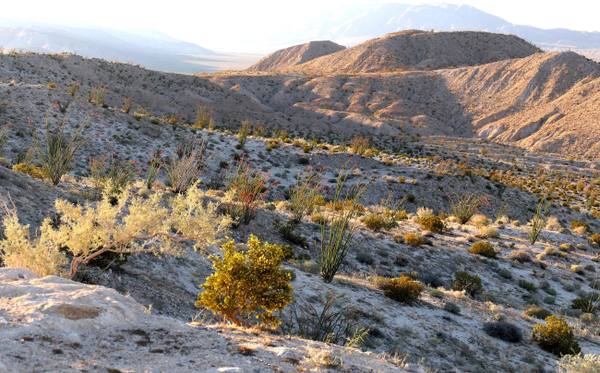
A hillside in Anza-Borrego in bloom at low sun — ocotillo standing in loose green wands tipped with red flower across the slope, yellow-flowered brittlebush and grey creosote between them, and pale ribbed badland ridges falling away behind into a hazy valley with a long mountain range beyond. The ground between the plants is bare pale gravel and broken rock. Neither the slot canyons nor the palm oases the park is known for are in the frame.

Anza-Borrego Desert State Park

Borrego Springs

Six hundred thousand acres of badlands, slot canyons, and palm oases, and the biggest state park in California.

View details →
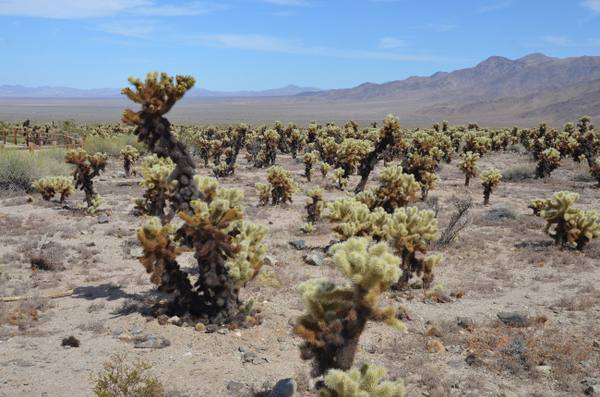
The Cholla Cactus Garden in Joshua Tree — hundreds of teddybear cholla standing close together across pale gravel, each a dark woody stem carrying pale yellow arms so densely spined that they read as fur in the sun. A split-rail fence and the start of the loop trail show at the left edge, the stand runs unbroken back to the middle distance, and a long dark ridge closes the horizon under a clear sky.

Cholla Cactus Garden

Twentynine Palms

Ten acres of teddybear cholla that look soft and are anything but, at the seam between two deserts.

View details →
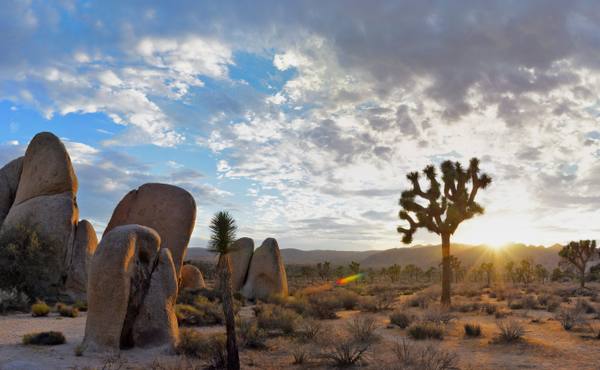
Joshua trees and rounded monzogranite boulders in the Hidden Valley area of Joshua Tree National Park, with the sun setting low through the branches of a Joshua tree and hills beyond.

Joshua Tree National Park

Twentynine Palms

Where the high Mojave meets the low Colorado, among monzogranite piles and a yucca that is not a tree.

View details →
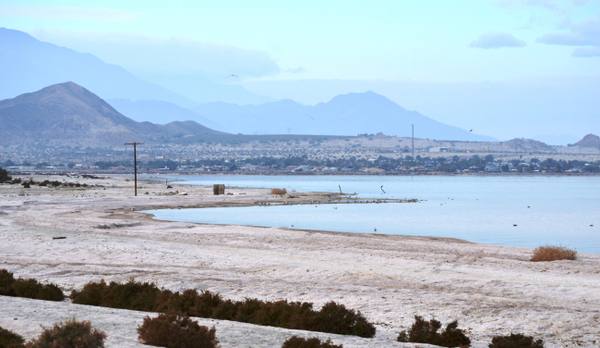
The Salton Sea from its western shore — pale blue water filling the middle of the frame, a broad white crust of dried salt and old shoreline in the foreground where the water has withdrawn, and a leaning power pole standing out on the flat. Low buildings and palms of a shoreline settlement run along the far side under layered blue ranges, gulls stand along the waterline and fly above it, and half-submerged debris breaks the surface where the beach meets the bay.

Salton Sea

Mecca

California's largest lake, made by accident in 1905 and shrinking ever since.

View details →

Towns & Gateways

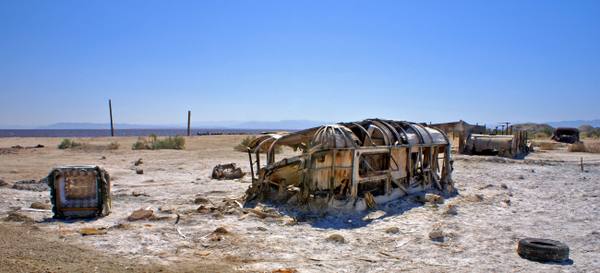
The salt flats below the seawall at Bombay Beach — the burnt-out shell of a trailer standing on white crusted ground, its roof ribs bare and its panels blistered and peeled, with a charred armchair sitting upright in the foreground at left and a tyre lying at right. More wreckage and a derelict car stand along the shoreline behind, and the Salton Sea shows as a thin blue band on the horizon under bare mountains. Neither the town nor the art installations it is now known for is in the frame.

Bombay Beach

Niland

The lowest town in America: a drowned resort turned open-air art colony, 223 feet below sea level.

View details →
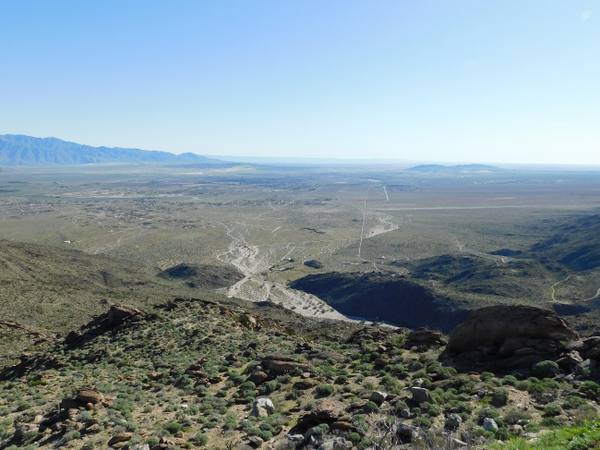
Borrego Springs seen from the rocky ridge above it — the town spread thin and low across the desert floor at the left, its grid of pale roads running out into open creosote flats, a straight airstrip at the centre right and a wash cutting down through dark hills in the middle distance. Ranges stand hazy along the horizon and boulders and low green shrubs fill the foreground. This is the valley in flat daylight: neither the night sky nor the metal sculptures the town is known for appears here.

Borrego Springs

Borrego Springs

A dark-sky town ringed by state park, with 130 metal beasts loose in the desert around it.

View details →
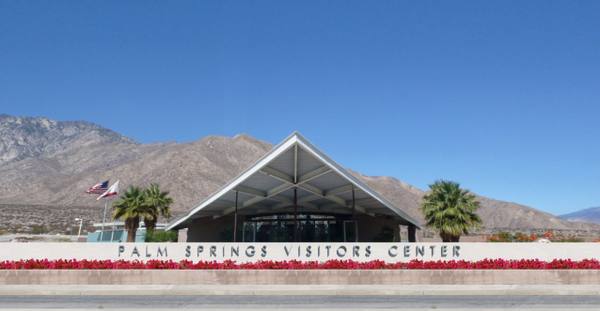
The Palm Springs Visitors Center — the 1965 Tramway Gas Station by Albert Frey and Robson Chambers — its cantilevered wedge roof against the bare slopes of Mount San Jacinto.

Palm Springs

Palm Springs

Cahuilla homeland, checkerboard reservation, mid-century playground, and the square mile the city burned.

View details →

Roadside Stops

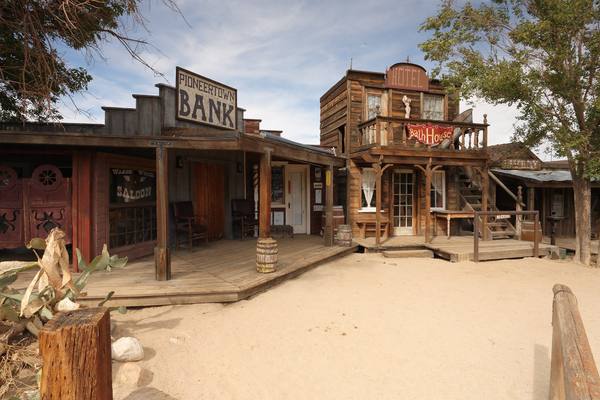
Mane Street at Pioneertown — a timber false front lettered PIONEERTOWN BANK at the left above a plank boardwalk, with a WAGON WHEEL SALOON window, a barber pole and two empty chairs under its porch roof. A two-storey building at the centre carries a HOTEL sign on its parapet and a painted Bath House sign on its balcony rail, a livery stands further along the row, and the street itself is bare graded sand. A prickly pear grows at the lower left and there is nobody in the frame.

Pioneertown

Yucca Valley

A Western movie set built in 1946 that people moved into and never left.

View details →

Salvation Mountain

Niland

One man, thirty years, half a million gallons of donated paint, and a hill that says God is Love.

View details →

Stories from Joshua Tree & the Southern Deserts

Culture

The Word They Used Was Abatement

Section 14 is one square mile of Agua Caliente land in the middle of downtown Palm Springs, and for decades it was where the city's Black and Latino families lived because racial covenants shut them out of everywhere else — until federal leasing law changed in 1959, the resort business wanted the ground, and the fire department burned 235 houses down.

7 min read

Joshua Tree & the Southern Deserts rewards the unhurried. Pick a base, fan out, and let the country between the headline stops surprise you.

← Explore more of Open Road Guide