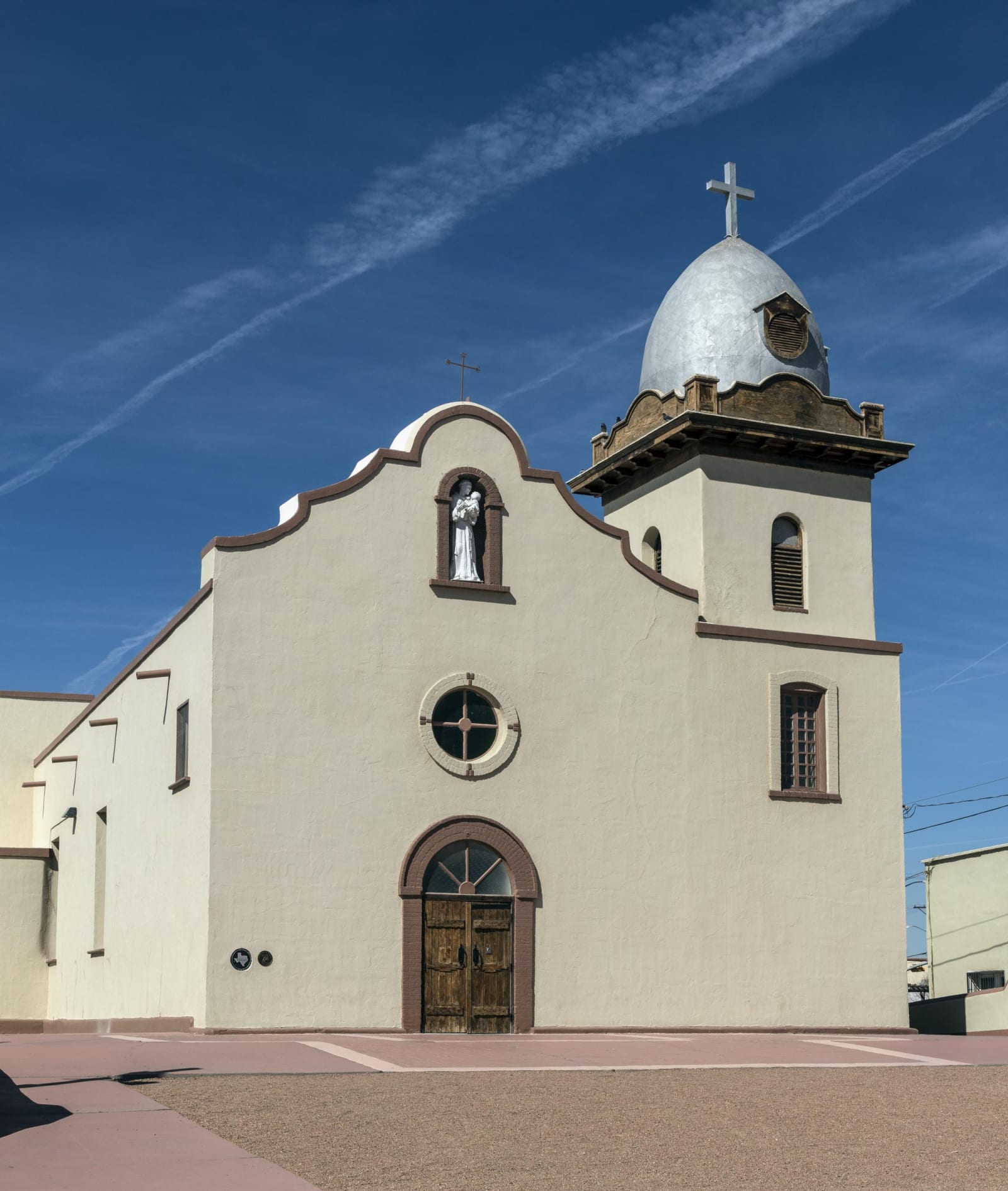
 Carol M. Highsmith / public domain via the Library of Congress
The Story
The church at Ysleta has been lost and rebuilt more than once, and most of the building you enter today dates from 1908. In 1907 a fire brought down the domed bell tower of the 1890s and collapsed the nave and transepts. What survived went into the new church: parts of the old mission walls, the sacristy, the church bell and the Santo Entierro, the figure of the entombed Christ that the parish holds dear. The rebuilt front is in a plain Spanish Colonial Revival style, with a smaller domed belfry on its right side, the silver outline that marks Ysleta from the road.
Inside, the style turns neoclassical, and the decoration belongs to the Pueblo. Rain clouds, corn stalks, baskets and blankets, motifs of the Tigua people who have worshipped here since 1682, run through the interior. Among the statues are San Antonio, patron of the Tigua, and Kateri Tekakwitha, the first Native American saint of the Catholic Church. The National Park Service's Historic American Buildings Survey has documented the church.
The mission stands on South Zaragoza Road within Ysleta del Sur Pueblo, at the head of the El Paso Mission Trail that continues to Socorro and San Elizario. It is open daily from 7 a.m. to 5 p.m. and is wheelchair accessible. This is a working parish and the church of a living Native community, so visit quietly and outside services, and ask before photographing anyone.
Visitor Info
On the Map
Nearby
The closest stops worth working into your route
Historical markers nearby
Roadside plaques and monuments within a short detour