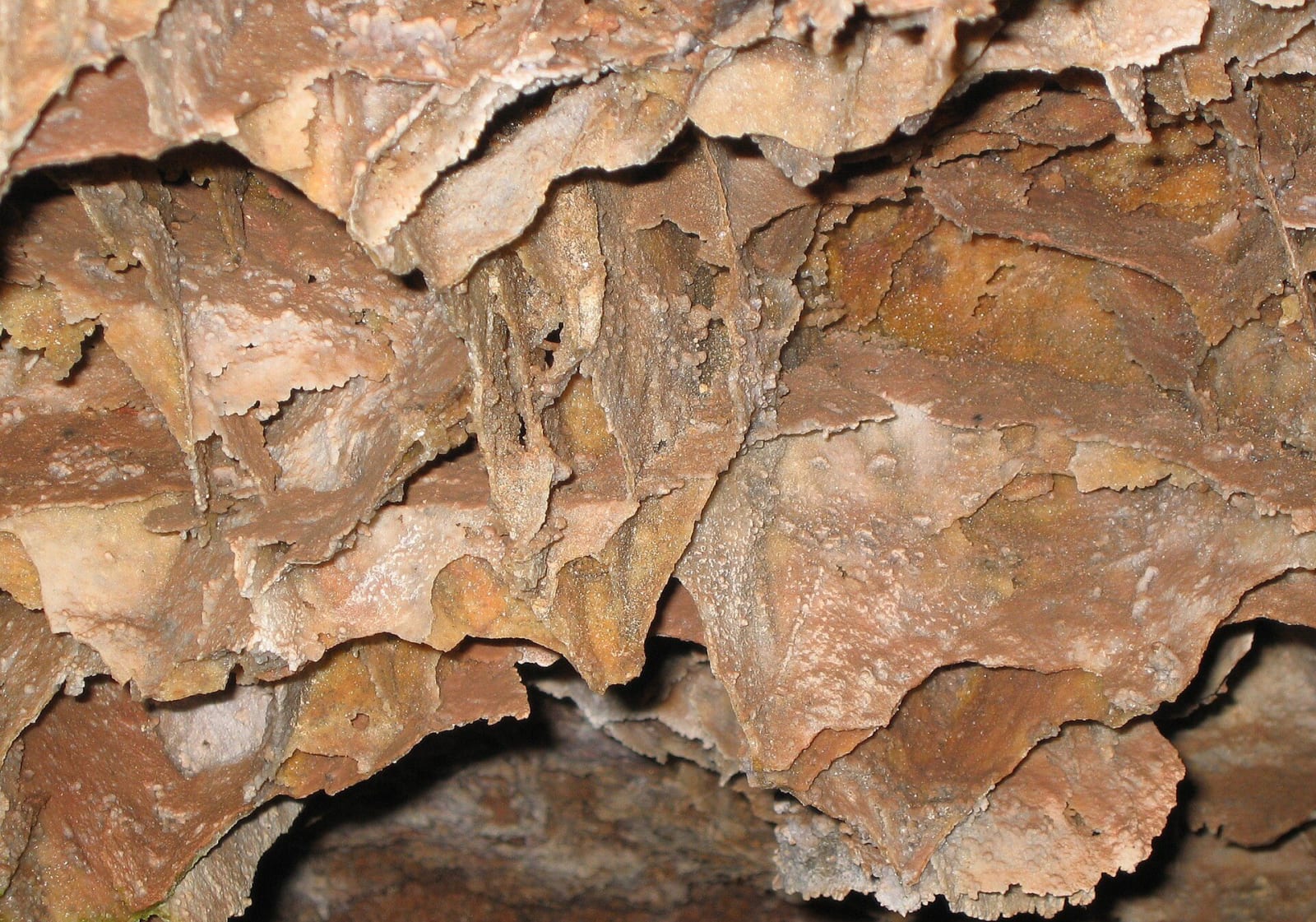
 National Park Service / public domain via Wikimedia Commons
The Story
In 1881 Tom and Jesse Bingham, riding up a draw on a calm day, heard wind roaring out of a hole in the limestone barely a foot across. The air was the cave equalizing with the weather outside: when the pressure on the surface drops ahead of a storm, the cave blows out, and when it rises the cave breathes in, as it still does at the natural entrance beside the trail. A mining company claimed the ground, and in the 1890s the McDonald family ran it as an attraction while young Alvin McDonald worked his way into the dark with candles and a ball of twine, keeping a diary of passages no one had seen.
The cave turned out to be one of the longest in the world, with more than 160 miles mapped since and no end found. Most of its walls carry boxwork, thin blades of calcite crossing like the cells of a honeycomb where the rock around them has dissolved, and roughly ninety-five percent of the boxwork known anywhere is here. The Conns, the climbing couple who had mapped Jewel Cave, pushed the first big new passages in the 1960s, and survey teams still add miles.
Above ground the park is mixed-grass prairie and pine. The bison had been gone from the Black Hills for decades when, in November 1913, fourteen of them left New York City by train for Hot Springs and went on by wagon to the park; the herd on the hills now descends from them. Prairie dog towns spread across the open slopes, and elk bugle in the fall.
Visitor Info
On the Map
Nearby
The closest stops worth working into your route