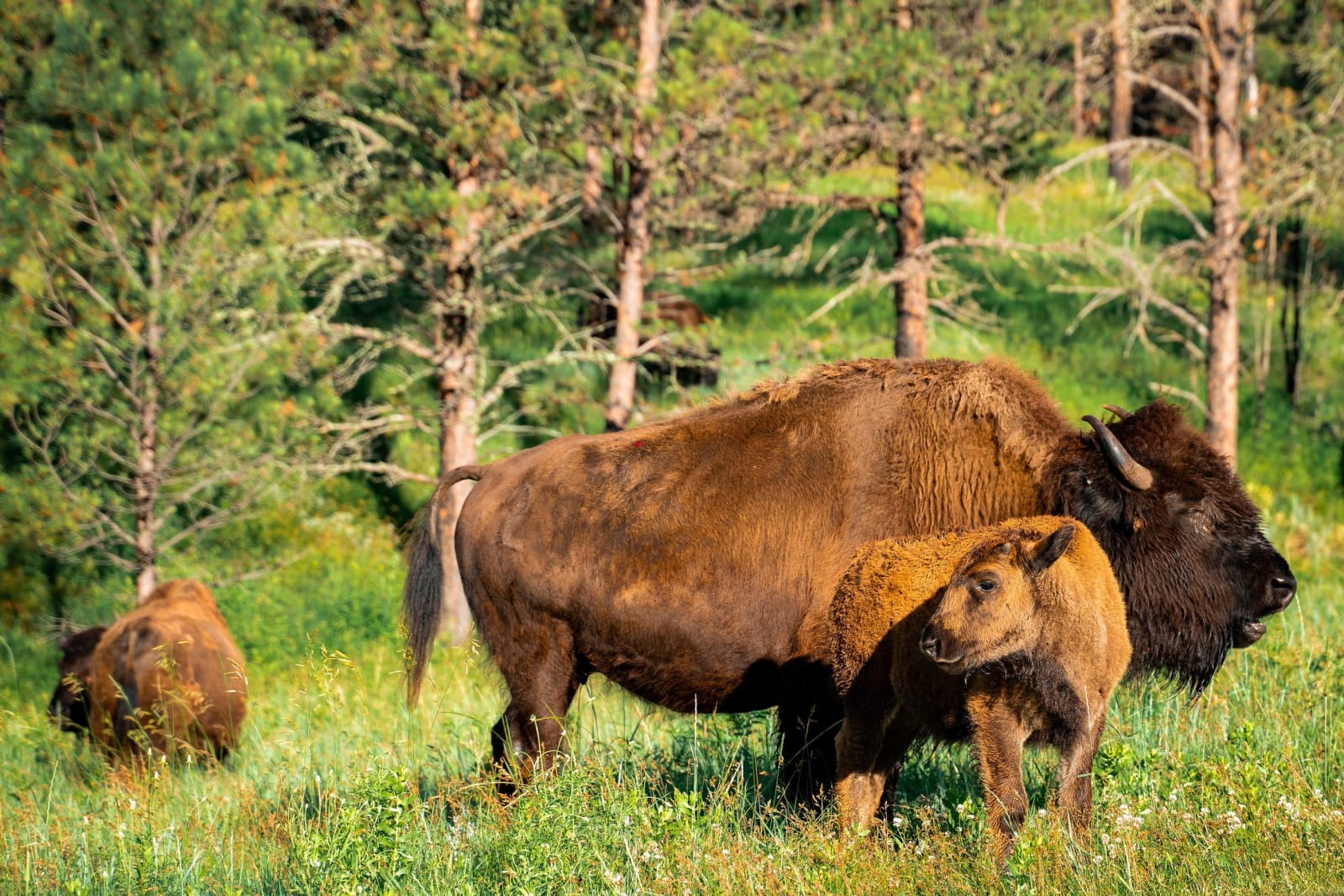
Tens of millions of bison once grazed the plains, and the Lakota built their lives around them. In little more than a decade after the railroads crossed the West, commercial hide hunters shot them nearly to extinction, and by the late 1880s a few hundred were left in the wild in the whole country. What saved the species was a handful of small private herds, most of them started by ranchers who happened to keep a few animals alive. Several of the most important were in the Dakotas.
The calves
In the early 1880s, on one of the last buffalo hunts along the Grand River in northwestern South Dakota, the family of Frederick Dupree, an old fur-trade hand who had worked at Fort Pierre since the 1830s, roped five calves and brought them home to their ranch. The sources disagree on the year and on which Dupree did the roping, but not on the number. Under the family's care the five grew into a herd of a few dozen.
When Frederick Dupree died, a neighbor bought the animals. James Philip, a Scot everyone called Scotty, had come west as a young man, married a Lakota woman, Sally, and built a ranch on the Missouri north of Fort Pierre. Like the Duprees, he wanted the buffalo to survive, and he fenced off a big pasture along the river breaks and let them multiply. By the time he died suddenly in 1911, the herd had grown to roughly a thousand animals, one of the largest in the world.
Thirty-six to the Hills
His family began selling the herd, and ranchers and states bought it up. In 1914 the State of South Dakota bought 36, six bulls, eighteen cows and twelve calves, and turned them loose in the new Custer State Game Preserve, the forerunner of Custer State Park. By 1924 there were 100. Sixty more came from the Pine Ridge Reservation's herd in 1951. Others of Philip's bison went north and founded the herd in what is now Theodore Roosevelt National Park.
The roundup
The Custer herd now numbers well over a thousand, about as many as the park's grass can carry. To keep it there, the park gathers the whole herd every fall in the Buffalo Roundup, when riders drive the animals across the open hills to the corrals off the Wildlife Loop Road, south of the State Game Lodge, to be counted, checked and vaccinated, and the surplus is sold at auction. The first live bison auction was held in February 1966, and the roundup, held in late September, now draws thousands of spectators to the hillsides.
The rest of the year the herd wanders where it likes, across the roads as well as the grass. Next door, Wind Cave National Park keeps a herd of its own that began with fourteen animals shipped from the Bronx Zoo in 1913. Bison weigh up to a ton and can run thirty-five miles an hour; watch them from the car.