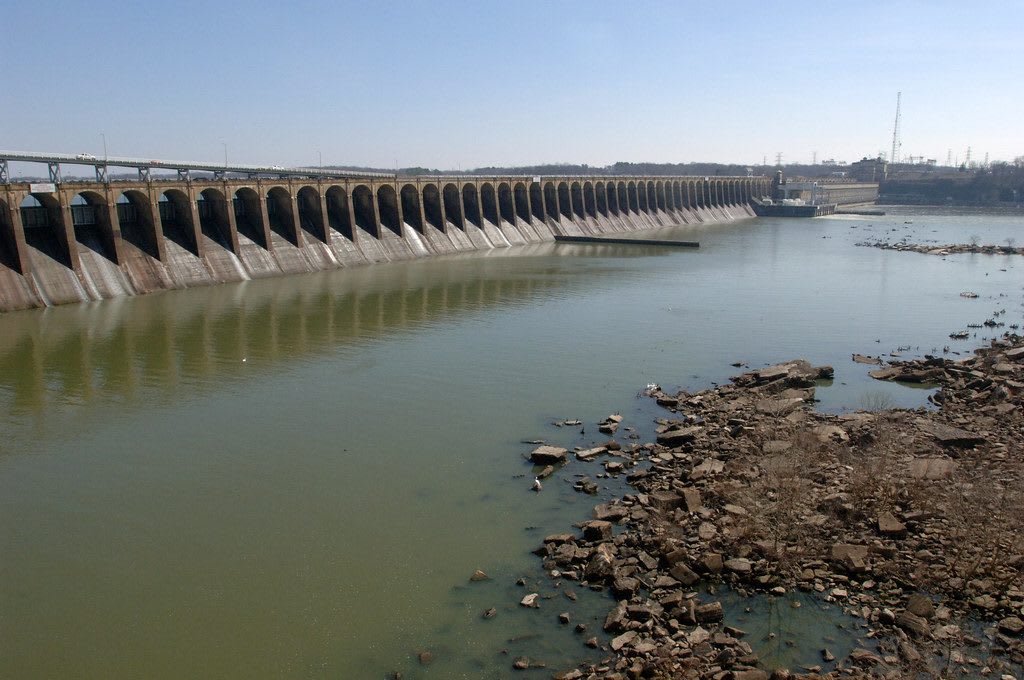
 U.S. Army Corps of Engineers Nashville District / CC BY-SA 2.0 via Flickr
The Story
The Muscle Shoals were shallow, rushing stretches of the Tennessee River that stopped steamboats much of the year, and early canals around them mostly failed. In 1916, fearing Germany could cut off the Chilean nitrates the country needed for explosives, Congress passed the National Defense Act, which authorized two nitrate plants here and a dam to power them. The Army Corps of Engineers built Wilson Dam from 1918 to 1924 with more than 18,000 workers and a temporary town of 1,700 buildings whose mess halls served 24,000 meals a day, with a school for 850 children and an 85-bed hospital. The war ended long before the dam was done, and its first generator did not turn until September 1925.
Then came years of argument. Henry Ford offered $5 million for the works and promised a "Detroit of the South"; Senator George Norris of Nebraska held out for public development of the whole river, and Ford withdrew. Franklin Roosevelt toured Muscle Shoals in January 1933 and in May signed the act creating the Tennessee Valley Authority, with Wilson Dam as its cornerstone and the idle nitrate plants turned to fertilizer research.
The concrete gravity dam runs 4,541 feet across the river on blue limestone and stands 137 feet high. Its main lock, finished in 1959, is 110 by 600 feet with a lift of 100 feet, the highest single lift east of the Rockies, and it fills in about twelve minutes. The dam became a National Historic Landmark in 1966 and is still the largest conventional hydro plant in the TVA system.
Visitor Info
On the Map
Nearby
The closest stops worth working into your route
Historical markers nearby
Roadside plaques and monuments within a short detour