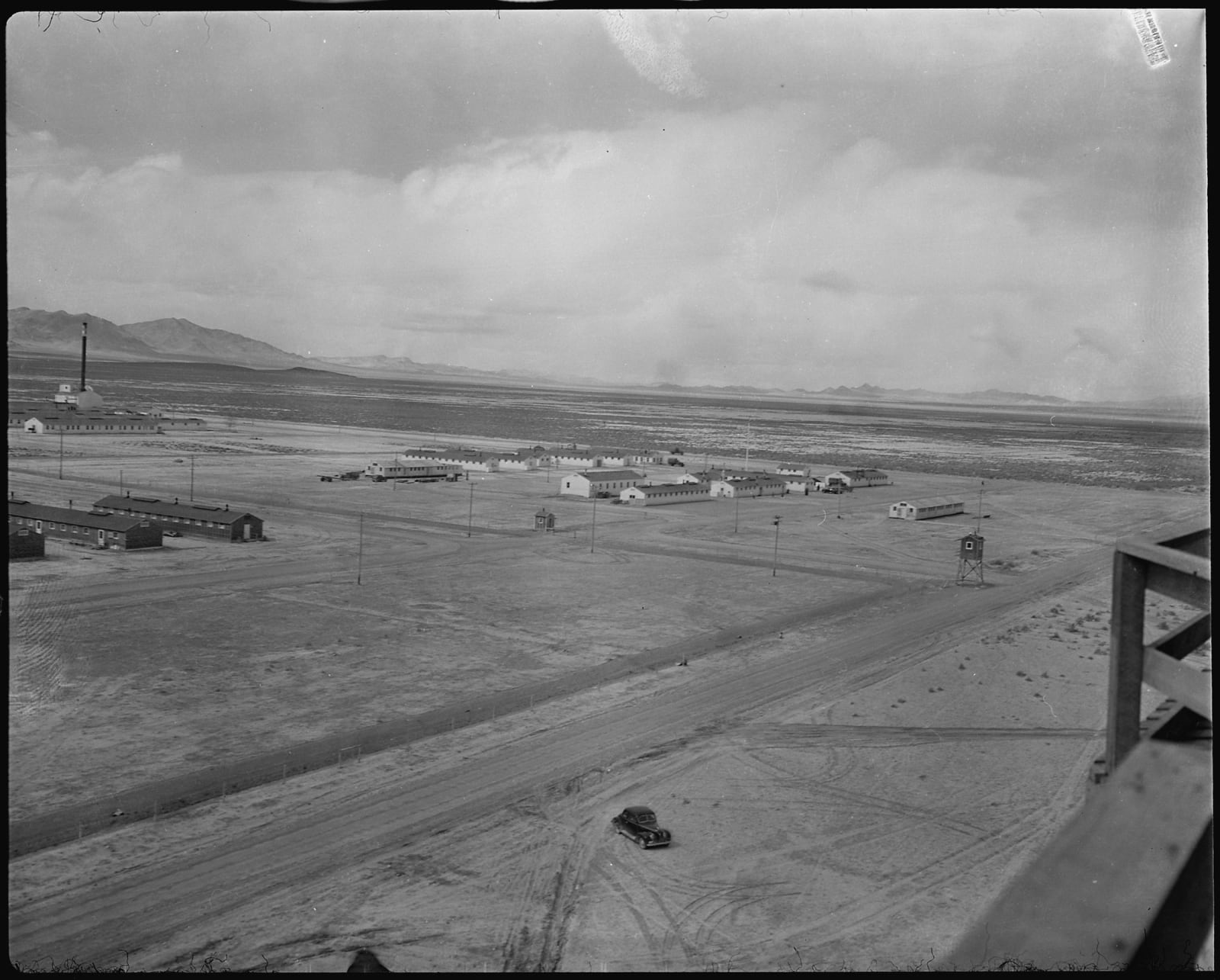
 Francis Stewart, War Relocation Authority / Public domain via Wikimedia Commons
The Story
Topaz was, for three years, the fifth-largest city in Utah — and every one of its residents was a prisoner. Between 1942 and 1945 the United States incarcerated more than 11,000 people of Japanese descent here, on a flat, wind-scoured shelf of the Sevier Desert fifteen miles northwest of Delta. Two-thirds were American citizens. Their crime was ancestry.
The government called it a "relocation center." It was a concentration camp: one square mile of tar-paper barracks ringed by barbed wire and seven guard towers, thrown up by an 800-man crew in two months. Most of the people sent here came from the San Francisco Bay Area, uprooted under Executive Order 9066 and held first in the horse stalls of a converted racetrack before the trains carried them out to this dust. Summers ran past a hundred degrees, winters fell below zero, and the fine alkaline soil of an ancient lakebed worked its way into everything.
People made a life anyway, because they had to. They named the streets for gemstones, dug ponds, coaxed gardens out of the hardpan. Chiura Obata, an art instructor from Berkeley, ran a school that enrolled hundreds. A newspaper printed nearly every day. And on April 11, 1943, a sentry shot and killed James Hatsuaki Wakasa — sixty-three years old, out walking his dog near the fence in the evening light. The guard said Wakasa was trying to escape. A court-martial acquitted him. Nearly two thousand people came to the funeral.
The barracks were hauled off and repurposed after the war, and for decades the site was little more than foundations and a stone monument in the sagebrush. The Topaz Museum, on Delta's Main Street, now holds the story — photographs, artifacts, and the recovered Wakasa memorial stone, itself the subject of painful controversy in 2021. See the museum first; it holds the map and the context you need before you stand on the ground itself, where the wind still carries the dust that never let anyone forget where they were.
Visitor Info
On the Map
Nearby
The closest stops worth working into your route
Historical markers nearby
Roadside plaques and monuments within a short detour