 Carol M. Highsmith / public domain via Wikimedia Commons
The Story
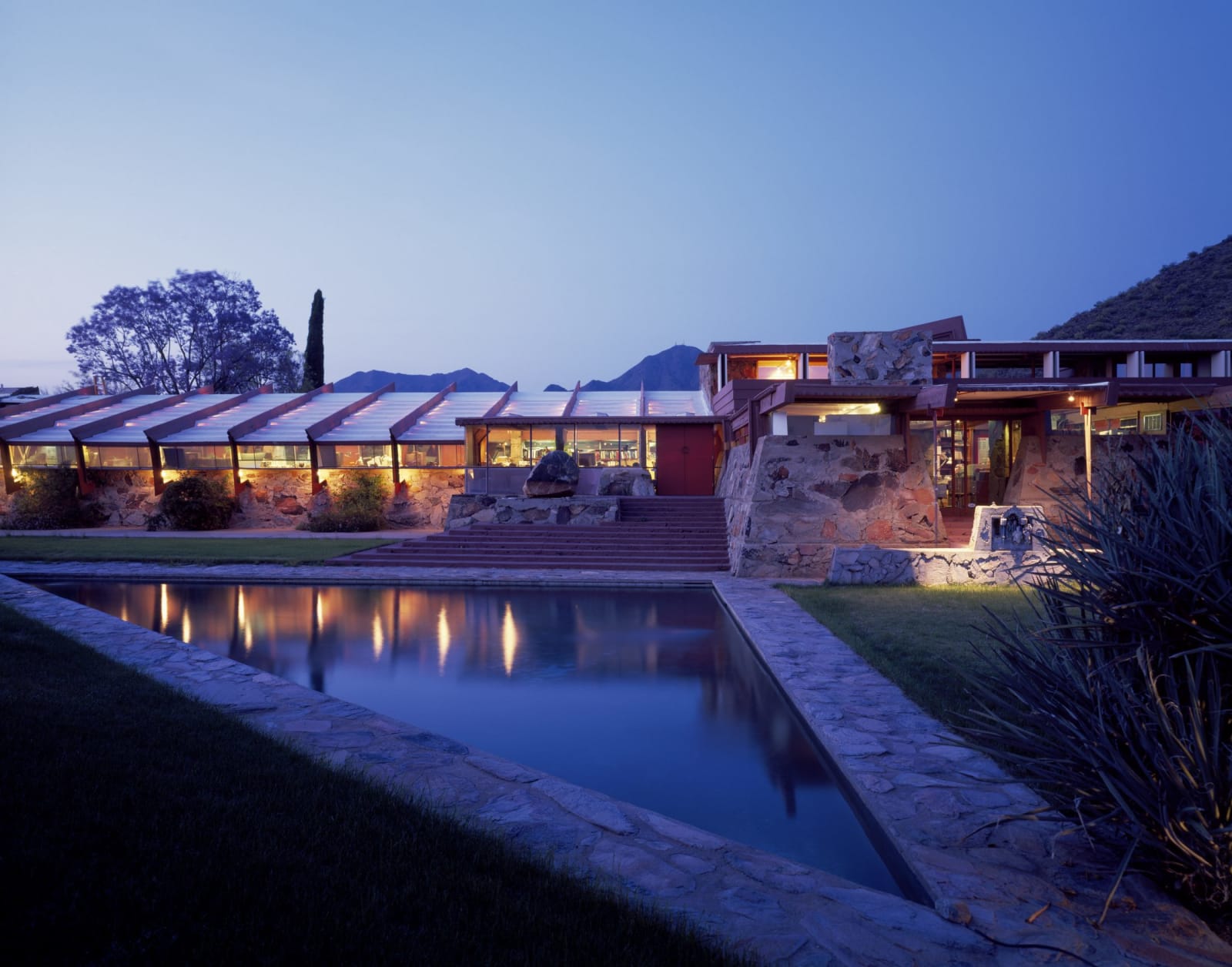
In 1937 Frank Lloyd Wright, seventy years old and short of money, bought a few hundred acres of raw Sonoran desert in the McDowell foothills for a few dollars an acre and set his apprentices to building a winter home out of the ground it stood on. They called the method desert masonry — local quartzite boulders stacked into wooden forms and bound with concrete and desert sand — and the low, canvas-roofed, redwood-beamed complex that resulted seems less built on the desert than grown from it. Wright meant exactly that: buildings, he argued all his life, should belong to their place. Taliesin West is the fullest surviving version of that argument.
It was never only a house. Wright ran his architecture school here, the Taliesin Fellowship, and apprentices earned their training partly by quarrying rock and pouring walls — learning a building by making one. From the drafting studio on this site came late masterworks including the Guggenheim in New York. Wright wintered here every year until his death in 1959, chasing the light and the dry air and calling the saguaro the finest skyscraper ever built. In 2019 UNESCO named Taliesin West a World Heritage Site as part of a group of eight Wright buildings — the first modern American architecture given that honor.
The one thing Wright couldn't design around was the future. He sited Taliesin West for isolation and clean desert dark, and the Phoenix sprawl has since climbed the foothills to meet it, trading his open horizon for a field of rooflines and a washed-out night sky. The Frank Lloyd Wright Foundation still runs the place, and it is open for tours out of Scottsdale. Go in winter, when the light is the thing he came for, and you can still read the desert in every wall.
Visitor Info
On the Map
Nearby
The closest stops worth working into your route
Historical markers nearby
Roadside plaques and monuments within a short detour