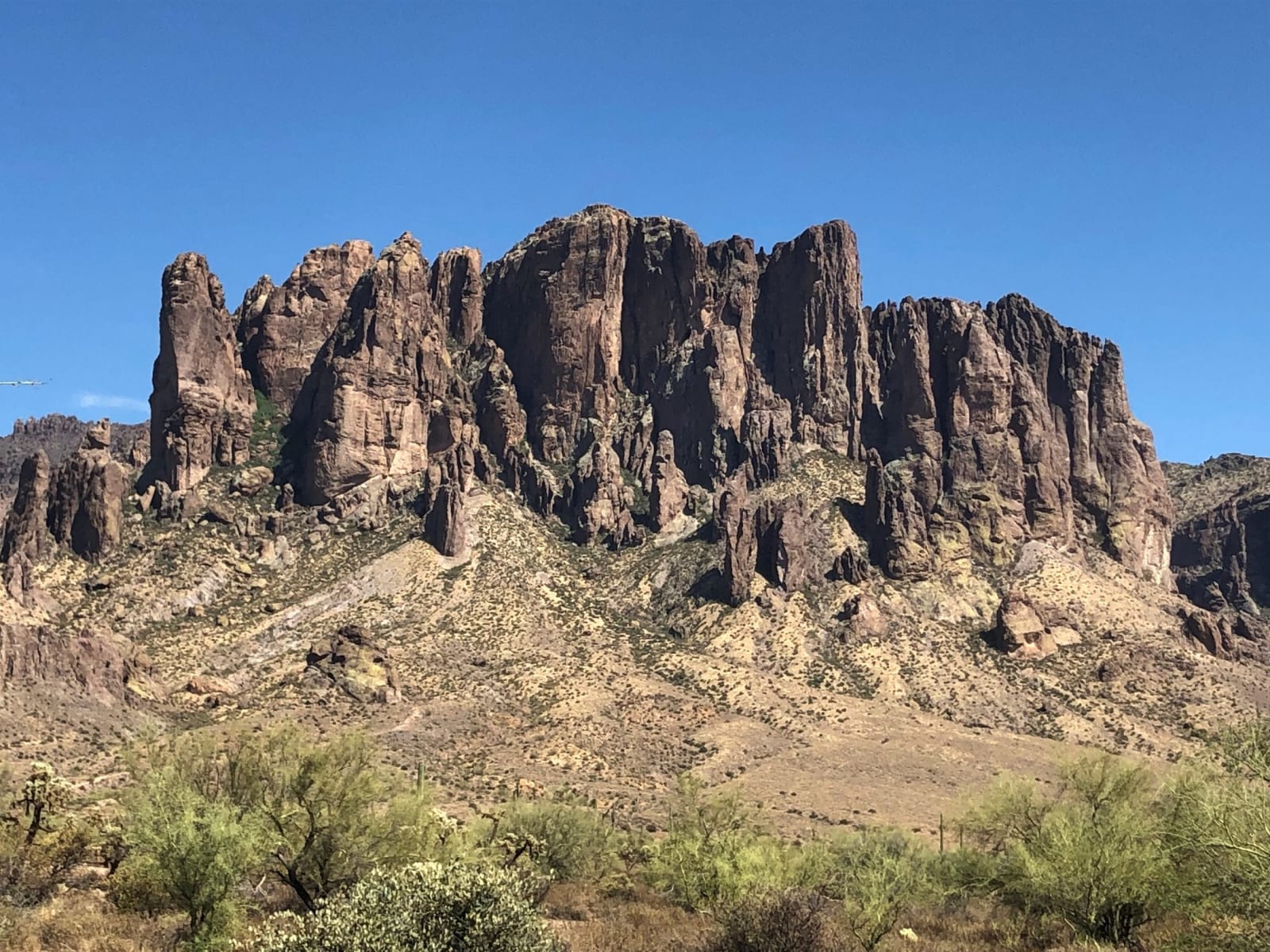
 Beyond My Ken / CC BY-SA 4.0 via Wikimedia Commons
The Story
East of the Phoenix sprawl the desert throws up a wall — the Superstition Mountains, a jagged volcanic rampart that is the eroded wreck of a caldera which blew itself apart some eighteen million years ago. The rock is rhyolite and welded ash from those eruptions, carved since into cliffs, hoodoos, and the leaning pinnacle of Weavers Needle. It is beautiful, and for its most famous export it is entirely the wrong kind of stone.
That export is the legend of the Lost Dutchman. Jacob Waltz — a German immigrant, "Dutchman" being the old American slur for Deutsch — supposedly found a fabulous gold mine somewhere in the range and, dying in Phoenix in 1891, whispered its location to a neighbor who could never relocate it. People have hunted it ever since; more than thirty have died in the wilderness trying, some by thirst and falls, some under stranger circumstances that keep the story dark. The trouble is geological: the Superstitions are volcanic, and the gold that actually exists nearby was mined out of the Goldfield hills to the northwest, not the range itself. Waltz was a placer miner. The mine is almost certainly a story. The deaths are not.
The name came earlier, and closer to the truth. In the 1860s the Akimel O'odham farming the valley told settlers the range was a place of strange sounds and disappearances, ground best left alone; the settlers called them superstitious and hung the word on the mountains. To the Apache and Yavapai who lived in and around the range, the peaks had been sacred long before any of that — a place of ceremony, not treasure. The Apache Trail skirts the range's northern flank toward Canyon Lake, and the Lost Dutchman State Park at the western foot is the easy way in. The legend is why most people come, and the rock doesn't care either way.
Visitor Info
On the Map
A story featuring this place
Go deeper into the history and character of this stop
Nearby
The closest stops worth working into your route
Historical markers nearby
Roadside plaques and monuments within a short detour