Home / Georgia / Savannah & the Golden Isles / Savannah Historic District
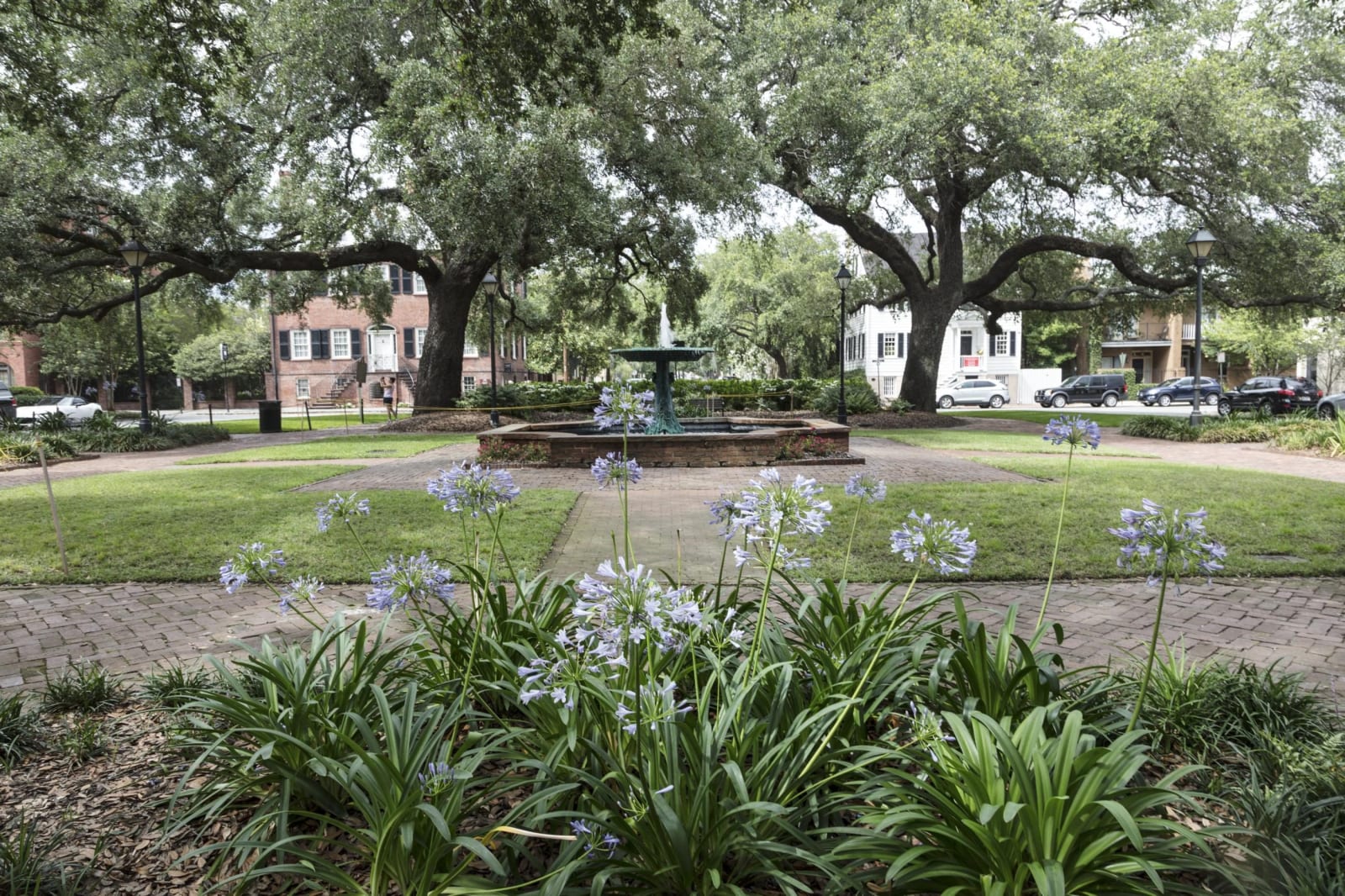
Columbia Square in Savannah, with a fountain, brick paths and agapanthus under spreading live oaks.Carol M. Highsmith / public domain via Library of Congress
🏛️Historical

Savannah Historic District

Part ofSavannah & the Golden Isles
On this driveUS 17, the Ocean Highway: Savannah, Midway, Darien and Brunswick

Oglethorpe's 1733 grid of wards and squares on Yamacraw Bluff, where Tomochichi is buried in Wright Square and Black ministers met Sherman before Field Order No. 15.

⏱
Duration
Half a day to a full day on foot.
🎟
Admission
Free to walk; the squares and streets are public.
📅
Best Season
Year round; spring and fall are the most comfortable for walking, and summer afternoons are hot and humid.

The Story

Before there was a city, the bluff above the Savannah River belonged to the Yamacraw, a band of about two hundred Muscogee (Creek) and Yamasee people who settled here around 1728 under Tomochichi, at a place they held to be the resting ground of his ancestors. When James Oglethorpe's colonists landed on February 12, 1733, Tomochichi agreed to move his town upriver, and Mary Musgrove, of Muscogee and English parentage, interpreted between the two men. He died in October 1739 and was buried in what is now Wright Square with a British military funeral. A granite boulder set in 1899 replaced the original pyramid of stones.

Oglethorpe and William Bull laid the town out in wards, each built around a square, with lots for churches and public buildings on two sides and homes on the others, a grid that still shapes the old city. The colony's Trustees banned slavery at first, but the ban was lifted in 1750, and by 1860 Savannah counted 7,712 enslaved people among its residents, the wealth of the port resting on the cotton and rice they grew and loaded.

Sherman took the city in December 1864. On January 12, 1865, he and Secretary of War Edwin Stanton met twenty Black Baptist and Methodist ministers, Garrison Frazier among them, at the Green-Meldrim House on Madison Square. Four days later Sherman issued Special Field Order No. 15, setting aside coastal land for freed families in forty-acre plots, an order President Andrew Johnson reversed that fall. Start at the visitor center on Martin Luther King Jr. Boulevard and walk east through the squares.

Visitor Info

⏱
Time Needed
Half a day to a full day on foot.
🎟
Admission
Free to walk; the squares and streets are public.
📅
Best Season
Year round; spring and fall are the most comfortable for walking, and summer afternoons are hot and humid.
🛣️
Highway
I-16

On the Map

Nearby

The closest stops worth working into your route

cultural0.3 mi away
Ralph Mark Gilbert Civil Rights Museum
Savannah's civil rights museum in a 1914 Black-owned bank on old West Broad Street, named for the pastor who rebuilt the city's NAACP.
historical0.4 mi away
First African Baptist Church
One of the oldest Black Baptist congregations in North America, on Franklin Square since 1859, and the pulpit of Savannah's civil rights movement.
historical6.6 mi away
Wormsloe State Historic Site
Noble Jones's colonial estate on the Isle of Hope, with tabby ruins from the 1730s, an avenue of live oaks and a plantation worked by enslaved people.
natural6.8 mi away
Savannah National Wildlife Refuge
A refuge of tidal marsh and cypress swamp on the lower Savannah River, its wildlife drive running on rice-field dikes built by enslaved people.
historical13 mi away
Fort Pulaski National Monument
The brick fort on Cockspur Island that rifled cannon broke in 1862, where General Orders No. 7 freed the enslaved and a contraband camp grew.
historical18 mi away
Old Town Bluffton
A May River town that began as a planters' summer retreat, gave its name to the 1844 secession movement, was burned in 1863 and keeps a freedman's house and an oyster factory.

Historical markers nearby

Roadside plaques and monuments within a short detour

Marker0.1 mi away
Savannah's African-American Medical Pioneers
Savannah
Marker0.1 mi away
Attack on British Lines
Savannah
Marker0.1 mi away
General Casimir Pulaski/Sergeant William Jasper
Savannah
Marker0.3 mi away
Telfair Academy of Arts & Sciences
Savannah
Marker0.3 mi away
Rev. Dr. Ralph Mark Gilbert (1899-1956): "Father of the Civil Rights Movement in Savannah"
Savannah
Marker0.3 mi away
Sherman's Headquarters: Green-Meldrim Mansion
Savannah