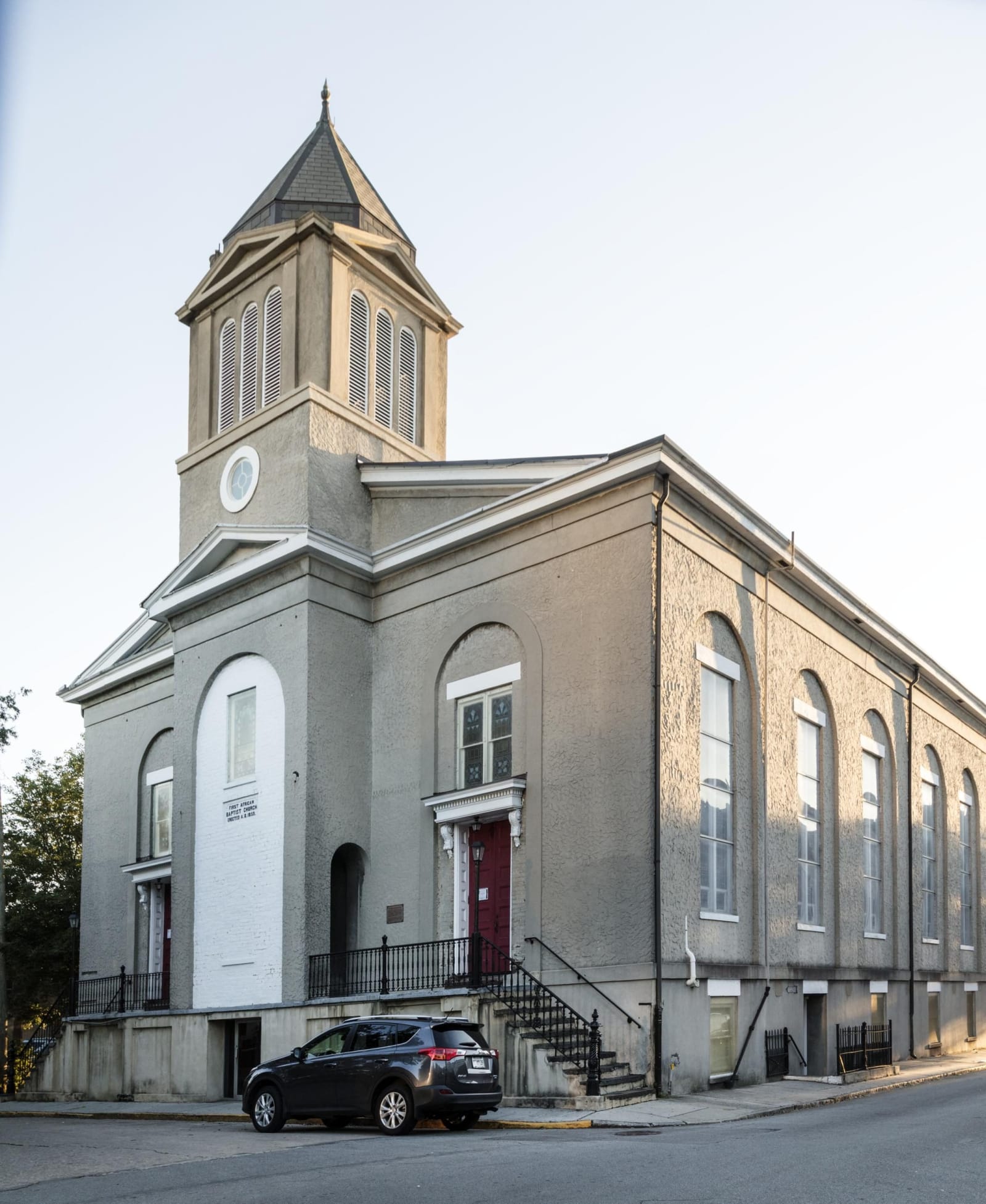
 Carol M. Highsmith / public domain via Library of Congress
The Story
The congregation traces its beginning to George Liele, born into slavery in Virginia in 1750, who was ordained a Baptist minister in 1775 and preached to enslaved people up and down the Savannah River. The church dates its founding to December 1777. When the British evacuated Savannah in 1782 many of Liele's followers were reenslaved, and others left and founded churches in Jamaica, Nova Scotia and Sierra Leone. Andrew Bryan, whom Liele baptized in 1782, kept the remaining members worshipping despite abuse from white Savannahians, and in January 1788 he was ordained and the congregation formally recognized, years before white Baptists organized a church in the city.
By 1831 it counted more than 2,700 members. In 1832 the white Sunbury Baptist Association suspended pastor Andrew Marshall for inviting a white evangelist who preached the equality of the races, and 155 members left to form what is now First Bryan Baptist Church. Both congregations still claim descent from Bryan's original church; a state Baptist committee ruled for First African in 1888. The congregation has worshipped in its building on Montgomery Street, facing Franklin Square, since 1859.
In the twentieth century the pulpit carried the city's freedom struggle. E. K. Love helped found what became Savannah State University in 1890, and Ralph Mark Gilbert, pastor from 1939 to 1956, rebuilt the local NAACP and brought Walter White, Martin Luther King Jr. and Adam Clayton Powell to speak here. His successors held mass meetings in the sanctuary against segregated public facilities. A small museum on the grounds keeps objects and records back to the eighteenth century.
Visitor Info
On the Map
Nearby
The closest stops worth working into your route
Historical markers nearby
Roadside plaques and monuments within a short detour