Home / New Mexico / Taos & the Northern Mountains / San Francisco de Asís Church, Ranchos de Taos
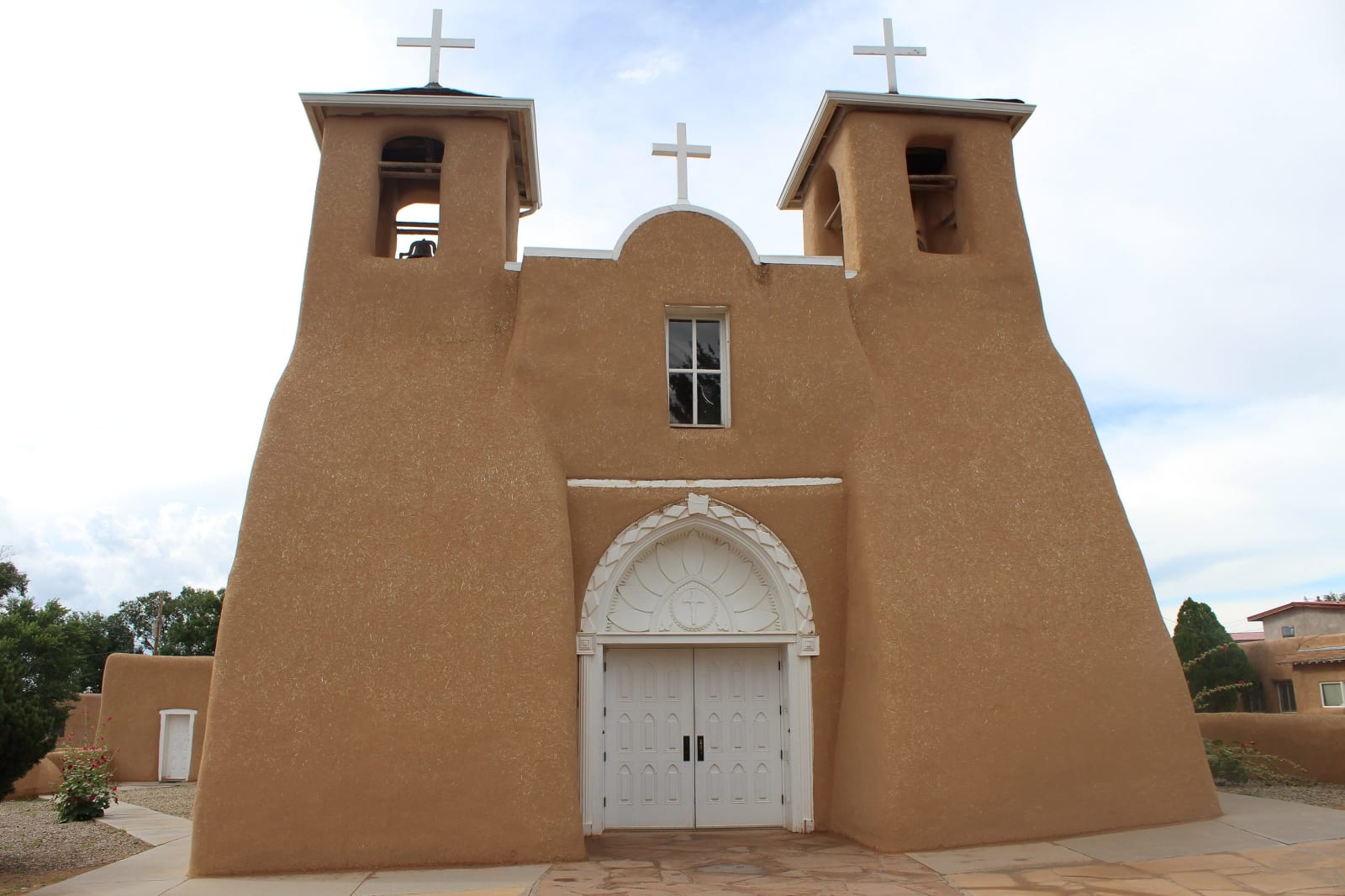
The adobe front of San Francisco de Asís at Ranchos de Taos, with twin bell towers and white wooden doorsM.Bucka / CC BY-SA 4.0 via Wikimedia Commons
🏗️Architectural

San Francisco de Asís Church, Ranchos de Taos

Part ofTaos & the Northern Mountains
On this driveThe High Road to Taos: Santa Fe to Taos Pueblo

The adobe church at Ranchos de Taos that artists always paint from behind, kept standing by the mud its parish spreads over it every June.

Year-RoundIconicPhotographyFree
⏱
Duration
Half an hour.
🎟
Admission
Free; donations welcome.
📅
Best Season
Year-round; the enjarre is in June.
💡
Fun Fact
There may be as many as 30,000 adobe bricks in the church's rear buttress alone.

The Story

The church of San Francisco de Asís faces the small plaza of Ranchos de Taos, about four miles south of Taos on NM-68, behind an adobe wall that encloses its forecourt and graveyard. It is about 120 feet long, with twin bell towers in front, but artists have always walked round to the back, where huge rounded buttresses swell out against the apse like poured earth. Georgia O'Keeffe painted it from there in 1929 and after, and Paul Strand and Ansel Adams photographed it.

Its dates are usually given as 1772 to 1816. Architectural historians think the church that stands was probably built between 1814 and 1816, when Ranchos, the first permanent Spanish village in the Taos valley, finally got a church of its own.

Adobe melts in the rain unless it is given fresh mud. In 1967 a restoration tried to end that chore with a hard cement stucco. The stucco trapped moisture, and the walls began to dissolve from within; in 1979 and 1980 it was stripped off, the crumbling facade and buttresses were rebuilt, and the church went back to mud. Every June since, parishioners and volunteers have spent about two weeks on the enjarre, the replastering: clay is dug and sifted, mixed with sand, straw and water, and spread by hand from the foot of the walls to the tops of the towers.

It is a working parish church, open to visitors outside services, and a National Historic Landmark since 1970.

Visitor Info

⏱
Time Needed
Half an hour.
🎟
Admission
Free; donations welcome.
📅
Best Season
Year-round; the enjarre is in June.
🛣️
Highway
NM-68

On the Map

Nearby

The closest stops worth working into your route

cultural6.6 mi away
Taos Pueblo
Two terraced adobe houses facing each other across Red Willow Creek, lived in for something like a thousand years, with no electricity or running water inside the old walls.
architectural11 mi away
Rio Grande Gorge Bridge
A steel truss strung across a slot in the basalt west of Taos, 565 feet above the river by the careful measure and 650 by the signs, built when the road beyond it did not yet exist.
cultural31 mi away
El Santuario de Chimayó
A small adobe shrine on the High Road to Taos, built around 1816 over earth that pilgrims still carry away in hope of healing.
historical40 mi away
St. James Hotel
Henri Lambert's 1872 inn and saloon on the Santa Fe Trail at Cimarron, a stage for the Colfax County War, where the old saloon ceiling still shows 22 bullet holes.
historical46 mi away
Fort Union National Monument
Three forts in one prairie valley where the two branches of the Santa Fe Trail met: a log post, a star-shaped earthwork, and an adobe supply town that fed the army's wars.
geological48 mi away
Ghost Ranch
Red, yellow and white cliffs above the Piedra Lumbre basin, where Georgia O'Keeffe bought seven acres in 1940 and paleontologists found a hillside full of dinosaurs in 1947.