Williams Lake in a basin of spruce below the bare summits of the Sangre de Cristo Mountains near Wheeler Peak
Highlightwiki / CC BY-SA 4.0 via Wikimedia Commons
New Mexico · Region

Taos & the Northern Mountains

Taos Pueblo and the return of Blue Lake, Ohkay Owingeh where Oñate set his first capital, the Jicarilla homeland at Dulce, and O'Keeffe's Abiquiú.

5 places to explore

Taos Pueblo's two adobe houses have stood on either side of Red Willow Creek for something like a thousand years, and the creek runs down from Blue Lake, high in the mountains behind them. The government took the lake into a national forest in 1906. The people of Taos spent sixty-four years asking for it back, and on December 15, 1970, President Nixon signed the law that returned it and some 48,000 acres around it.

Juan de Oñate set up the first Spanish capital in 1598 beside Ohkay Owingeh, where the Chama meets the Rio Grande. Eighty-two years later Po'pay, a religious leader from Ohkay Owingeh, worked out of Taos to plan the revolt that in August 1680 drove the Spanish out of New Mexico for twelve years. Taos rose again in January 1847, after the American conquest, and killed the new governor, Charles Bent of Bent's Fort; the Army shelled the pueblo's church with people sheltering inside it.

West of the Rio Grande gorge the land climbs into the Jicarilla Apache Nation, with its capital at Dulce, and the narrow-gauge Cumbres & Toltec still steams over the pass from Chama into Colorado. Down the Chama, Georgia O'Keeffe painted the red and yellow cliffs at Ghost Ranch and lived in Abiquiú, a village founded in the 1750s as a settlement for genízaros, Native people taken captive and raised in Spanish households.

What to See in Taos & the Northern Mountains

5 places across the region, grouped by what they are.

Geology & Rock Formations
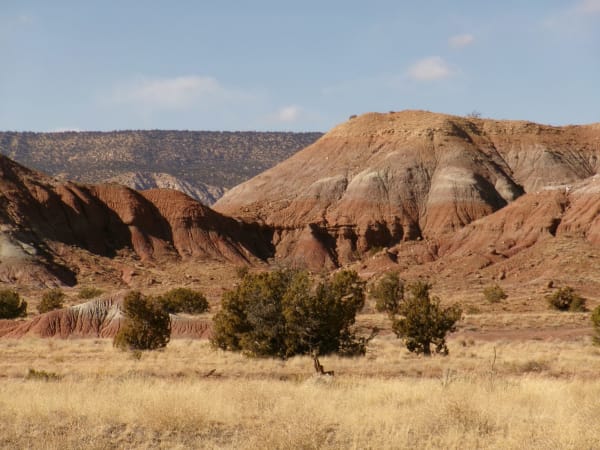
Banded red and white badlands above dry grassland and junipers at Ghost Ranch

Ghost Ranch

Abiquiu

Red, yellow and white cliffs above the Piedra Lumbre basin, where Georgia O'Keeffe bought seven acres in 1940 and paleontologists found a hillside full of dinosaurs in 1947.

View details →

Historic Sites

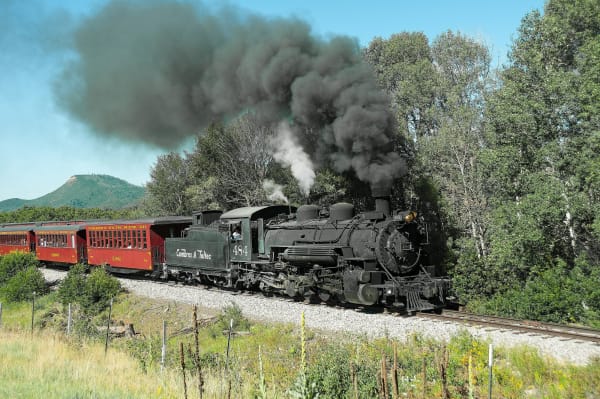
A Cumbres and Toltec steam locomotive trailing black smoke as it pulls red passenger coaches past green trees

Cumbres & Toltec Scenic Railroad

Chama

A narrow-gauge steam railroad from Chama over 10,015-foot Cumbres Pass to Antonito, kept narrow because nobody ever thought it worth converting.

View details →

Towns & Gateways

Taos Pueblo

Taos

Two terraced adobe houses facing each other across Red Willow Creek, lived in for something like a thousand years, with no electricity or running water inside the old walls.

View details →

Architecture

The steel arch of the Rio Grande Gorge Bridge spanning the basalt gorge, the river far below and mountains on the horizon

Rio Grande Gorge Bridge

Taos

A steel truss strung across a slot in the basalt west of Taos, 565 feet above the river by the careful measure and 650 by the signs, built when the road beyond it did not yet exist.

View details →
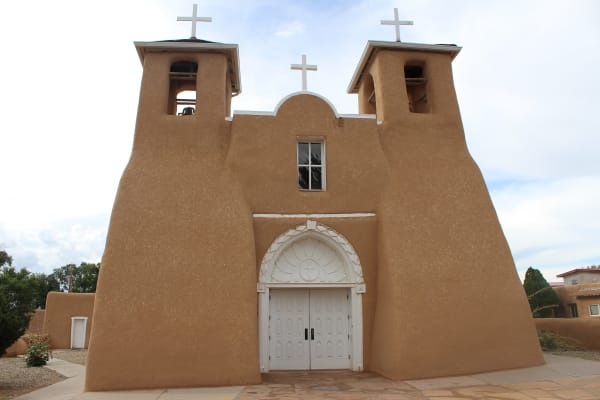
The adobe front of San Francisco de Asís at Ranchos de Taos, with twin bell towers and white wooden doors

San Francisco de Asís Church, Ranchos de Taos

Ranchos de Taos

The adobe church at Ranchos de Taos that artists always paint from behind, kept standing by the mud its parish spreads over it every June.

View details →

Scenic Drives through Taos & the Northern Mountains

Scenic Byway

The High Road to Taos: Santa Fe to Taos Pueblo

From the Santa Fe plaza through the land-grant villages of the Sangre de Cristo foothills, Chimayó, Truchas and Las Trampas, to Ranchos de Taos and Taos Pueblo.

80 mi · 2.5 hrs

Stories from Taos & the Northern Mountains

History

The Lake They Would Not Sell

In 1906 the federal government made Taos Pueblo's sacred Blue Lake part of a national forest. The pueblo refused every offer of money and spent sixty-four years getting the land itself back.

6 min read

Taos & the Northern Mountains rewards the unhurried. Pick a base, fan out, and let the country between the headline stops surprise you.

← Explore more of Open Road Guide