 Wesley Fryer / CC BY 2.0 via Flickr
The Story
In late 1861 the Confederacy turned an empty three-story brick cotton mill here into a military prison. Its early inmates were fed and played baseball inside the stockade in 1862. Exchanges then broke down, largely over the Confederacy's treatment of captured Black soldiers, and in October 1864 more than 10,000 men were sent to a prison meant for about 2,500. Denied wood for barracks, men dug burrows in the ground. Rations were cut to almost nothing, though escaped prisoners reported a country full of corn and pork, and diarrhea and pneumonia did most of the killing.
The prisoners left their own record. Benjamin F. Booth of the 22nd Iowa lost nearly a hundred pounds and kept a diary counting the dead each day. On November 25, 1864, men who had gone two days without food rushed the guards at a shift change; artillery fired grape and canister into them, and one diarist counted eighty-one killed. That December two New York Tribune correspondents, Albert D. Richardson and Junius Henri Browne, escaped, walked more than 400 miles to Union lines and published a list of the Salisbury dead. The Confederates moved the survivors out in February 1865, and Union cavalry under George Stoneman burned the prison that spring.
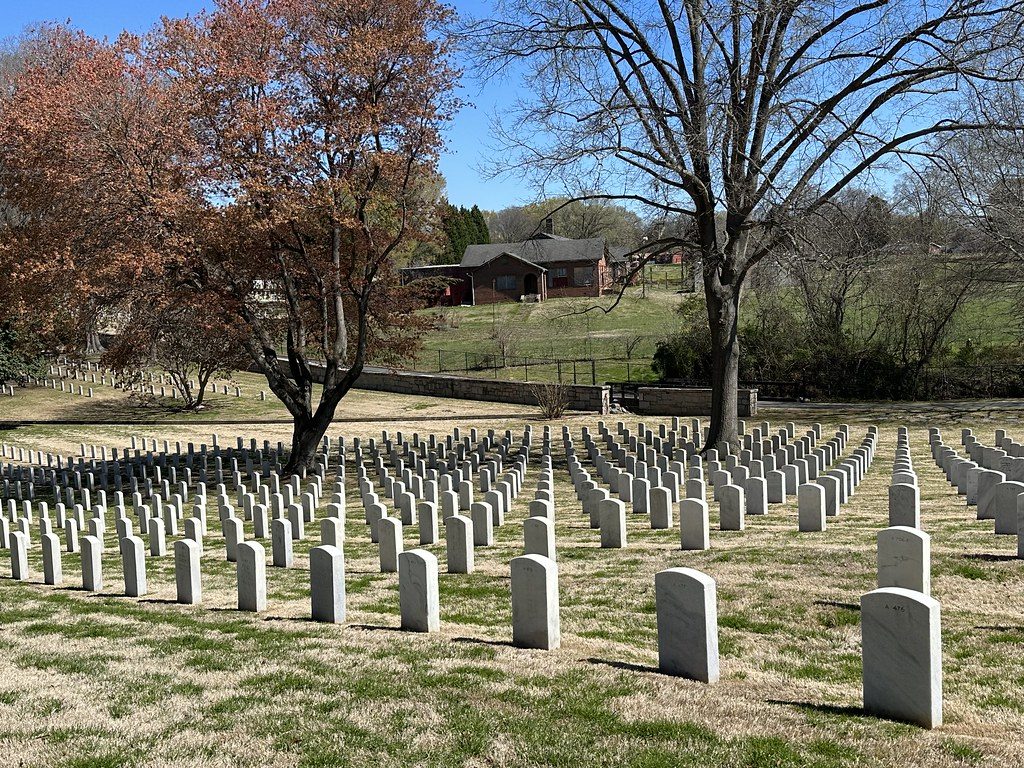
The dead were laid without coffins in eighteen trenches, each about 240 feet long, in a cornfield west of the prison. The 1875 obelisk gives 11,700 unknown dead; later research puts the trench burials near 3,800, and a panel added in 2009 explains the count. The trenches lie under an open lawn kept unbroken among the headstones.
Visitor Info
On the Map
Nearby
The closest stops worth working into your route
Historical markers nearby
Roadside plaques and monuments within a short detour