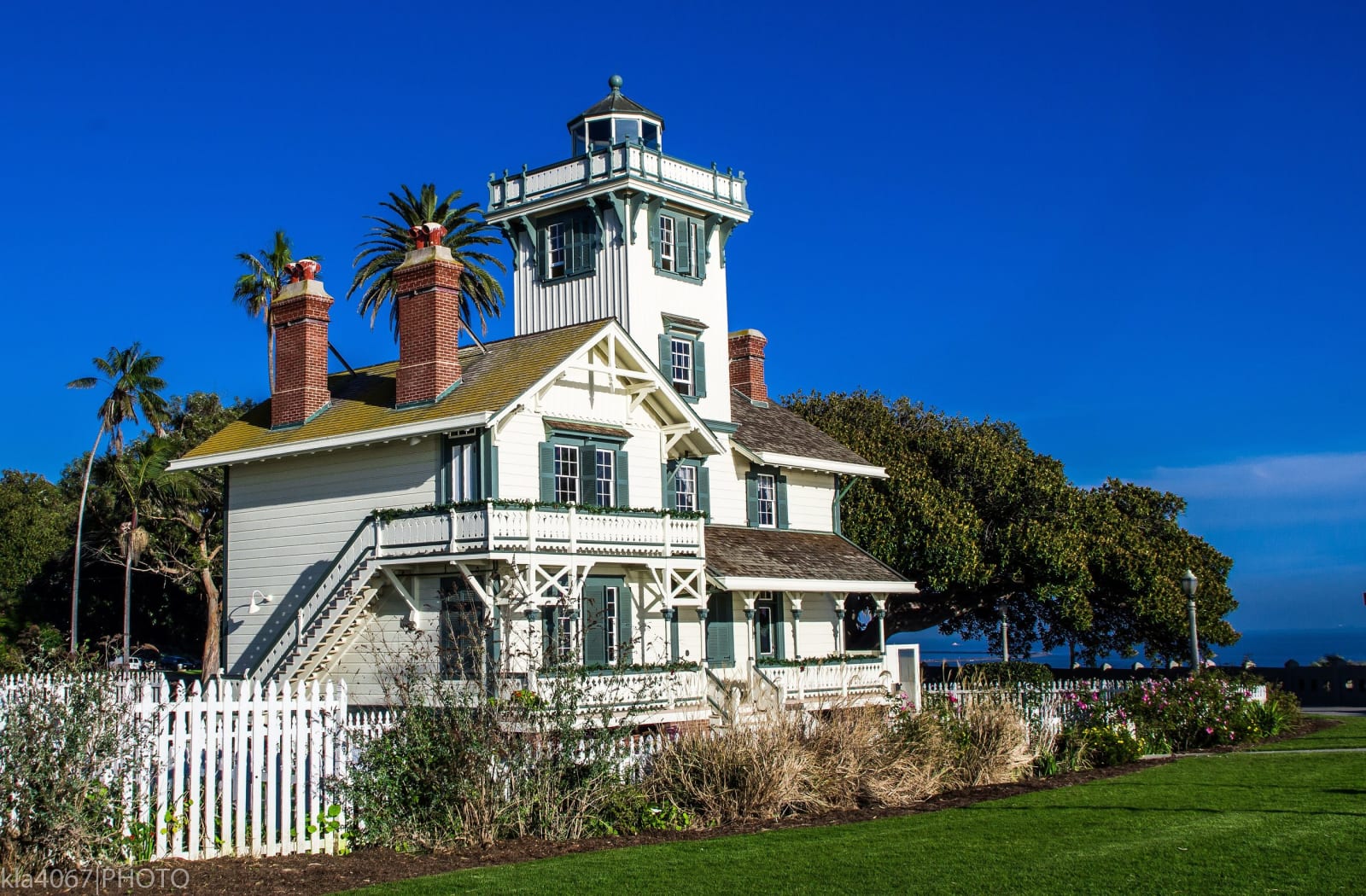
 Ron Reiring / CC BY 2.0 via Wikimedia Commons
The Story
Phineas Banning asked the federal government for a light on this point in 1854. It took twenty years to arrive. When the lamp was finally lit on December 15, 1874, the keepers who lit it were two sisters, Mary and Ella Smith, transferred down from Ediz Hook in Washington Territory. They stayed eight years and resigned, saying the place was too lonely; the nearest settlement was Wilmington. The last keepers were sisters as well, Thelma and Juanita Austin.
The building is not a tower. It is a Stick Style Victorian house with the lantern built into its roof, one of six raised to the same drawings in 1873 and 1874, of which three still stand. The redwood and fir came by ship, and the fourth-order Fresnel lens came around Cape Horn.
The light went out on December 7, 1941, when the whole coast was blacked out, and it was never relit as a working navigational aid.
The ground here does not hold still. Just east of the lighthouse the bluff began to slide in 1929, moving eleven inches a day, and carried roughly forty thousand square feet of a 1920s subdivision into the water. What is left is called Sunken City: broken street slab and foundations tilted down to the waterline. It is fenced and closed to the public.
Visitor Info
On the Map
Nearby
The closest stops worth working into your route
Historical markers nearby
Roadside plaques and monuments within a short detour