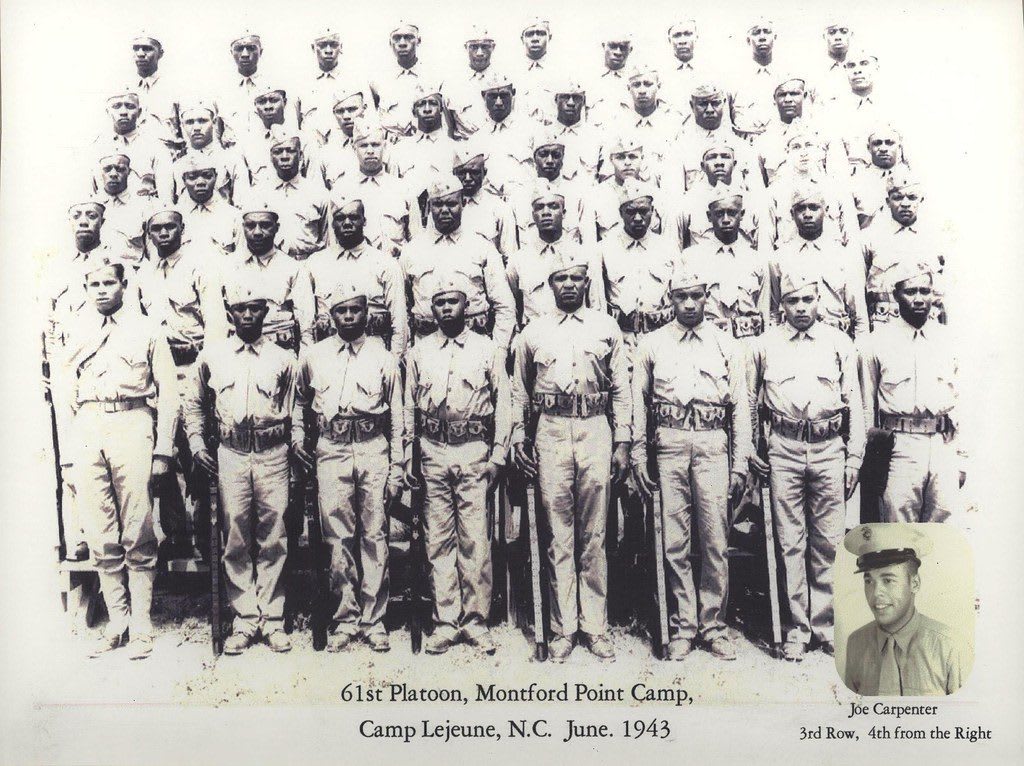
 USMC History Division Archives / CC BY 2.0 via Flickr
The Story
The Marine Corps took no Black recruits until A. Philip Randolph's threatened march on Washington pushed Franklin Roosevelt to sign Executive Order 8802 in June 1941. Enlistment opened on June 1, 1942, and Alfred Masters of Oklahoma City was sworn in at midnight. The recruits trained apart, at Montford Point on the edge of Camp Lejeune, in prefabricated huts, with railroad tracks dividing the camp from white residents, and they could not enter the main base unless a white Marine was with them. By 1945 every drill instructor at the camp was Black, among them Gilbert "Hashmark" Johnson.
More than 20,000 men trained here between 1942 and 1949, most of them assigned to ammunition and supply work that took them to the Pacific front lines. Harry Truman ordered the armed forces desegregated in 1948, the camp closed to recruits in 1949, and the Corps integrated fully during the Korean War. In 1974 Montford Point was renamed Camp Gilbert H. Johnson. Veterans founded the Montford Point Marine Association at a 1965 reunion in Philadelphia, and in 2012 the Montford Point Marines received the Congressional Gold Medal.
The memorial stands in Lejeune Memorial Gardens, outside the base on Lejeune Boulevard near US 17, dedicated in 2016. Three rings stand for the Marines, the Corps and the society around them, and a nine-foot bronze shows a Marine lifting a rifle as he sets down an ammunition can; a Wall of Stars counts the 20,000. The association's museum is in Building M101 on Camp Johnson itself, which requires base access through the Wilson Gate visitor center; call ahead.
Visitor Info
On the Map
Nearby
The closest stops worth working into your route
Historical markers nearby
Roadside plaques and monuments within a short detour