 Larry Syverson (Stabbur's Master) / CC BY-SA 2.0 via Flickr
The Story
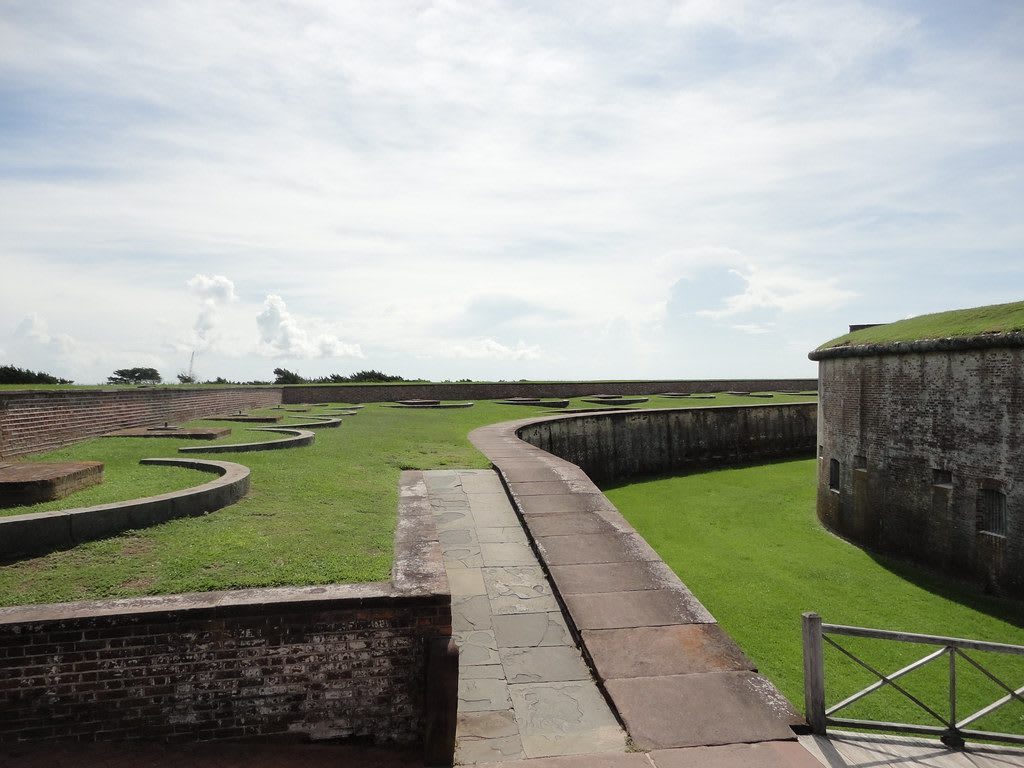
Beaufort Inlet was the colony's best deepwater entrance, and raiders used it: Spanish privateers took Beaufort in 1747 and the British in 1782. A small fort of oyster-shell tabby built here after 1808 was soon undercut by the sea and lay in the ship channel by 1834. The Army Corps of Engineers began its replacement in 1826 to a plan by Simon Bernard and finished it in December 1834 for $463,790, a five-sided brick and stone work of twenty-six vaulted casemates named for Senator Nathaniel Macon.
Two days after Fort Sumter, in April 1861, Beaufort militia seized it from its lone caretaker. A ship soon brought tools and enslaved and free Black laborers to repair the woodwork and mount the guns. Union troops under John G. Parke landed on Bogue Banks in the spring of 1862, and on April 25 their batteries of new rifled cannon struck the walls 560 times in eleven hours. Colonel Moses J. White surrendered the next morning. The fort served as a Union coaling station, then as a civil and military prison until 1877.
Congress sold it to North Carolina for one dollar in 1924, the Civilian Conservation Corps restored it, and the park opened on May 1, 1936, the state's first to function as one. Coast Artillery troops manned it again from December 1941 to November 1944. The casemates hold furnished rooms and exhibits, rangers give daily tours and firing demonstrations, and trails cross the dunes and salt marsh to an ocean beach.
Visitor Info
On the Map
Nearby
The closest stops worth working into your route
Historical markers nearby
Roadside plaques and monuments within a short detour