Home / North Carolina / New Bern, Beaufort & the Crystal Coast / Downtown New Bern
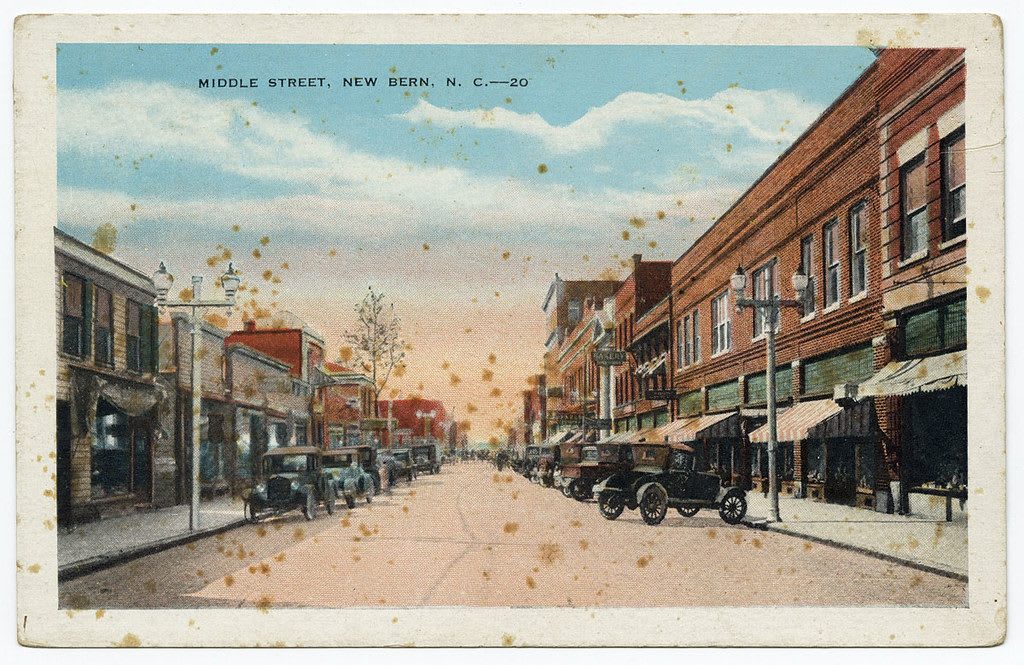
An early twentieth-century postcard of Middle Street in New Bern, lined with brick storefronts and parked cars.UNC Libraries / public domain via Flickr
🏛️Historical

Downtown New Bern

Part ofNew Bern, Beaufort & the Crystal Coast
On this driveThe Albemarle and Pamlico Colonial Towns: Somerset Place, Edenton, Hope, Bath and New Bern

The river town where the Neuse meets the Trent: Chattoka, the 1710 Swiss settlement that set off the Tuscarora War, the Union-held city of 1862 and the freedpeople of James City.

⏱
Duration
Two to three hours on foot.
🎟
Admission
Free to walk; Union Point Park is a public city park.
📅
Best Season
Spring and fall; summers are hot and humid, and hurricanes are a risk from August into October.

The Story

Before New Bern there was Chattoka, a town on the point where the Neuse and the Trent meet; most accounts call its people Tuscarora, some Neusiok. In October 1710 Christoph von Graffenried laid out a town for Swiss and Palatine settlers here, on land the Tuscarora counted as their own. With surveyor John Lawson, whom the Tuscarora blamed for the settlement, he was seized on an expedition upriver the next September; Lawson was killed and Graffenried released. On September 22, 1711, Tuscarora under Hancock, with Coree, Neuse, Pamlico, Machapunga and other allies, struck the farms along the Neuse, Trent and Pamlico. By 1713 about 950 Tuscarora had been killed or captured and sold into slavery, and most of the nation moved north to join the Haudenosaunee.

New Bern was the colony's capital from 1770 and grew rich on plantation trade, in enslaved people among other goods; in 1860, 3,072 of its 5,432 people were Black. Union troops took the city on March 14, 1862, and held it to the war's end. Nearly 10,000 people escaped slavery to the Union lines here, and the camp the army built for them across the Trent became James City, named for its superintendent, chaplain Horace James.

After the war freedpeople built churches, lodges and businesses, and by 1877 the town had a Black majority. The district elected four Black congressmen before a 1900 suffrage amendment shut Black voters out until the Voting Rights Act. Sixteen lumber mills ran by 1890. Union Point Park sits on the confluence, and more than 160 National Register buildings stand within walking distance.

Visitor Info

⏱
Time Needed
Two to three hours on foot.
🎟
Admission
Free to walk; Union Point Park is a public city park.
📅
Best Season
Spring and fall; summers are hot and humid, and hurricanes are a risk from August into October.
🛣️
Highway
US 70 / US 17

On the Map

Nearby

The closest stops worth working into your route

historical0.4 mi away
Tryon Palace
The rebuilt 1770 Governor's House of colonial North Carolina, told now with Tom, Surry, Prima and the other enslaved people whose labor kept its households running.
historical29 mi away
Historic Bath
North Carolina's first town, chartered in 1705 on the Pamlico River, struck in the Tuscarora War of 1711 and keeping the state's oldest church and Blackbeard's brief retirement.
natural31 mi away
Hammocks Beach State Park
Bear Island and The Hammocks, a gift steered by Gertrude and John Hurst to North Carolina's Black teachers in 1950, when segregation kept Black families off the state's beaches.
historical33 mi away
Montford Point Marine Memorial
The memorial to the 20,000 Black recruits trained at segregated Montford Point from 1942 to 1949, the first African Americans in the Marine Corps, beside the Camp Johnson museum.
historical33 mi away
CSS Neuse Civil War Museum
The burned lower hull of a Confederate ironclad that never reached the sounds, raised from the Neuse in 1963 and shown in downtown Kinston with Lenoir County's war.
culinary33 mi away
Skylight Inn BBQ
Whole hogs cooked over wood coals and chopped with crisp skin since 1947 in Ayden, under a silver Capitol dome on the roof.

Historical markers nearby

Roadside plaques and monuments within a short detour

Marker0.1 mi away
USRC Diligence
New Bern
Marker0.3 mi away
Baron de Graffenried
New Bern
Marker0.3 mi away
Graham A. Barden
New Bern
Marker0.3 mi away
First Provincial Congress
New Bern
Marker0.3 mi away
Caleb Bradham
New Bern
Marker0.3 mi away
William Gaston
New Bern