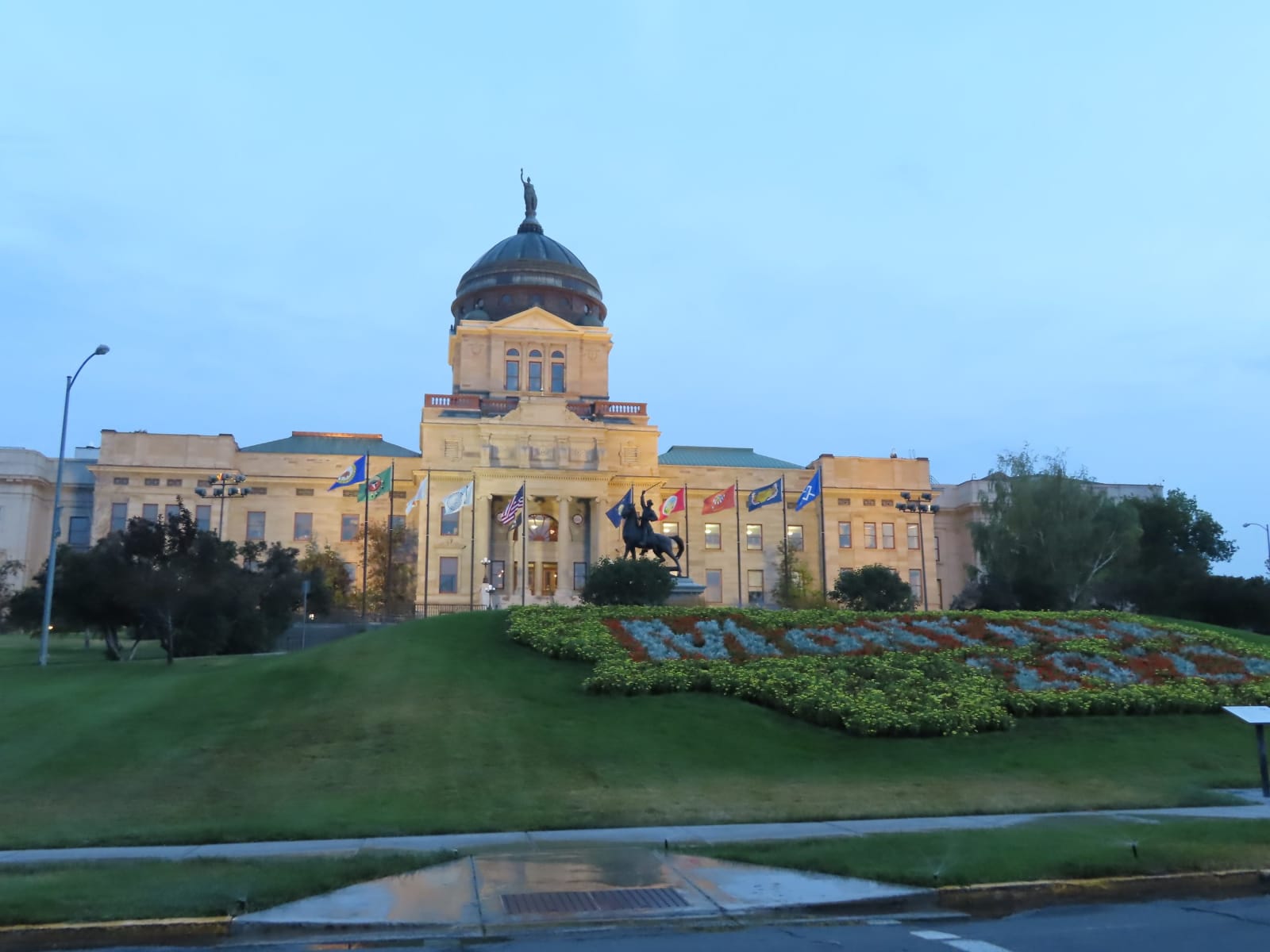
 David Wilson / CC BY 2.0 via Wikimedia Commons
The Story
Helena had held the territorial capital since 1875, but statehood in 1889 reopened the question. Seven towns ran in 1892, and the top two, Helena and Anaconda, went to a runoff in 1894 that the copper kings turned into their own war. Marcus Daly, who had built Anaconda around his smelter, wanted it for his town. William A. Clark, his rival, put his money behind Helena chiefly to beat him. Helena won, 27,024 votes to 25,118, and Anaconda never quite accepted it.
The first plans were thrown out in a scandal over the building commission, and a new commission chose the architects Charles Bell and John Kent. The cornerstone was laid on July 4, 1899, the stone building under its copper dome was finished in 1902, and the east and west wings were added between 1909 and 1912. The earthquakes of 1935 cracked it, and crews of the Works Progress Administration put it right.
The painting most people come for hangs above the Speaker's chair in the House. The state commissioned Charles M. Russell in 1911. He first proposed an Indian attack on a wagon train; the choice settled instead on the expedition's meeting with the Séliš, the Salish, at Ross' Hole in the upper Bitterroot in September 1805. Russell made the Salish the subject. Their riders and horses fill the twenty-five-foot canvas, and Lewis and Clark stand small at one side. It was installed on July 11, 1912, and it has hung in the room it was painted for ever since.
Visitor Info
On the Map
Nearby
The closest stops worth working into your route