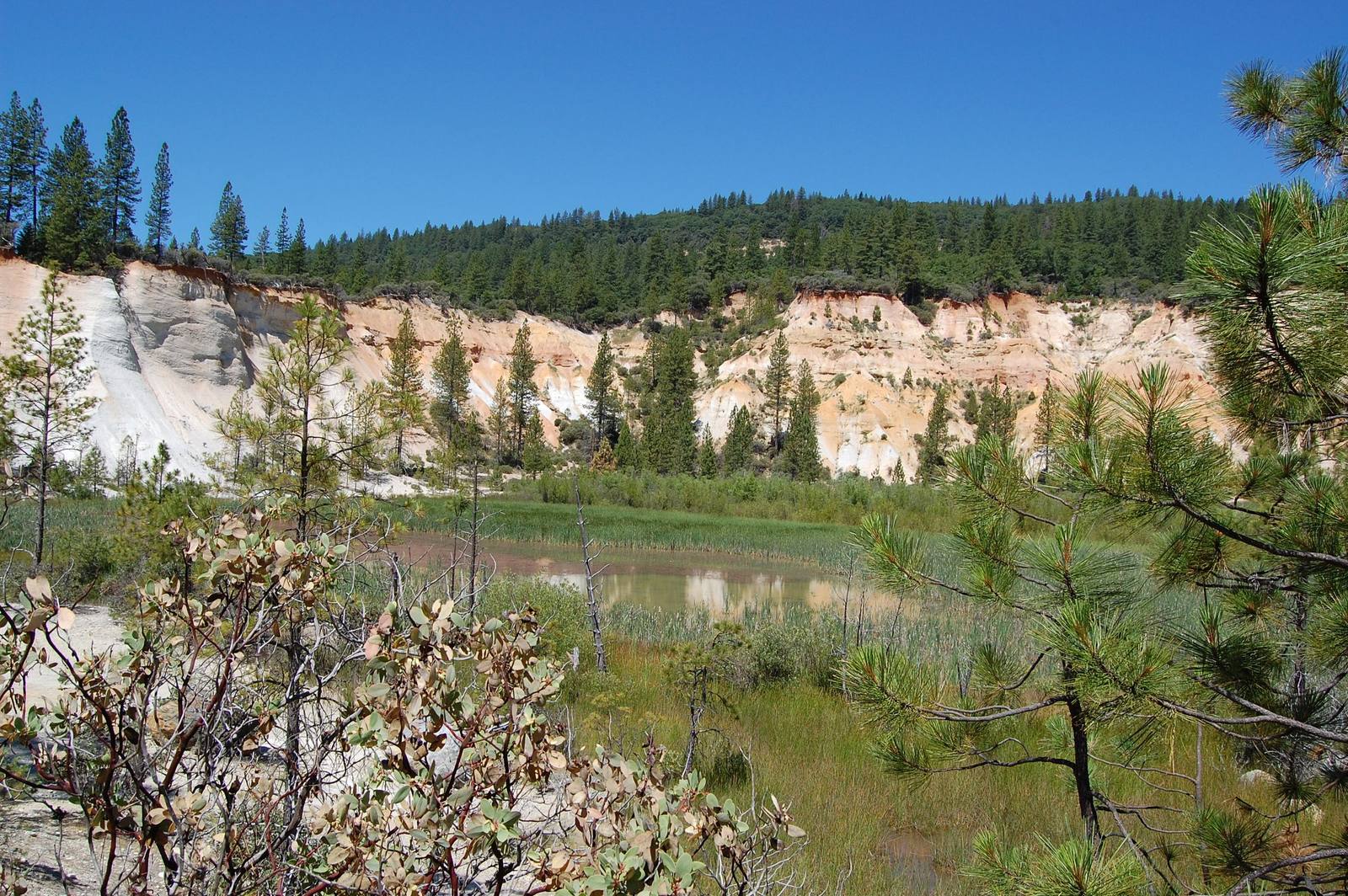
 Commodoredudley / CC BY-SA 3.0 via Wikimedia Commons
The Story
Hydraulic mining did not dig for gold. It dissolved the ground and sorted the pieces. At Malakoff, the North Bloomfield Gravel Mining Company aimed monitors, water cannon fed by more than a hundred miles of ditches and flumes, at the gravel of San Juan Ridge and washed entire hillsides through sluices. What is left is a pit roughly seven thousand feet long, up to three thousand wide, and six hundred deep, with pale cliffs and hoodoos standing where a forested ridge used to be. It is beautiful, and it is a wound.
The debris went downstream. Rivers filled with slickens, farmland in the valley flooded, and orchards died under the sediment. In 1882 a Marysville landowner named Edwards Woodruff sued. On January 7, 1884, Judge Lorenzo Sawyer issued a 225-page decision permanently barring the company from dumping tailings into the watercourses. It is generally counted the first major environmental ruling in the United States, and it finished large-scale hydraulic mining in California within a couple of decades.
The park preserves the pit and the town of North Bloomfield, whose population had halved by 1900. A rim trail runs the edge of the diggins and a road drops into the bottom. It sits sixteen miles up Tyler Foote Crossing Road from CA-49, north of Nevada City, and the last stretch is slow.
Visitor Info
On the Map
A story featuring this place
Go deeper into the history and character of this stop
Nearby
The closest stops worth working into your route
Historical markers nearby
Roadside plaques and monuments within a short detour