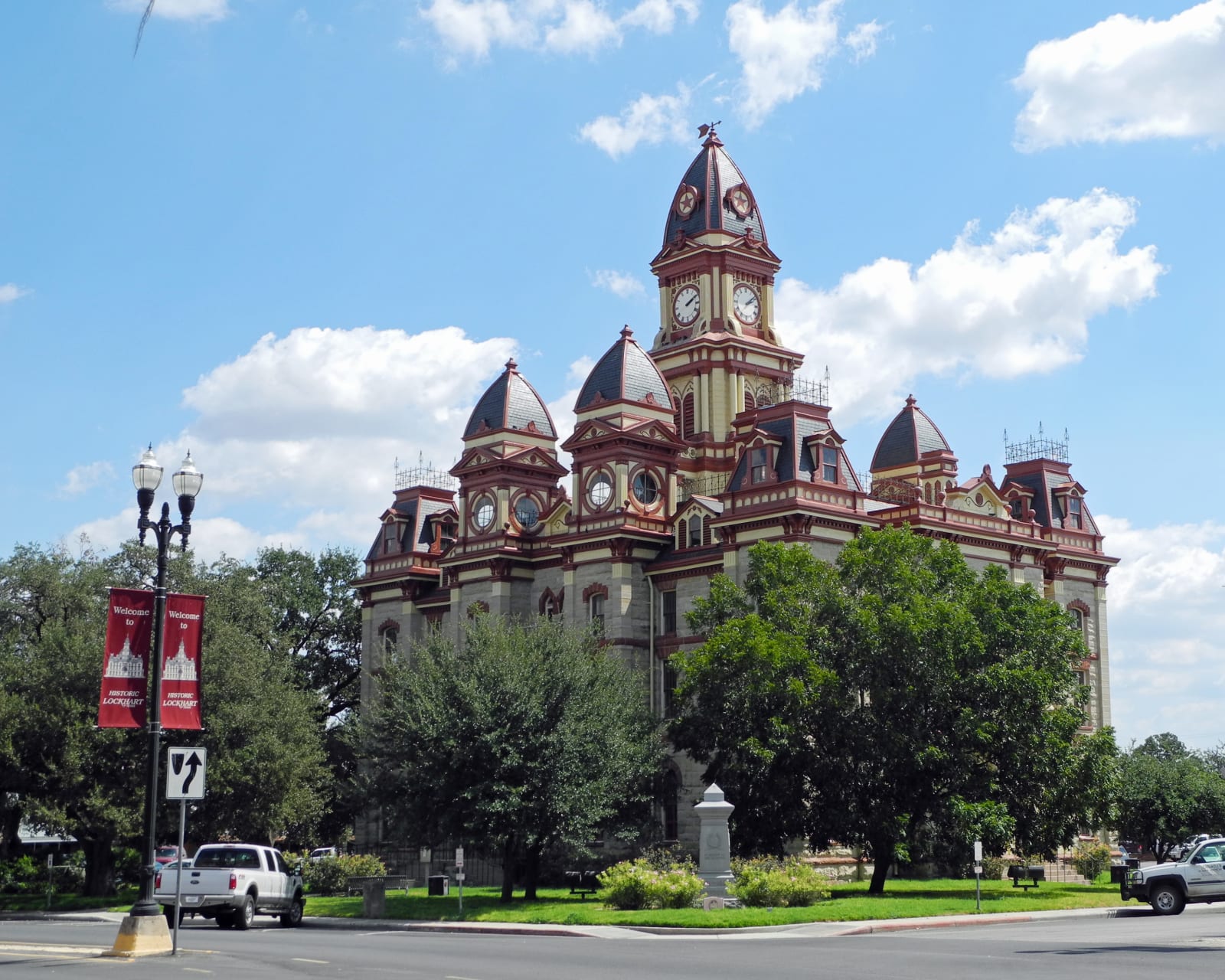
 Woody Hibbard / CC BY 2.0 via Flickr
The Story
Lockhart grew up after the fighting. Through the 1830s the threat of raids kept settlers away, but after the Plum Creek fight of August 1840, at the end of the Great Raid that followed the Council House killings in San Antonio, families settled near Lockhart Springs. When Caldwell County was formed in 1848 the new town became its seat and took over the Plum Creek post office. By its incorporation in 1852 Isabel Stewart was publishing a weekly paper, the Lockhart Academy had opened, and a Masonic lodge of 1850 housed both school and church.
The town took its name from Byrd Lockhart, who received the land in 1831 as partial pay for surveying. It became a Chisholm Trail starting point in the late 1860s and a cotton town by the 1890s, with a cottonseed oil mill in 1893 and a compress in 1901. The Dr. Eugene Clark Library, from around 1900, is said to be the state's oldest continuously operating city library, and Kreuz's Market dates from the same years. In 1999 the Legislature proclaimed Lockhart the Barbecue Capital of Texas.
The courthouse of 1893 and 1894 is Second Empire, cream limestone and red sandstone under a mansard roof, with a four-faced Seth Thomas clock and a 900-pound bell. Often credited to Alfred Giles, it was likely drawn by Henry E. M. Guidon, and it nearly twins the Goliad courthouse. It and the blocks around it joined the National Register in 1978.
Visitor Info
On the Map
Nearby
The closest stops worth working into your route
Historical markers nearby
Roadside plaques and monuments within a short detour