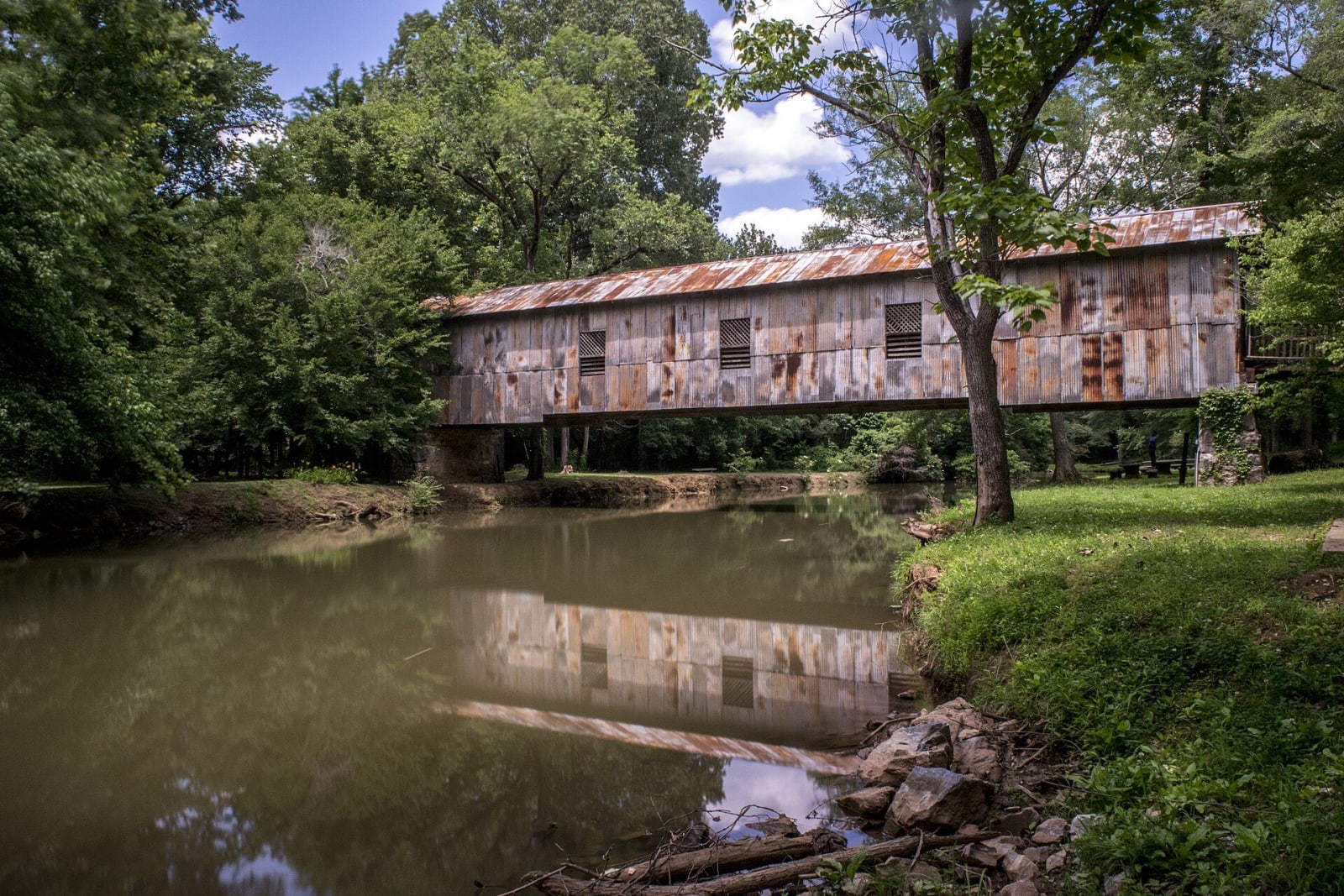
 UnknownUser12 / CC BY-SA 4.0 via Wikimedia Commons
The Story
The covered bridge over Talladega Creek was probably finished around 1861 to carry the Old Georgia Road, also called the McIntosh Road after the Creek leader William McIntosh. That road ran through Muscogee (Creek) country, ceded in the 1832 Treaty of Cusseta, and the homesteads that followed it filled the valley. Remnants of the old roadbed still run through the woods past the bridge.
In early 1864 George Hoke Forney, a merchant from Jacksonville and a Confederate officer, hired the German builder G. E. Morris to put up a grist mill here. Forney was killed at the Wilderness in May, and the mill was finished largely by enslaved workers Morris leased for the job. They also dug the millrace by hand and built the wooden dam that holds the mill pond. The mill escaped the Union raiders who burned so many Alabama mills and works, and it ground grain under one owner after another until 1977. It was unusually mechanized: grain came in by rail spur and buckets lifted it to the top floor, and its five sets of stones included two of French buhrstone.
It is the only place in Alabama where a mill and covered bridge both stand where they were built, and both are on the National Register. The city of Childersburg owns the park and the Childersburg Historical Preservation Commission runs it; the mill still grinds, and the bridge now leads to trails along the creek.
Visitor Info
On the Map
Nearby
The closest stops worth working into your route
Historical markers nearby
Roadside plaques and monuments within a short detour