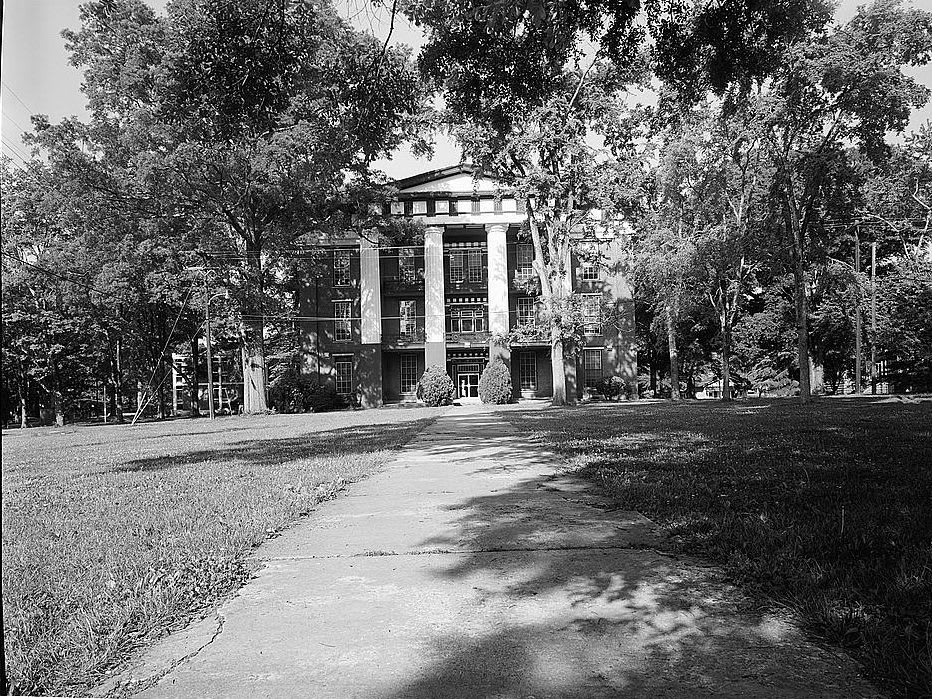
 Historic American Buildings Survey / public domain via Library of Congress
The Story
Talladega takes its name from Talatigi, a Muscogee (Creek) town whose name means border town. In November 1813 Andrew Jackson's militia broke a Red Stick siege of Creeks allied with the United States at Fort Leslie here, killing about three hundred Red Stick warriors, and the Creek Nation ceded what was left of its Alabama land in the 1832 Treaty of Cusseta, the road to removal. The county was formed from that cession the same year.
The college was the work of freedmen. In 1865 William Savery and Thomas Tarrant, both freedmen of Talladega, came home from a freedmen's convention in Mobile determined to open a school. Classes began in the two-room house of David White Sr., taught by Leonard Johnson, both formerly enslaved. With Gen. Wager Swayne of the Freedmen's Bureau they got the American Missionary Association to buy the Baptist Academy, a school for white boys that enslaved men, Savery and Tarrant among them, had built. Swayne School opened there in 1867 and became Talladega College in 1869. Swayne Hall is a National Historic Landmark.
In 1938 the college commissioned Hale Woodruff to paint the Amistad murals for its new Savery Library: three panels on the 1839 revolt, the Supreme Court trial that freed the captives, and their return to Africa. After conservation and a national tour they came back in 2020 to the college's William R. Harvey Museum of Art. In 1956 the college offered a home to Autherine Lucy after the University of Alabama expelled her.
Visitor Info
On the Map
Nearby
The closest stops worth working into your route
Historical markers nearby
Roadside plaques and monuments within a short detour