Home / Alabama / Birmingham & Central Alabama / Vulcan Park and Museum
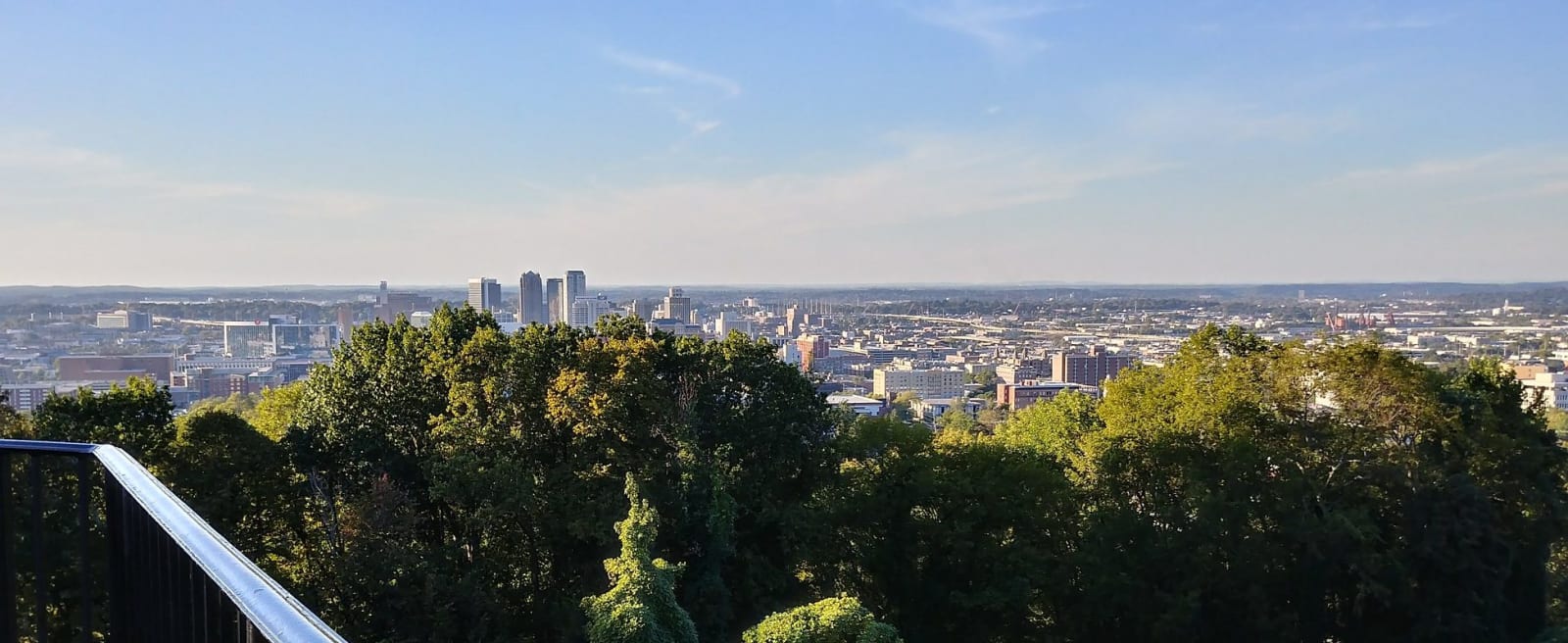
Downtown Birmingham's towers on the horizon beyond the wooded slope of Red Mountain, seen from the railing at Vulcan Park.Charity Davenport / CC0 via Flickr
🏛️Historical

Vulcan Park and Museum

Part ofBirmingham & Central Alabama

The 56-foot cast-iron Vulcan, made for the 1904 World's Fair from Red Mountain ore, on a 1930s WPA tower above Birmingham.

⏱
Duration
One to two hours.
🎟
Admission
Tickets are sold for the museum and observation deck; the park grounds are open to walk.
📅
Best Season
Year round; clear fall and winter days give the longest views.

The Story

Red Mountain and Jones Valley below it were Muscogee (Creek) land until the Treaty of Fort Jackson took it in 1814. The red iron ore in this ridge, with coal and limestone close by, is the reason Birmingham exists, and in 1903 the city's Commercial Club decided to show it off at the St. Louis World's Fair with a giant iron man. The Italian sculptor Giuseppe Moretti modeled Vulcan, the Roman god of the forge, and the figure was cast from pig iron in Birmingham in the spring of 1904: 56 feet tall and about 60 tons, the largest iron figure ever cast.

Vulcan won a grand prize in St. Louis, then came home to an awkward life. Workers bolted the right arm on wrong, the statue stood at the state fairgrounds for about thirty years and wore advertisements for Coca-Cola and overalls. In 1935 the Works Progress Administration moved it to a site on Red Mountain that the Tennessee Coal, Iron and Railroad Company sold to the city for five dollars, and built the park and a 124-foot pedestal with an observation deck. From 1946 a neon torch glowed green, or red on days with a traffic death.

A restoration finished in 2004 recast damaged pieces and returned the pedestal to its first look. The museum tells the statue's story and the city's. The real reward is the deck: downtown, the furnaces and the long valley all spread out below.

Visitor Info

⏱
Time Needed
One to two hours.
🎟
Admission
Tickets are sold for the museum and observation deck; the park grounds are open to walk.
📅
Best Season
Year round; clear fall and winter days give the longest views.
🛣️
Highway
US-31

On the Map

Nearby

The closest stops worth working into your route

cultural2 mi away
Birmingham Civil Rights Institute
The museum and archive across from Sixteenth Street Baptist Church, beside Kelly Ingram Park, where police turned hoses and dogs on marching children in May 1963.
historical2.1 mi away
Sixteenth Street Baptist Church
Birmingham's first Black church, the staging ground of the 1963 campaign, where a Klan bomb killed four girls on September 15, 1963.
industrial2.1 mi away
Sloss Furnaces National Historic Landmark
Birmingham's preserved blast furnace plant, founded in 1881, a museum of pig iron and of the convict labor and Black workforce behind it.
historical3.6 mi away
Rickwood Field
The nation's oldest operating professional ballpark, opened in 1910, home of the Birmingham Barons and the Negro League Birmingham Black Barons.
historical4.2 mi away
Historic Bethel Baptist Church
Fred Shuttlesworth's 1926 church in Collegeville, headquarters of the Alabama Christian Movement for Human Rights and bombed three times.
natural12 mi away
Oak Mountain State Park
Alabama's largest state park, just south of Birmingham: ridges, lakes, Peavine Falls, 70 miles of trail and a wildlife center.

Historical markers nearby

Roadside plaques and monuments within a short detour

Marker0.7 mi away
The Attempted Bombing of Congregation Beth-El
Birmingham
Marker1 mi away
School of Medicine
Birmingham
Marker1.6 mi away
Rev. Martin Luther King Jr.'s 'Letter From Birmingham Jail'
Birmingham
Marker1.9 mi away
Emory Overton Jackson
Birmingham
Marker1.9 mi away
Jefferson County Courthouse Site
Birmingham
Marker1.9 mi away
Colored Masonic Temple
Birmingham