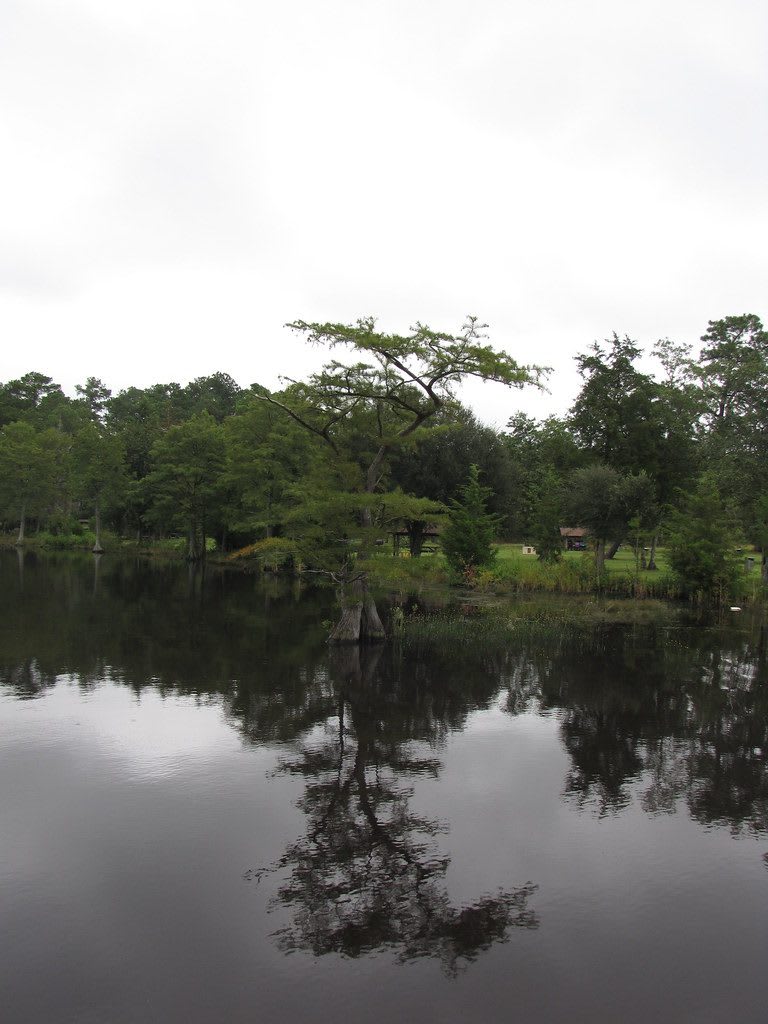
 Gerry Dincher / CC BY-SA 2.0 via Flickr
The Story
Jones Lake opened in 1939 as the first North Carolina state park to welcome Black citizens, in the years when the state parks were segregated. The National Park Service had begun buying the worn-out farm and timber land around Jones and Salters lakes in 1936 as a recreational demonstration project, and young men of the Civilian Conservation Corps built its first facilities. For decades Black families from across southeastern North Carolina came here for reunions, baptisms and church picnics. Parks for Black visitors got little money under segregation, and that neglect left the two lakes and their woods largely wild.
Both lakes are Carolina bays, the shallow oval basins of the coastal plain whose origin is still argued. No stream feeds Jones Lake; it lives on rain, and its tea-colored water, stained by peat and decaying leaves, is only about eight feet deep at most and too acid for many fish. Pond cypress hung with Spanish moss stands along the edge, with loblolly bay, red bay, pond pine and Atlantic white cedar in the bay forest behind. The lake is named for Isaac Jones, who gave the land for Elizabethtown in 1773, and Salters Lake for Sallie Salter, remembered for spying on Tories camped by the Cape Fear during the Revolution.
The four-mile Bay Lake Trail circles Jones Lake through that forest, and the mile-long Cedar Loop crosses a sand ridge. Swimming and picnicking by the beach are still what draw most visitors, and canoes and paddleboats rent from the boathouse in summer.
Visitor Info
On the Map
Nearby
The closest stops worth working into your route
Historical markers nearby
Roadside plaques and monuments within a short detour