Home / North Carolina / Wilmington & the Cape Fear / Moores Creek National Battlefield
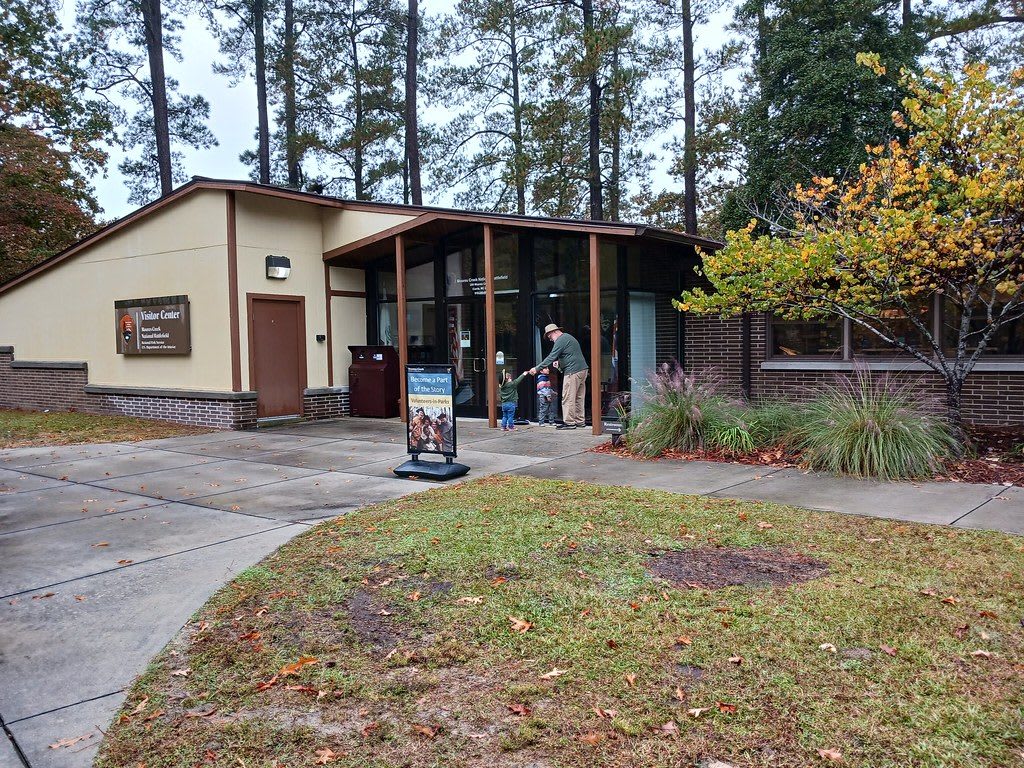
A low tan and brick visitor center among tall pines, with autumn leaves on the lawn and a few visitors at the glass doors.Gerry Dincher / CC BY-SA 2.0 via Flickr
🏛️Historical

Moores Creek National Battlefield

Part ofWilmington & the Cape Fear

The creek crossing where Patriot militia broke a Loyalist Highland charge on February 27, 1776, ending royal hopes for North Carolina that year.

⏱
Duration
One to two hours.
🎟
Admission
Free (NPS, 2026).
📅
Best Season
Year round; grounds open daily 9 a.m. to 5 p.m. and the visitor center Tuesday to Saturday (NPS, 2026). The anniversary falls on the last full weekend of February.

The Story

At dawn on February 27, 1776, Loyalist militia, most of them Scottish Highland settlers from the upper Cape Fear, charged across the Widow Moore's Creek Bridge with broadswords drawn and ran into musket and artillery fire from Patriot earthworks on the far bank. Overnight the Patriots under Richard Caswell and Alexander Lillington had pulled up the bridge planks and greased the rails. Lt. Col. Donald MacLeod fell with some 20 musket balls in him, and the Loyalist force broke within minutes. Col. James Moore put the Loyalist loss at perhaps 50 killed or wounded; the Patriots reported one killed and one wounded.

Governor Josiah Martin had called the Loyalists down from Cross Creek, today's Fayetteville, to meet a British expedition at Brunswick on the coast. The defeat ended that plan. Many of the men were rounded up in the days that followed, among them the Gaelic poet Iain mac Mhurchaidh, John MacRae of Kintail, whose son Murdo was mortally wounded at the bridge. North Carolina saw no British army again until 1780, and the victory helped carry the colony toward its vote for independence that spring.

Private efforts saved the ground in the late 1800s, the War Department made it a national military park in 1926, and the Park Service took it over in 1933. The one-mile History Trail follows remnants of the 1776 road past the earthworks and over the creek to the bridge site, with wayside exhibits, and the shorter Tar Heel Trail runs through the forest. The anniversary is marked each year on the last full weekend of February.

Visitor Info

⏱
Time Needed
One to two hours.
🎟
Admission
Free (NPS, 2026).
📅
Best Season
Year round; grounds open daily 9 a.m. to 5 p.m. and the visitor center Tuesday to Saturday (NPS, 2026). The anniversary falls on the last full weekend of February.
🛣️
Highway
NC 210

On the Map

Nearby

The closest stops worth working into your route

historical17 mi away
1898 Memorial Park
Six bronze paddles on North Third Street for the Black Wilmingtonians killed on November 10, 1898, in the coup that overthrew the city's elected government.
historical18 mi away
Bellamy Mansion Museum
A 1859-61 Market Street mansion built by enslaved and free Black craftsmen, with one of the best-preserved urban slave quarters in the country behind it.
historical18 mi away
Gregory Congregational Church
The church of a freedpeople's school at Third and Nun streets, where Wilmington's Black students gathered in 1971 and the Wilmington Ten case began.
natural24 mi away
Lake Waccamaw State Park
The largest Carolina bay, buffered by limestone and home to aquatic species found nowhere else, near the Waccamaw Siouan homeland at the edge of the Green Swamp.
natural27 mi away
Green Swamp Preserve
Nature Conservancy longleaf savannas in the Green Swamp, kept open by fire, with wild Venus flytraps, pitcher plants, sundews and orchids.
historical30 mi away
Brunswick Town / Fort Anderson State Historic Site
The excavated foundations of a colonial Cape Fear port burned in 1776, St. Philip's church walls, and the sand walls of Confederate Fort Anderson on the same bluff.

Historical markers nearby

Roadside plaques and monuments within a short detour

Marker12 mi away
Saints Peter and Paul Russian Orthodox Church
St. Helena
Marker12 mi away
S. S. Satchwell
Burgaw
Marker12 mi away
Samuel Swann
Rocky Point
Marker13 mi away
William S. Ashe
Rocky Point
Marker13 mi away
Samuel Ashe
Rocky Point
Marker13 mi away
Edward Moseley
Burgaw