Home / North Carolina / Fayetteville, Pinehurst & the Sandhills / Fayetteville State University
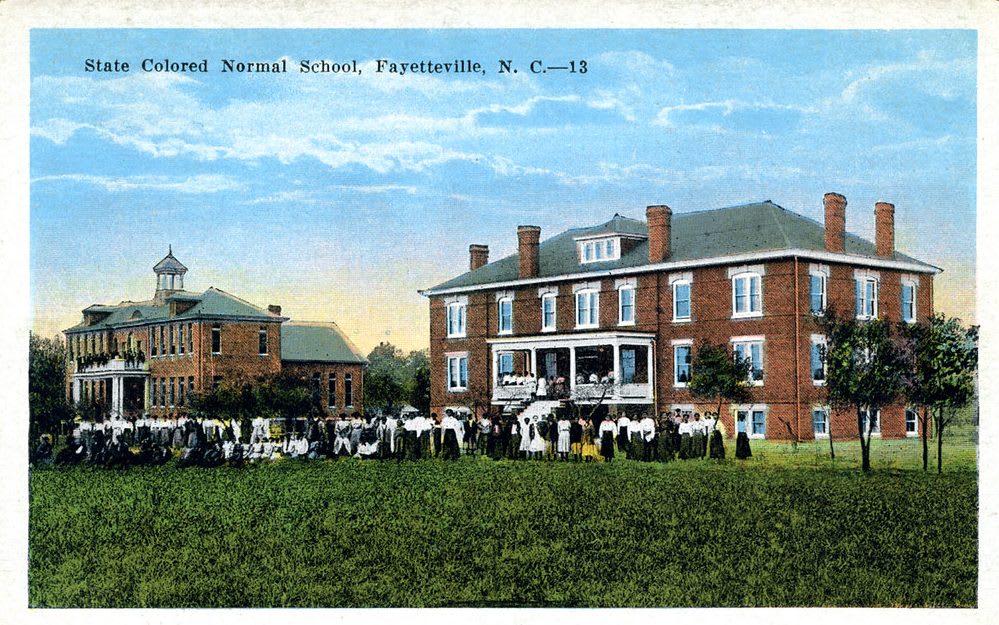
An early 20th-century postcard of two brick school buildings on a lawn, with students gathered in front, captioned State Colored Normal School, Fayetteville.UNC Libraries Commons / public domain mark via Flickr
🏛️Historical

Fayetteville State University

Part ofFayetteville, Pinehurst & the Sandhills

The historically Black university that grew from the 1867 Howard School, founded on land seven Black men bought, where Charles W. Chesnutt was principal.

⏱
Duration
Thirty minutes to an hour.
🎟
Admission
Free to walk the campus.
📅
Best Season
Year round; fall for homecoming.

The Story

Right after the war Fayetteville's Black community opened the Phillips and Sumner schools, and in 1867 they joined as the Howard School, named for the Freedmen's Bureau chief who put up its building. The land came from the community: seven Black men, Matthew N. Leary, Andrew Jackson Chesnutt, Robert Simmons, George Grainger, Thomas Lomax, Nelson Carter and David A. Bryant, paid $136 for two lots on Gillespie Street and made themselves a self-perpetuating board of trustees to hold them for the education of Black children.

Andrew Chesnutt's son Charles was nine when the family returned to Fayetteville from Ohio. He studied at the Howard School and was teaching there as a pupil-teacher at fourteen. In 1877 the legislature made the school the State Colored Normal School, the first state school in the South for training Black teachers, and Chesnutt became assistant principal; by 1880 he was principal. He left in 1883 for the North and a writing career, and his stories and novels, The Conjure Woman and The Marrow of Tradition among them, made his name far beyond Fayetteville. The library here bears his name.

Ezekiel Ezra Smith, a Shaw graduate, led the school for most of the next fifty years and moved it to Murchison Road, deeding land of his own to bring it to 92 acres. It became a four-year teachers college in 1939 and Fayetteville State University in 1969, and joined the UNC system in 1972. The campus is open to drive and walk.

Visitor Info

⏱
Time Needed
Thirty minutes to an hour.
🎟
Admission
Free to walk the campus.
📅
Best Season
Year round; fall for homecoming.
🛣️
Highway
Murchison Road

On the Map

Nearby

The closest stops worth working into your route

historical1.5 mi away
Market House
The 1832 arcaded market and town hall in the traffic circle at the heart of Fayetteville, where enslaved people were sold, built on the site of the state house of 1789.
geological27 mi away
Raven Rock State Park
A crystalline bluff rising 150 feet over the Cape Fear River on the fall line, with the ruins of a lock and dam and trails through beech woods.
natural27 mi away
Weymouth Woods-Sandhills Nature Preserve
A remnant of the old longleaf pine forest at Southern Pines, saved by the novelist James Boyd's family, with trees centuries old and the scars of the turpentine trade.
historical28 mi away
East Carolina Indian School
The 1943 cinder-block high school the Coharie and other eastern North Carolina Native communities won, now the Coharie Tribe's office and powwow ground.
natural32 mi away
Jones Lake State Park
A rain-fed Carolina bay north of Elizabethtown, opened in 1939 as the first North Carolina state park to welcome Black visitors.
cultural32 mi away
Museum of the Southeast American Indian at Old Main
The 1923 brick building at UNC Pembroke that Lumbee people fought to save, burned in 1973 and rebuilt, now home to a free museum of Native Southeast life.

Historical markers nearby

Roadside plaques and monuments within a short detour

Marker0.2 mi away
Lewis Leary
Fayetteville
Marker0.4 mi away
Hiram R. Revels
Fayetteville
Marker0.9 mi away
Frank P. Graham
Fayetteville
Marker1 mi away
U.S. Arsenal
Fayetteville
Marker1.1 mi away
C. M. Stedman
Fayetteville
Marker1.2 mi away
James C. Dobbin
Fayetteville