Home / North Carolina / Fayetteville, Pinehurst & the Sandhills / Market House
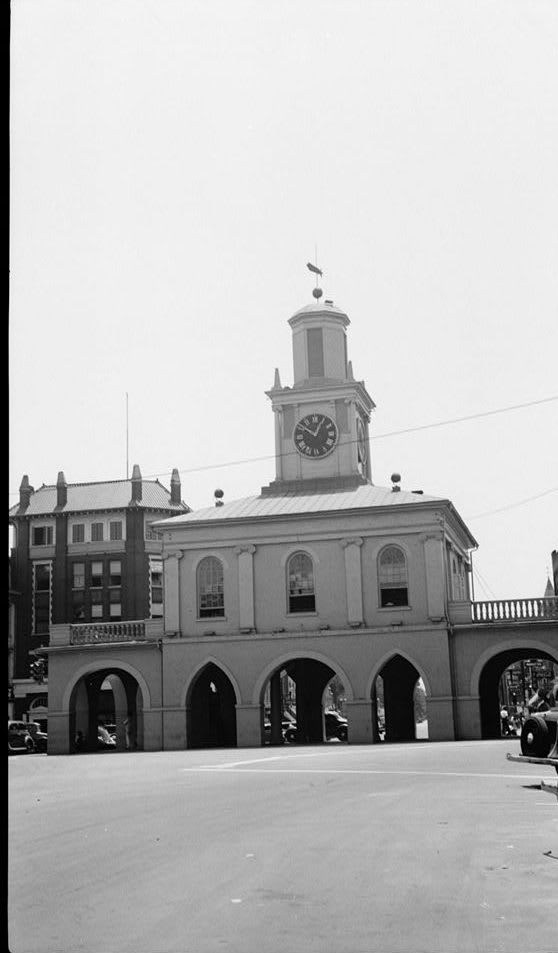
A black-and-white view of a two-story arcaded brick market house with a clock tower, standing in an open street.Historic American Buildings Survey / public domain via Library of Congress
🏛️Historical

Market House

Part ofFayetteville, Pinehurst & the Sandhills

The 1832 arcaded market and town hall in the traffic circle at the heart of Fayetteville, where enslaved people were sold, built on the site of the state house of 1789.

⏱
Duration
Fifteen to thirty minutes.
🎟
Admission
Free; the ground-floor arcade is open to the street.
📅
Best Season
Year round.

The Story

The building at the center of Fayetteville's four main streets stands on the foundations of the state house where North Carolina ratified the federal Constitution in 1789 and where the legislature met while the town was the capital. The great fire of 1831 took it. The Market House went up the next year, an arcaded open market below and a town hall above. Records suggest its builders were free Black craftsmen, Thomas Grimes, a native of Jamaica, and the mason and carpenter John Patterson, working with other free and enslaved Black tradesmen.

Under these arches meat, produce, livestock and people were sold. Enslaved men, women and children were auctioned here and in front of the building until the end of the Civil War, beside the corn and the horses, and families were broken apart. In 1867 a mob shot Archibald Beebe, a Black drayman accused of assaulting a white woman, as he was brought out from a hearing upstairs, where the town held court; the men charged were pardoned by President Andrew Johnson. Emancipation Day parades later passed the same corner.

The building served as a market until 1907 and as town hall until 1906, and citizens saved it from demolition then and again when traffic engineers wanted it gone. A plaque added in 1994 honors the people sold here. Protesters set a fire in it in 2020, and in 2021 the city council voted to keep the building and repurpose it; what it should become is still argued in town.

Visitor Info

⏱
Time Needed
Fifteen to thirty minutes.
🎟
Admission
Free; the ground-floor arcade is open to the street.
📅
Best Season
Year round.
🛣️
Highway
Hay Street

On the Map

Nearby

The closest stops worth working into your route

historical1.5 mi away
Fayetteville State University
The historically Black university that grew from the 1867 Howard School, founded on land seven Black men bought, where Charles W. Chesnutt was principal.
historical28 mi away
East Carolina Indian School
The 1943 cinder-block high school the Coharie and other eastern North Carolina Native communities won, now the Coharie Tribe's office and powwow ground.
geological28 mi away
Raven Rock State Park
A crystalline bluff rising 150 feet over the Cape Fear River on the fall line, with the ruins of a lock and dam and trails through beech woods.
natural29 mi away
Weymouth Woods-Sandhills Nature Preserve
A remnant of the old longleaf pine forest at Southern Pines, saved by the novelist James Boyd's family, with trees centuries old and the scars of the turpentine trade.
natural30 mi away
Jones Lake State Park
A rain-fed Carolina bay north of Elizabethtown, opened in 1939 as the first North Carolina state park to welcome Black visitors.
cultural31 mi away
Museum of the Southeast American Indian at Old Main
The 1923 brick building at UNC Pembroke that Lumbee people fought to save, burned in 1973 and rebuilt, now home to a free museum of Native Southeast life.

Historical markers nearby

Roadside plaques and monuments within a short detour

Marker0 mi away
Charter of the University of N.C.
Fayetteville
Marker0 mi away
Sherman's Army
Fayetteville
Marker0 mi away
Plank Roads
Fayetteville
Marker0.1 mi away
Lafayette
Fayetteville
Marker0.1 mi away
First Presbyterian Church
Fayetteville
Marker0.1 mi away
Cross Creek
Fayetteville