Home / Louisiana / New Orleans & the River Parishes / Chalmette Battlefield
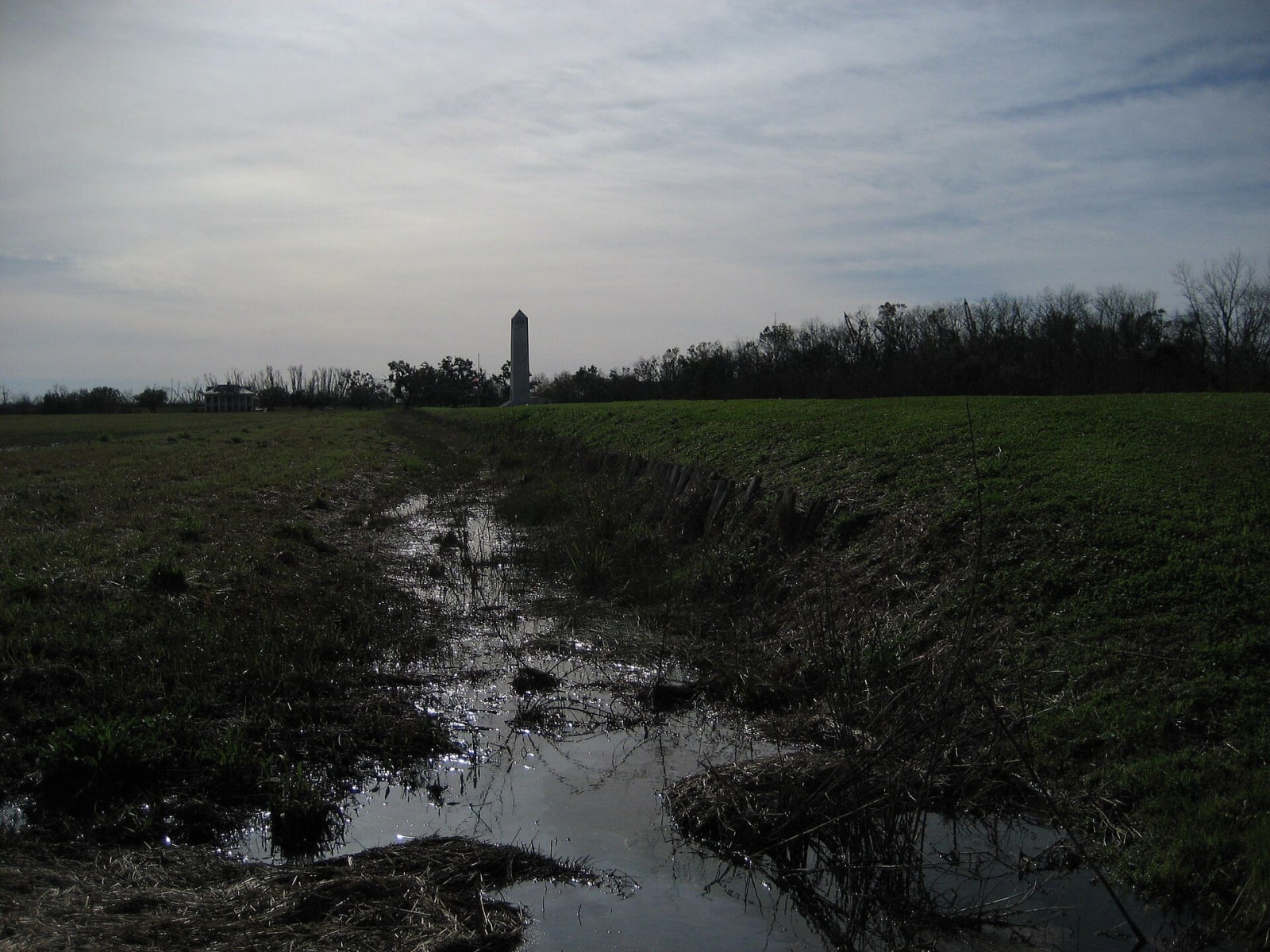
The Rodriguez Canal runs as a water-filled ditch across the flat Chalmette battlefield toward the distant Chalmette Monument under a gray sky.Infrogmation of New Orleans / CC BY 2.5 via Wikimedia Commons
πŸ›οΈHistorical

Chalmette Battlefield

Part ofNew Orleans & the River Parishes

The ground of the January 8, 1815 Battle of New Orleans, beside Chalmette National Cemetery and the site of Fazendeville, a freedpeople's community founded in 1867 and bought out in the 1960s.

⏱
Duration
One to two hours.
🎟
Admission
No admission fee for Jean Lafitte National Historical Park and Preserve; donations accepted at its visitor centers.
πŸ“…
Best Season
Open year round. Per the Park Service, the battlefield is open to pedestrians sunrise to sunset and vehicle gates run 9 a.m. to 4:30 p.m.; the cemetery gates open 9:30 a.m. to 4:30 p.m. Confirm before you go.

The Story

Chalmette Battlefield, about five miles southeast of the French Quarter, is where Andrew Jackson's army met the British on January 8, 1815. The British had landed near the VillerΓ© Plantation on December 20, 1814, and Jackson held a line behind the Rodriguez Canal. His men included regulars, Marines, militia that counted free men of color, Baratarian privateers and Choctaw warriors, and enslaved people built the ramparts. The Treaty of Ghent had been signed fifteen days earlier, on December 24, 1814, and the main British assault failed in about half an hour.

The ground has a longer Black history. Jean Pierre Fazende, a free man of color and New Orleans grocer, inherited the land in 1857, and after the Civil War he sold parcels to formerly enslaved people from nearby plantations. Fazendeville was established in 1867 and grew to more than 200 people. The Park Service bought the land in the mid-1960s after long, contentious negotiations, and many residents moved to the Ninth Ward. Beside the field, Chalmette National Cemetery began in May 1864, and its oldest section holds U.S. Colored Troops; in 2016 volunteers cleaned and reset 671 headstones there. A Freedmen's Cemetery of about four acres was set out next to it in 1867.

The one-hundred-foot Chalmette Monument was begun by the state in 1855 and finished with federal funds in 1908. It closed after Hurricane Katrina and was rededicated on September 28, 2013.

Visitor Info

⏱
Time Needed
One to two hours.
🎟
Admission
No admission fee for Jean Lafitte National Historical Park and Preserve; donations accepted at its visitor centers.
πŸ“…
Best Season
Open year round. Per the Park Service, the battlefield is open to pedestrians sunrise to sunset and vehicle gates run 9 a.m. to 4:30 p.m.; the cemetery gates open 9:30 a.m. to 4:30 p.m. Confirm before you go.
πŸ›£οΈ
Highway
St. Bernard Highway

On the Map

Nearby

The closest stops worth working into your route

historical4.5 mi away
The Cabildo
The Spanish town hall on Jackson Square, finished in 1799, where Louisiana changed flags in 1803 and where the state Supreme Court sat in the same room until 1910, Plessy v. Ferguson among its cases.
cultural4.5 mi away
New Orleans Jazz National Historical Park
A National Park Service unit created in 1994 to tell where jazz came from, with free programs and a visitor center in the French Quarter and park land inside Louis Armstrong Park.
cultural4.6 mi away
The Historic New Orleans Collection
A French Quarter museum and research center founded in 1966, whose 2015 Purchased Lives exhibition took on New Orleans' place as the largest slave market in antebellum America.
cultural4.8 mi away
Congo Square
The 2.35-acre corner of Louis Armstrong Park where, from 1817, New Orleans confined Sunday dancing by enslaved people to one place, and where crowds of hundreds gathered to drum, dance and trade.
historical5 mi away
St. Louis Cemetery No. 1
New Orleans' oldest surviving city of the dead, opened in 1789 after the fire of 1788 and the burial place of Homer Plessy, reachable only on a guided tour since March 2015.
historical5.8 mi away
Lafayette Cemetery No. 1
The Garden District's 1833 cemetery of about 1,100 family tombs, closed to visitors in 2019 and reopened on October 1, 2026 for small guided tours run by the Preservation Resource Center.

Historical markers nearby

Roadside plaques and monuments within a short detour

Marker3.8 mi away
Plessy v. Ferguson - Press Street Railroad Yards
New Orleans
Marker4.2 mi away
Faubourg Marigny
New Orleans
Marker4.3 mi away
French Market
New Orleans
Marker4.3 mi away
New Orleans and the Domestic Slave Trade
New Orleans
Marker4.4 mi away
Old Ursuline Convent
New Orleans
Marker4.4 mi away
Natchez Steamboats
New Orleans