Home / Texas / La Grange, Gonzales & the Painted Churches / Nativity of Mary, Blessed Virgin Catholic Church (High Hill)
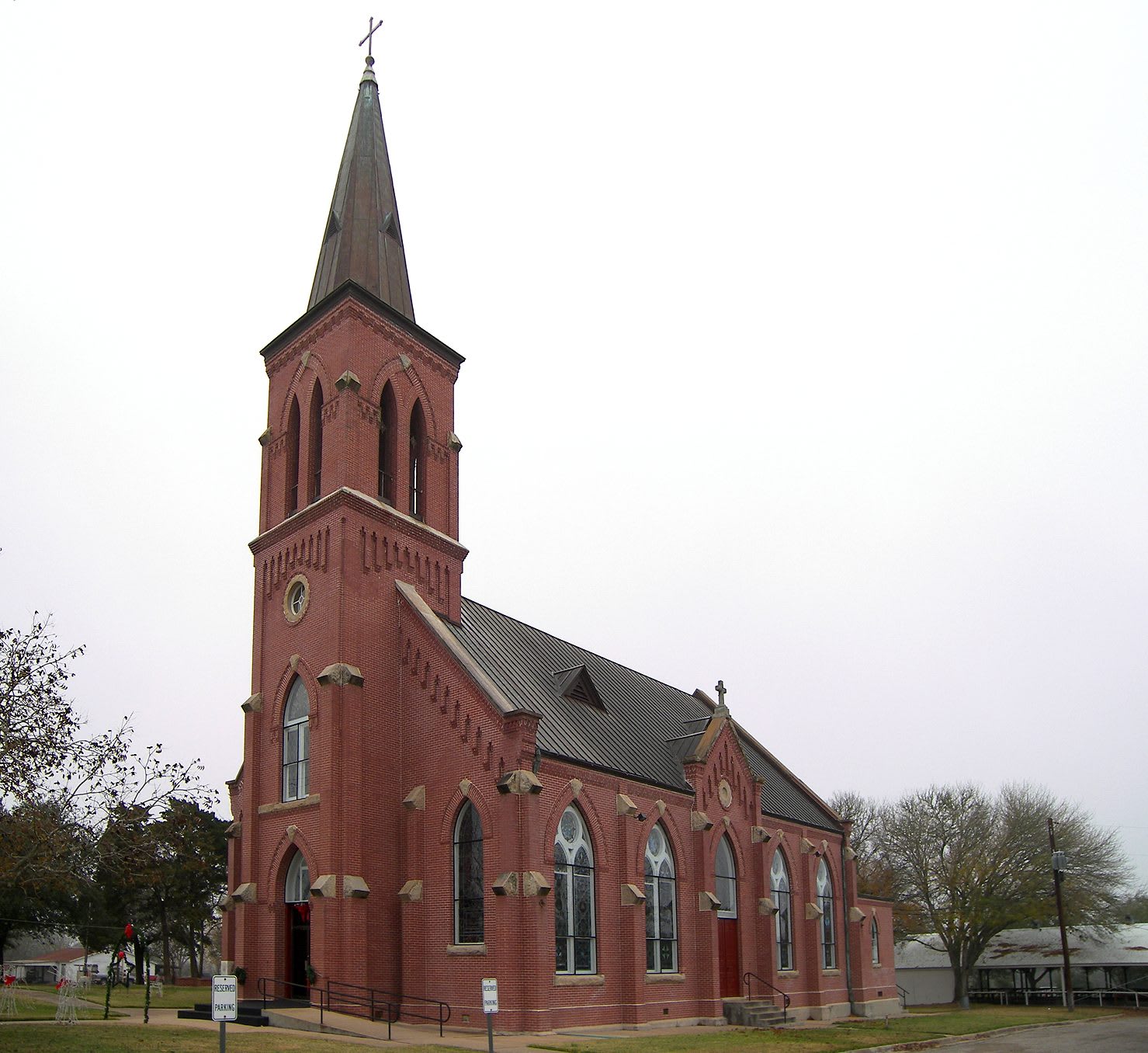
The red brick Gothic Revival church at High Hill, its tall spire and pointed windows set against an overcast sky.Larry D. Moore / CC BY 4.0 via Wikimedia Commons
🏗️Architectural

Nativity of Mary, Blessed Virgin Catholic Church (High Hill)

Part ofLa Grange, Gonzales & the Painted Churches

A red brick Gothic Revival church of 1906 in a German farm settlement, where two San Antonio painters spent 1912 faking marble columns and stone vaults on wood.

⏱
Duration
About 30 minutes; a four-church tour takes most of a morning.
🎟
Admission
Free to visit on your own; guided Painted Churches tours through the Schulenburg Chamber of Commerce, from $18 a person for one or two churches plus a guide fee, with a $60 deposit.
📅
Best Season
Year round, Monday to Saturday, normally 9 a.m. to 4 p.m.; no tours on Sundays, holidays or Catholic holy days, and weddings or funerals close the church to visitors. The parish festival falls on the Sunday before Labor Day.

The Story

High Hill grew out of two German settlements of the late 1840s, Blum Hill and Oldenburg, and its families were German and Austrian-Moravian. By the 1880s it had a Catholic church, four schools and a steam gristmill. Some sources say the town refused the railroad in 1874; the line went to Schulenburg instead, and many residents followed it.

The present church, built in 1906, was one of the first by the Texas church architect Leo M. J. Dielmann, newly back from his studies in Germany. Church leaders of the period pushed for brick or stone, since so many wooden churches had burned or blown down, and the parish built its Gothic Revival walls in red brick around a wooden interior.

That wooden interior is the reason to come. In 1912 Ferdinand Stockert and Hermann Kern of San Antonio painted it in a few months. Eight wooden columns read as ocher marble, and the ceiling ribs read as Gothic vaulting that was never built. Parishioners' parents told of the painters working on canvas and gluing it to the walls, and from the choir loft the hardened bubbles still show. It is one of the fifteen churches listed together on the National Register in 1983 as churches with decorative interior painting. It is an active parish. The Schulenburg Chamber runs guided tours; small groups may also visit on their own Monday to Saturday.

Visitor Info

⏱
Time Needed
About 30 minutes; a four-church tour takes most of a morning.
🎟
Admission
Free to visit on your own; guided Painted Churches tours through the Schulenburg Chamber of Commerce, from $18 a person for one or two churches plus a guide fee, with a $60 deposit.
📅
Best Season
Year round, Monday to Saturday, normally 9 a.m. to 4 p.m.; no tours on Sundays, holidays or Catholic holy days, and weddings or funerals close the church to visitors. The parish festival falls on the Sunday before Labor Day.
🛣️
Highway
FM 2672 / I-10

On the Map

Nearby

The closest stops worth working into your route

architectural5.7 mi away
Saints Cyril and Methodius Catholic Church (Dubina)
The church of Texas's first Czech settlement, under a sky-blue painted ceiling that was whitewashed in the 1950s and brought back from faint traces by its own parishioners.
architectural6.3 mi away
St. John the Baptist Catholic Church (Ammannsville)
A wooden Carpenter Gothic church built in 1919 after storm and fire took two before it, its dusty-rose interior painted by an artist whose name was lost for decades.
architectural9 mi away
St. Mary's Church of the Assumption (Praha)
The mother parish of the Czech settlements around Flatonia, a stone-fronted church of 1895 whose ceiling Gottfried Flury turned into a turquoise garden, with an August 15 feast since 1855.
historical12 mi away
Monument Hill and Kreische Brewery State Historic Sites
A shared tomb on the Colorado River bluff for the men of the Dawson fight and the black bean lottery, beside the ruins of a German stonemason's spring-fed brewery.
architectural19 mi away
Lavaca County Courthouse
A limestone Romanesque courthouse of 1897-99 on the square of a town founded by a widow trader, in a county seat that once printed the Socialist Party's state paper.
historical23 mi away
Stafford Opera House
A cattleman's bank and theater of 1886 on the Columbus square, in a river town Sam Houston burned in 1836 and a county marked by a long feud and a 1935 lynching.

Historical markers nearby

Roadside plaques and monuments within a short detour

Marker0.1 mi away
Creuzbaur's Battery, C.S.A. "The Big Guns of Fayette"
Schulenburg
Marker1.1 mi away
High Hill Cemetery
Schulenburg
Marker2.3 mi away
Col. William F. Upton
Schulenburg
Marker2.3 mi away
Lyons Family Cemetery
Schulenburg
Marker2.9 mi away
Schulenburg
Schulenburg
Marker3 mi away
Turner Hall
Schulenburg