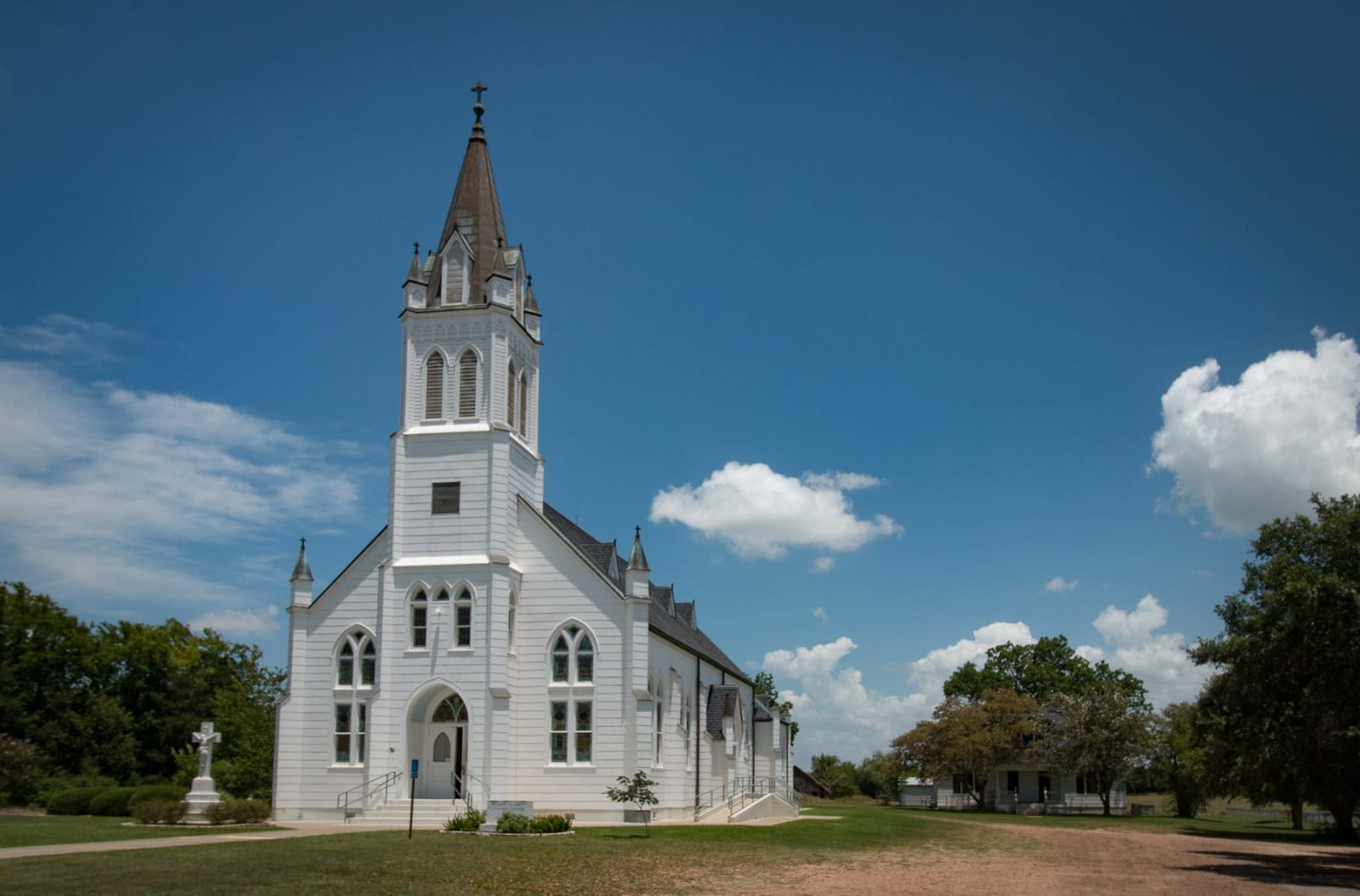
 Renelibrary / CC BY-SA 4.0 via Wikimedia Commons
The Story
Andrew Ammann arrived on March 12, 1870, and German and Czech farmers followed him onto land first allotted to the Fayette County schools. A Catholic church and school opened in 1890. The church was destroyed by the storm of 1909, rebuilt and dedicated in November 1910, and on October 2, 1917, it burned.
The third church, built by John F. Bujnoch and finished in 1919, is Carpenter Gothic: what Europe did in stone, done here in wood. There are no columns in the nave, so it feels wider than it is, and the walls are dusty rose. Stencils and freehand work run floor to ceiling: flowers, draped garlands, interlaced circles and multicolored geometric bands. The painting reflects the town's Czech heritage, though many of its settlers were German.
When the church was listed on the National Register with the other painted churches in 1983, nobody remembered who had painted it. The design historian Buie Harwood, researching decorative painting across Texas, later identified him as Fred Donecker, a fresco painter from San Antonio. The town around the church has thinned to a few remnant buildings; in 1900 it had three stores and saloons, two blacksmiths and two gins, and the First State Bank of Ammannsville was chartered in 1914. It is an active parish. Visit Monday to Saturday, and stay outside if a service or funeral is under way.
Visitor Info
On the Map
Nearby
The closest stops worth working into your route
Historical markers nearby
Roadside plaques and monuments within a short detour