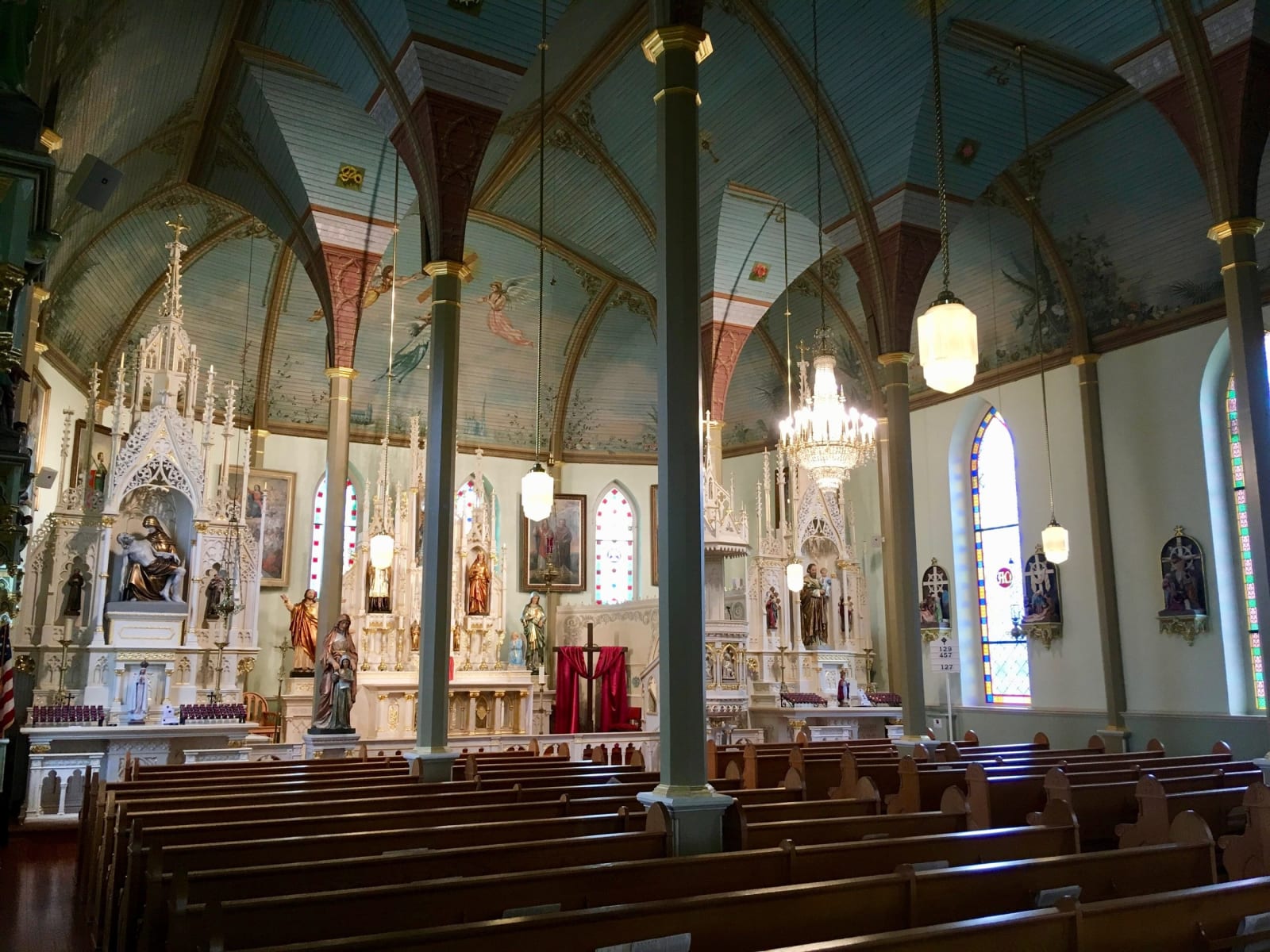
 Kyle G. Sweeney / CC BY 4.0 via Wikimedia Commons
The Story
Czech settlers renamed the place Praha, for Prague, in 1858; before that it had been Mulberry and Hottentot. Mathias Novak, a Bohemian who had worked for the Anglo settlers long enough to buy 100 acres, opened his house for the first Masses, and a Bernardine priest, Joseph Bithowski, built a frame church in 1865. Praha became the mother parish for the towns around it, and it kept that role after the railroad passed a mile north in 1873 and Flatonia drew the business away.
The present church went up in 1895, one of the oldest of the painted churches, with a stone front and a steeple of more than 130 feet. Inside, the Swiss-born painter Gottfried Flury of Moulton, who mixed his own paints, covered the ceiling with foliage in turquoise, emerald and blue. Father Louis Netardus, pastor from 1901 and a painter as well as a preacher in Czech, added to it, including a life-sized Saints Cyril and Methodius. The house painter Gene A. Mikulik spent more than thirty years restoring statues and gilding altars here and painted Our Lady of Victory, the Virgin over the parish's men who died in World War II.
The parish has kept the Feast of the Assumption on August 15 since 1855, with Mass, Czech food and bands, and the crowd now runs past 5,000. On Saturdays the church closes at 3 p.m.
Visitor Info
On the Map
Nearby
The closest stops worth working into your route
Historical markers nearby
Roadside plaques and monuments within a short detour