Home / Texas / La Grange, Gonzales & the Painted Churches / Saints Cyril and Methodius Catholic Church (Dubina)
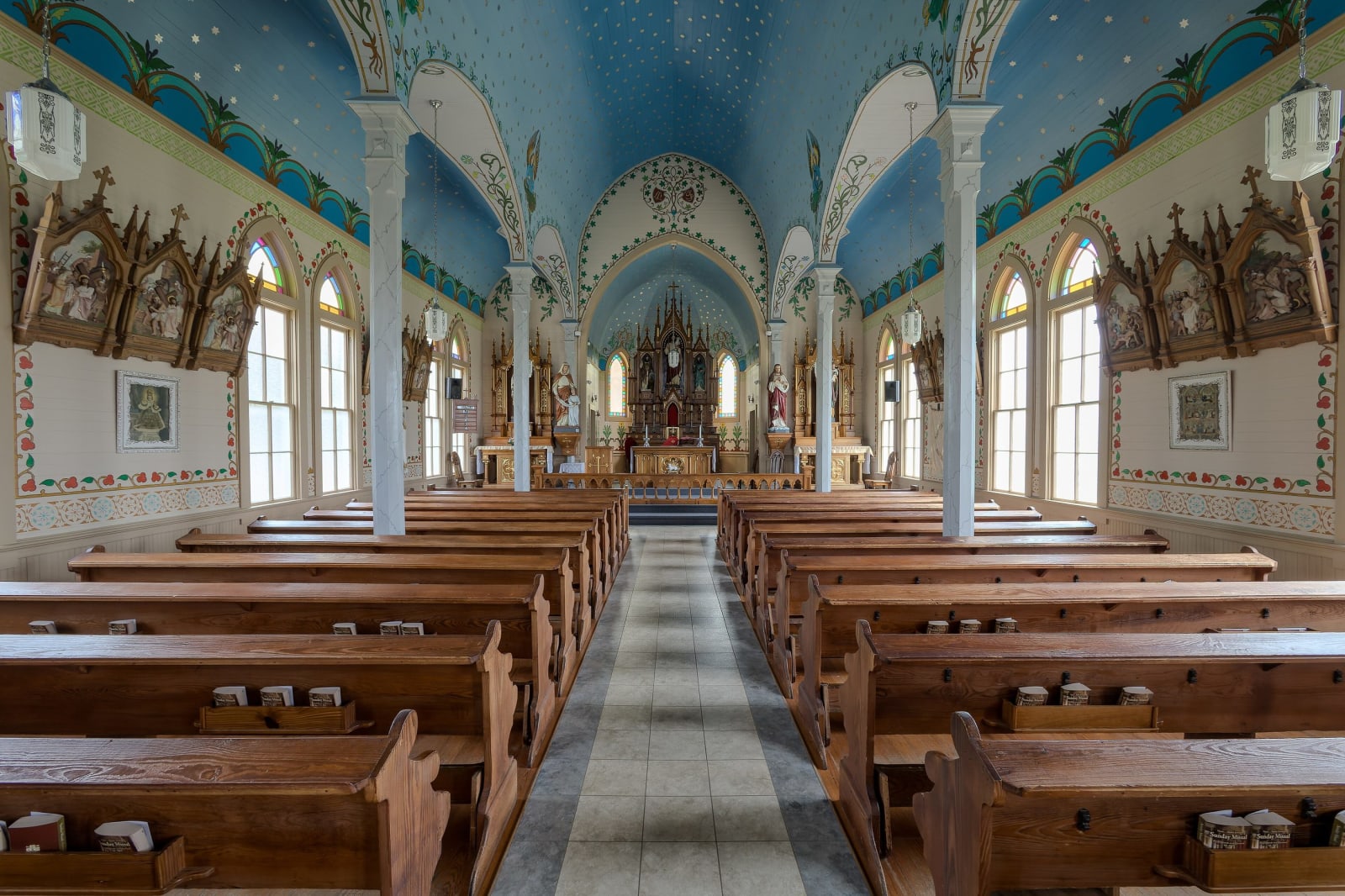
The nave of Saints Cyril and Methodius Church at Dubina, wooden pews leading to the altar under a sky-blue ceiling painted with stars and vines.Clyde Charles Brown / CC BY-SA 4.0 via Wikimedia Commons
🏗️Architectural

Saints Cyril and Methodius Catholic Church (Dubina)

Part ofLa Grange, Gonzales & the Painted Churches

The church of Texas's first Czech settlement, under a sky-blue painted ceiling that was whitewashed in the 1950s and brought back from faint traces by its own parishioners.

⏱
Duration
About 30 minutes.
🎟
Admission
Free to visit on your own; guided Painted Churches tours through the Schulenburg Chamber of Commerce, from $18 a person for one or two churches plus a guide fee, with a $60 deposit.
📅
Best Season
Year round, Monday to Saturday, normally 9 a.m. to 4 p.m.; no tours on Sundays, holidays or Catholic holy days, and services close the church to visitors.

The Story

Dubina, Czech for oak grove, was founded in November 1856 by Moravian families who spent their first night in Fayette County under the oaks in a sleeting norther, with a fire and no shelter. Augustine Haidušek, who made the trip at twelve, remembered the women weeping for fear of freezing. He went on to become the first lawyer of Czech descent in the United States. The Handbook of Texas calls Dubina the first Czech settlement in Texas, and for a time it was the stopover for Czechs arriving in the state.

The first church, of 1876 or 1877, was topped with an iron cross made by Tom Lee, a freedman and blacksmith. A storm destroyed that church in 1909, and the community raised $5,571.90 for the present one by Leo Dielmann, finished in 1912. Lee's cross, pulled from the wreckage, went back on the steeple.

No record names who painted the interior: vines, oak leaves and angels on a sky-blue ceiling and walls. In the 1950s it was whitewashed over. In the 1980s Judge Ed Janecka, who had seen faint traces in the sunlight as an altar boy, and Butch Koenig led the parish in uncovering it, using some of the original stencils they found. Janecka painted the last angel left of the choir loft himself and admitted making her brighter. Mind the pews: the Chamber warns that their feet stick out.

Visitor Info

⏱
Time Needed
About 30 minutes.
🎟
Admission
Free to visit on your own; guided Painted Churches tours through the Schulenburg Chamber of Commerce, from $18 a person for one or two churches plus a guide fee, with a $60 deposit.
📅
Best Season
Year round, Monday to Saturday, normally 9 a.m. to 4 p.m.; no tours on Sundays, holidays or Catholic holy days, and services close the church to visitors.
🛣️
Highway
FM 1383 / I-10

On the Map

Nearby

The closest stops worth working into your route

architectural4.2 mi away
St. John the Baptist Catholic Church (Ammannsville)
A wooden Carpenter Gothic church built in 1919 after storm and fire took two before it, its dusty-rose interior painted by an artist whose name was lost for decades.
architectural5.7 mi away
Nativity of Mary, Blessed Virgin Catholic Church (High Hill)
A red brick Gothic Revival church of 1906 in a German farm settlement, where two San Antonio painters spent 1912 faking marble columns and stone vaults on wood.
historical11 mi away
Monument Hill and Kreische Brewery State Historic Sites
A shared tomb on the Colorado River bluff for the men of the Dawson fight and the black bean lottery, beside the ruins of a German stonemason's spring-fed brewery.
architectural15 mi away
St. Mary's Church of the Assumption (Praha)
The mother parish of the Czech settlements around Flatonia, a stone-fronted church of 1895 whose ceiling Gottfried Flury turned into a turquoise garden, with an August 15 feast since 1855.
historical18 mi away
Stafford Opera House
A cattleman's bank and theater of 1886 on the Columbus square, in a river town Sam Houston burned in 1836 and a county marked by a long feud and a 1935 lynching.
architectural21 mi away
Lavaca County Courthouse
A limestone Romanesque courthouse of 1897-99 on the square of a town founded by a widow trader, in a county seat that once printed the Socialist Party's state paper.

Historical markers nearby

Roadside plaques and monuments within a short detour

Marker0 mi away
Dubina
Dubina
Marker3.2 mi away
John Pettit Borden
Weimar
Marker3.6 mi away
Saint Michael's Catholic Church
Weimar
Marker3.7 mi away
Town of Weimar
Weimar
Marker3.7 mi away
Etta Moten Barnett
Weimar
Marker3.7 mi away
Weimar Railroad Depot
Weimar