Home / West Virginia / Harpers Ferry & the Eastern Panhandle / Harpers Ferry National Historical Park
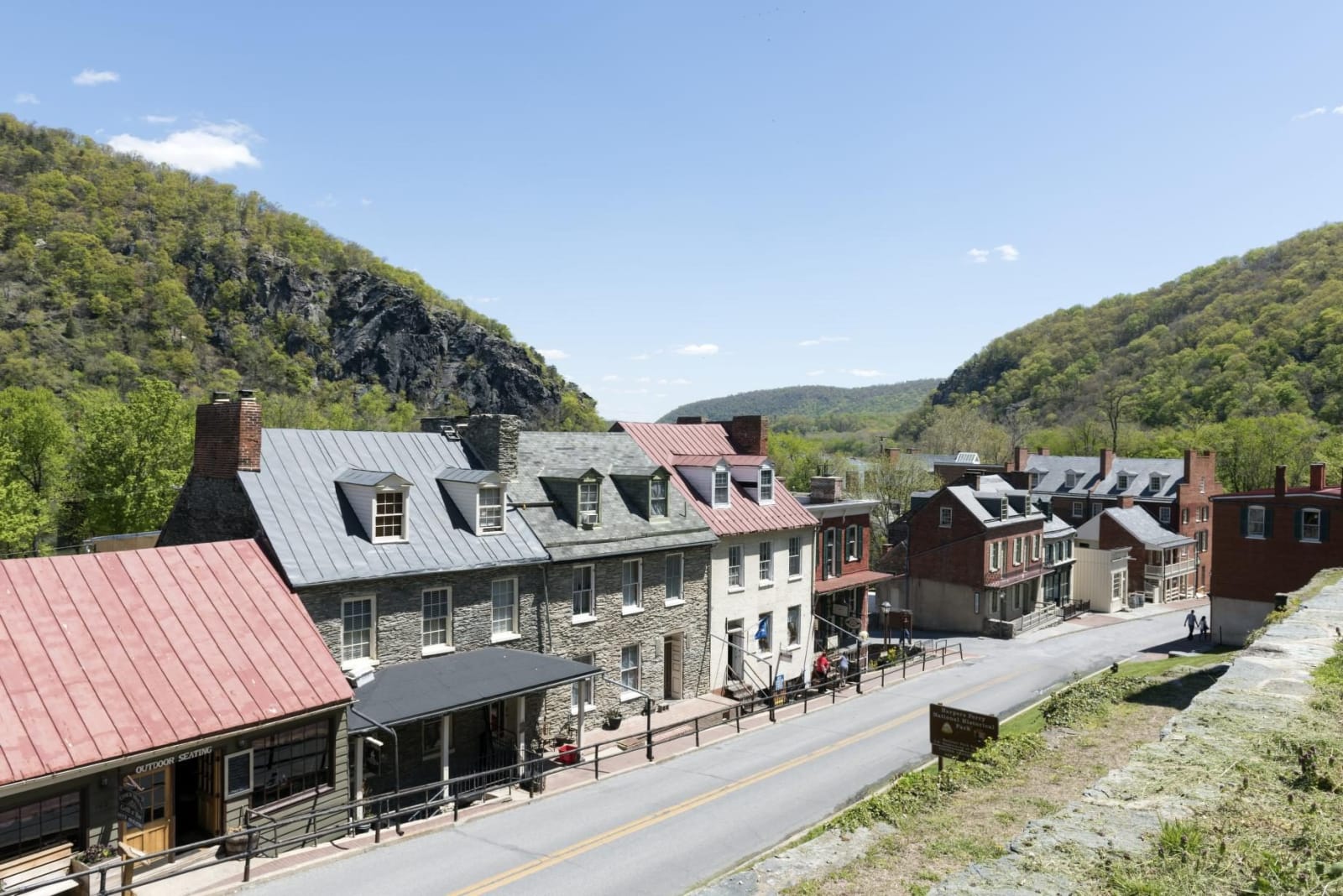
Stone and brick buildings with metal roofs line a street in Lower Town Harpers Ferry, with wooded cliffs rising behind.Carol M. Highsmith / public domain via Library of Congress
🏛️Historical

Harpers Ferry National Historical Park

Part ofHarpers Ferry & the Eastern Panhandle
On this driveThe Washington Heritage Trail: Charles Town, Harpers Ferry, Shepherdstown, Martinsburg and Berkeley Springs

The river town in the Blue Ridge water gap where the Potomac meets the Shenandoah: the old U.S. Armory grounds, Lower Town's museums, Jefferson Rock and the Appalachian Trail.

⏱
Duration
Half a day to a full day.
🎟
Admission
$20 per private vehicle, $15 per motorcycle, $10 per person on foot or bicycle; passes are good for three days (NPS, 2026).
📅
Best Season
Year round, except Thanksgiving, December 25 and January 1. Lower Town museums open daily 9 a.m. to 5 p.m.; trails and lots from 30 minutes before sunrise to 30 minutes after sunset (NPS, 2026).

The Story

Before there was a town, the riverbank here was a road. The Potomac shore between Shepherdstown and this gap in the Blue Ridge carried a warrior path that Haudenosaunee war parties followed south against the Catawba, and Catawba parties followed north, into the first half of the 1700s, while Delaware and Shawnee hunters worked the valley behind it. Robert Harper had settled at the point by the 1740s and ran the ferry that gave the place its name.

In 1799 the United States Armory began making muskets here on the power of the two rivers, and the Lewis and Clark Expedition was outfitted in large part from it. At John Hall's rifle works on the Shenandoah, between 1820 and 1840, interchangeable parts were first made to work in practice. The railroad bridged the Potomac into town in 1837. The town changed hands eight times in the Civil War, the armory burned in 1861 and was never rebuilt, and floods did the rest: on March 19, 1936, the Potomac crested at a record 36.5 feet. Congress made the Lower Town a national monument in 1944.

Park at the visitor center on US 340 and ride the shuttle down, since Lower Town parking is scarce. Museums line Shenandoah Street, and The Point, where the rivers meet, looks into Maryland, Virginia and West Virginia at once. Stone steps climb past St. Peter's Church to Jefferson Rock, the shale slab whose view Thomas Jefferson praised in 1785, and the Appalachian Trail comes through town on its way across the Potomac.

Visitor Info

⏱
Time Needed
Half a day to a full day.
🎟
Admission
$20 per private vehicle, $15 per motorcycle, $10 per person on foot or bicycle; passes are good for three days (NPS, 2026).
📅
Best Season
Year round, except Thanksgiving, December 25 and January 1. Lower Town museums open daily 9 a.m. to 5 p.m.; trails and lots from 30 minutes before sunrise to 30 minutes after sunset (NPS, 2026).
🛣️
Highway
US 340

On the Map

Nearby

The closest stops worth working into your route

historical0.4 mi away
Murphy-Chambers Farm
Fields and earthworks above the Shenandoah where A. P. Hill's 1862 flank attack forced the Harpers Ferry surrender, and where John Brown's Fort stood from 1895 to 1909.
historical1 mi away
Storer College
The Camp Hill campus where Freewill Baptists opened a school for freed people in 1867, the only college in West Virginia open to Black students until 1891, and host of the Niagara Movement in 1906.
historical1.5 mi away
John Brown's Fort
The 1848 armory fire-engine house where John Brown's raiders made their last stand in October 1859, moved four times and now back in Lower Town near The Point.
historical5.8 mi away
Jefferson County Courthouse
The Charles Town courthouse where John Brown was tried for treason in 1859 and Bill Blizzard and the Blair Mountain miners in 1922, a National Historic Landmark since 2023.
historical8.2 mi away
Shepherdstown Historic District
A Potomac river town at Pack Horse Ford, chartered in 1762, where James Rumsey ran his steamboat in 1787 and German Street is still the main road through town.
historical12 mi away
Waterford Historic District
A Quaker mill village of about 1733 that sided with the Union, raised the Loudoun Rangers, and kept its 1867 Black schoolhouse and 1891 church.

Historical markers nearby

Roadside plaques and monuments within a short detour

Marker0.8 mi away
Union Skirmish Line
Harpers Ferry
Marker1 mi away
Storer College Veterans Memorial Gate
Harpers Ferry
Marker1 mi away
Harpers Ferry / John Brown's Fort
Harpers Ferry
Marker1.5 mi away
Lewis and Clark
Harpers Ferry
Marker1.5 mi away
"I just had to speak out" - Pearl Tatten
Harpers Ferry
Marker1.5 mi away
Short-lived Sanctuary
Harpers Ferry