Home / Kansas / The Red Hills & Medicine Lodge / Fromme-Birney Round Barn
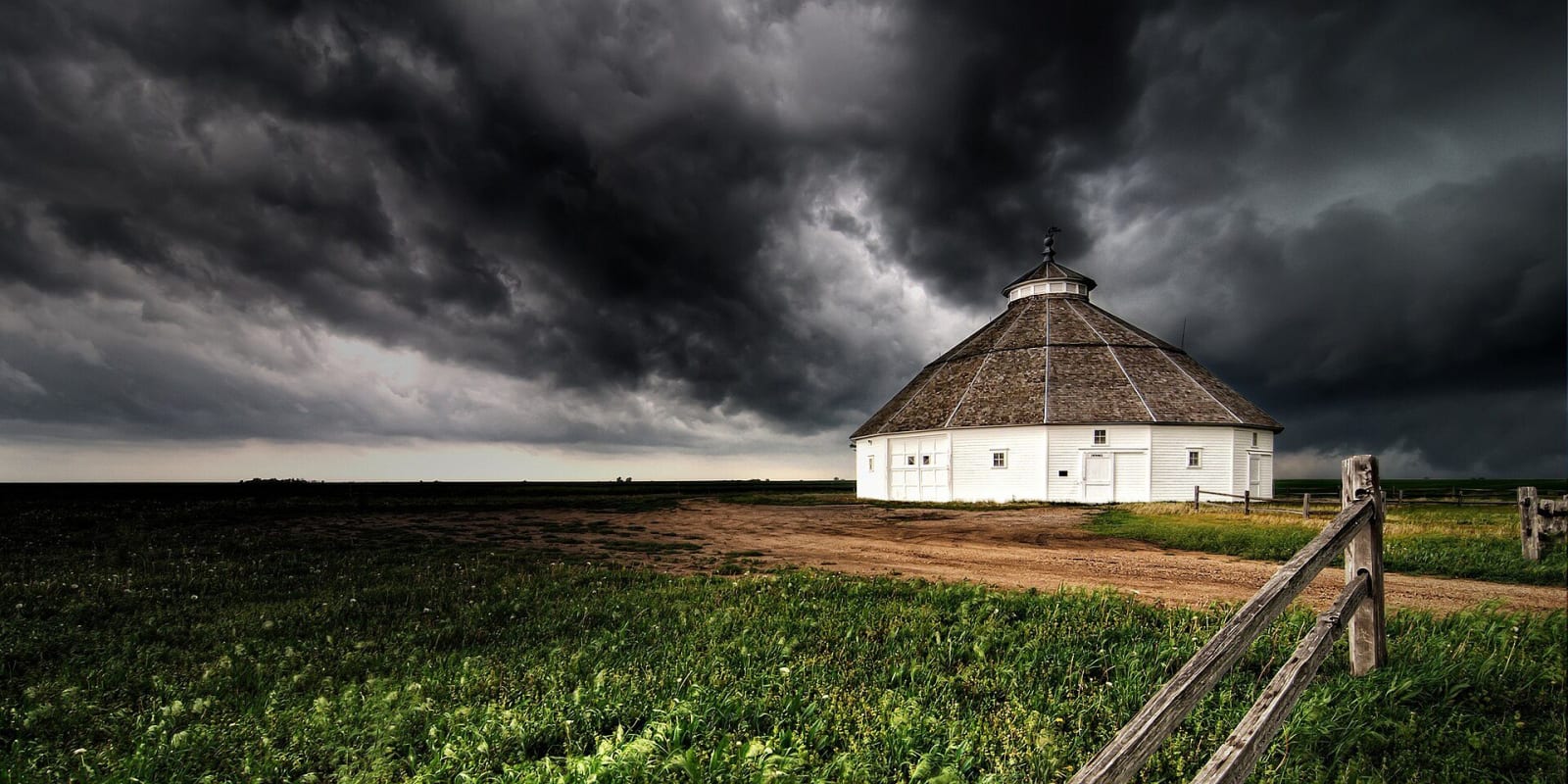
The white sixteen-sided Fromme-Birney barn under dark storm clouds, with green fields and a rail fence in front.Lane Pearman / CC BY 2.0 via Wikimedia Commons
🏗️Architectural

Fromme-Birney Round Barn

Part ofThe Red Hills & Medicine Lodge

A sixteen-sided horse barn of 1912 on the wheat country south of Mullinville, built for 28 draft horses and a French Percheron stallion and outdated by a tractor four years later.

⏱
Duration
Thirty minutes to an hour.
🎟
Admission
No fee stated; donations welcome.
📅
Best Season
Open daily, by the Kansas Sampler Foundation's listing; the last miles are county roads.

The Story

Henry W. Fromme, a German immigrant whose family farmed this ground from 1885, hired a local carpenter, William "Pat" Campbell, in 1912 to build a barn for 28 draft horses and a box stall for a registered Percheron stallion named Bouquet that he had brought from France. Round barns were sold to farmers as stronger against wind, more efficient inside and cheaper in lumber for the volume they held. This one cost about $8,000, several thousand more than an ordinary barn. It is not round but sixteen-sided, 50 feet tall and 70 feet across, under a domed double-pitch roof and a sixteen-sided cupola.

Campbell cut every rafter by hand, working out the angles with a framing square so that 160 two-by-sixes met at the cupola. A sixteen-sided granary stands at the center of the ground floor, circled by a wagon way, with trapezoidal stalls along the outer wall and Bouquet's heavy stall first on the left as you enter. The Frommes bought their first tractor in 1916, and the barn went to hay. Its silhouette later served as a landmark for training bomber navigators in the Second World War.

The Birney family bought the farm in the 1950s. In the 1980s Lawrence Birney gave the barn and an acre to his wife Phyllis for their fifteenth anniversary; she had it listed on the National Register in 1987 and gave it to the Kiowa County Historical Society in 1993, which restored it in 1995. Inside are displays on round barns and farm life in 1912.

Visitor Info

⏱
Time Needed
Thirty minutes to an hour.
🎟
Admission
No fee stated; donations welcome.
📅
Best Season
Open daily, by the Kansas Sampler Foundation's listing; the last miles are county roads.
🛣️
Highway
US-54

On the Map

Nearby

The closest stops worth working into your route

attraction13 mi away
Big Well Museum
Greensburg's hand-dug well of 1887 and 1888, 109 feet deep and 32 across, and the half-ton Brenham pallasite meteorite that was pulled from the rubble of the old museum after the 2007 tornado.
cultural27 mi away
Pioneer-Krier Museum
Clark County's museum on US-160 in Ashland, where a ranch county's household goods share a wing with the aerobatic biplanes of Harold Krier and the records of miler Wes Santee.
historical32 mi away
Boot Hill Museum
Dodge City's museum on the site of the original Boot Hill cemetery, a 1950s replica of Front Street built around a collection one family began gathering in the 1870s.
historical42 mi away
Santa Fe Trail Ruts west of Dodge City
Two miles of wagon swales up to 400 feet wide on a grass hillside above the Arkansas, nine miles west of Dodge City, a National Historic Landmark seen from a pull-off on US-50.
historical48 mi away
Fort Larned National Historic Site
Nine sandstone buildings of 1866-68 on the Pawnee Fork, a post that guarded the Santa Fe Trail and served as the agency where the Plains nations came for the annuities promised at Medicine Lodge.
cultural50 mi away
Santa Fe Trail Center
Pawnee County's museum and archive two miles west of Larned, ten buildings on ten acres that carry the story from the trail years into the town that grew up beside Fort Larned.

Historical markers nearby

Roadside plaques and monuments within a short detour

Marker14 mi away
Cannonball Stage Line Highway
Marker21 mi away
Fort Dodge-Camp Supply Military Road
Marker28 mi away
Fort Dodge
Marker28 mi away
The Road to Santa Fe
Marker29 mi away
Battle of Coon Creek