Home / Kansas / The Red Hills & Medicine Lodge / Big Well Museum
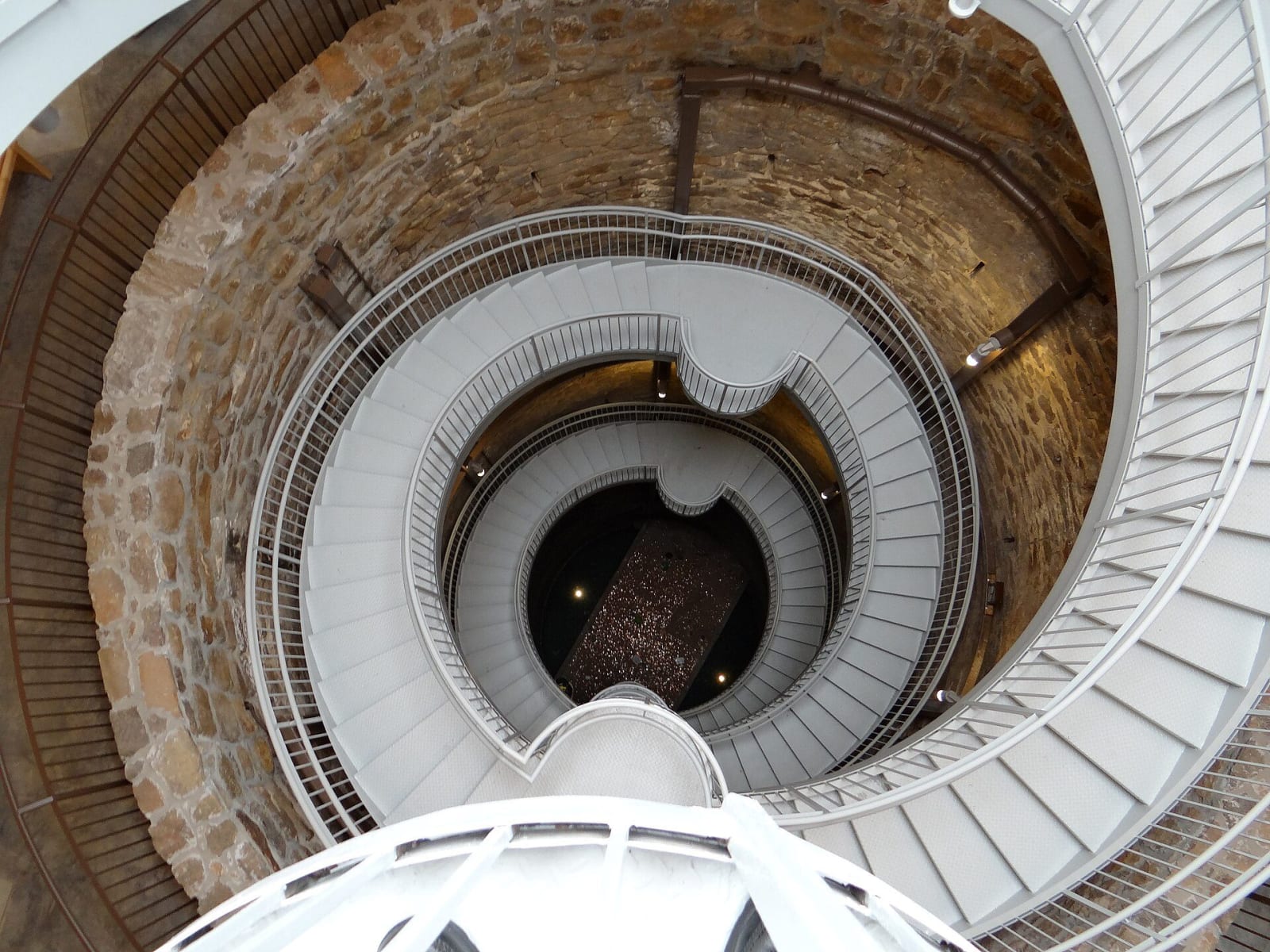
Looking down the stone-lined Big Well in Greensburg, a white spiral staircase winding to the bottom.Michael Adams / CC BY-SA 4.0 via Wikimedia Commons
⭐Attraction

Big Well Museum

Part ofThe Red Hills & Medicine Lodge

Greensburg's hand-dug well of 1887 and 1888, 109 feet deep and 32 across, and the half-ton Brenham pallasite meteorite that was pulled from the rubble of the old museum after the 2007 tornado.

⏱
Duration
One hour.
🎟
Admission
$8 adults; $6 seniors 60 and over and children 5-12; 4 and under free; $4 Kiowa County residents; $25 family pass.
📅
Best Season
Year-round. Monday-Saturday 9 a.m.-6 p.m. and Sunday 1-6 p.m.; in January and February, Monday-Saturday 9 a.m.-5 p.m., closed Sunday.

The Story

The well was dug by hand in 1887 and 1888 for the new town and the Santa Fe railroad, which it served until 1895. Finished, it was 109 feet deep and 32 feet across, and Greensburg drew its water from it until 1932. It survived the tornado of May 4, 2007, and the museum over it opened on May 26, 2012.

The other reason to stop is the Space Wanderer, a pallasite meteorite of about 1,000 pounds, half iron and half stone, with yellowish olivine crystals set in the metal. It is part of the Brenham meteorite. In 1882 Eliza Kimberly began collecting strange heavy rocks on her family's land near Brenham in Kiowa County, and since then scientists and hunters have taken more than three tons of the same meteorite, which broke apart on its way down. H. O. Stockwell of Hutchinson found this mass in 1949 on the Ellis Peck farm east of Greensburg, using a device like a mine detector, and dug it out with hand tools. In 2005 another hunter's detector located a 1,400-pound oriented pallasite in the same county, shaped by the heat of its fall; only two larger meteorites of that type are known.

The Space Wanderer was shown in the old museum beside the well. In 2007 that building fell down around it, and it was dug out of the rubble and moved into the new building. The museum lends free bicycles and maps for a tour of the rebuilt town.

Visitor Info

⏱
Time Needed
One hour.
🎟
Admission
$8 adults; $6 seniors 60 and over and children 5-12; 4 and under free; $4 Kiowa County residents; $25 family pass.
📅
Best Season
Year-round. Monday-Saturday 9 a.m.-6 p.m. and Sunday 1-6 p.m.; in January and February, Monday-Saturday 9 a.m.-5 p.m., closed Sunday.
🛣️
Highway
US-54

On the Map

Nearby

The closest stops worth working into your route

architectural13 mi away
Fromme-Birney Round Barn
A sixteen-sided horse barn of 1912 on the wheat country south of Mullinville, built for 28 draft horses and a French Percheron stallion and outdated by a tractor four years later.
cultural39 mi away
Pioneer-Krier Museum
Clark County's museum on US-160 in Ashland, where a ranch county's household goods share a wing with the aerobatic biplanes of Harold Krier and the records of miler Wes Santee.
historical40 mi away
Fort Larned National Historic Site
Nine sandstone buildings of 1866-68 on the Pawnee Fork, a post that guarded the Santa Fe Trail and served as the agency where the Plains nations came for the annuities promised at Medicine Lodge.
historical41 mi away
Boot Hill Museum
Dodge City's museum on the site of the original Boot Hill cemetery, a 1950s replica of Front Street built around a collection one family began gathering in the 1870s.
cultural41 mi away
Santa Fe Trail Center
Pawnee County's museum and archive two miles west of Larned, ten buildings on ten acres that carry the story from the trail years into the town that grew up beside Fort Larned.
geological42 mi away
Gyp Hills Scenic Drive
A 22-mile loop of mostly gravel road west of Medicine Lodge through red Permian mesas capped with white gypsum, past open range and cedar canyons in a county with more than a hundred cataloged gypsum caves.

Historical markers nearby

Roadside plaques and monuments within a short detour

Marker1.1 mi away
Cannonball Stage Line Highway
Marker23 mi away
Battle of Coon Creek