Home / Texas / The Guadalupe & Davis Mountains / Frijole Ranch
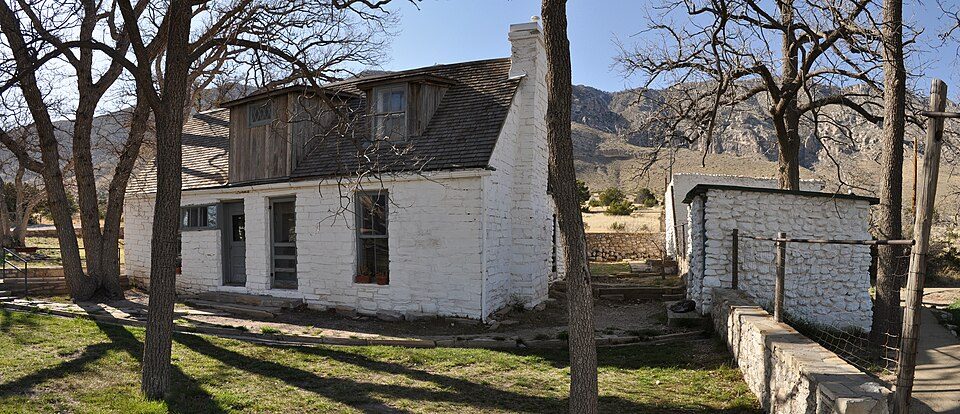
The two-story stone Frijole Ranch house and a small outbuilding shaded by bare trees at the foot of the Guadalupe Mountains.Fredlyfish4 / CC BY-SA 3.0 via Wikimedia Commons
🏛️Historical

Frijole Ranch

Part ofThe Guadalupe & Davis Mountains

An old ranch house at a desert spring below the Guadalupe escarpment, home to the Smith family's orchard and now the park's history museum.

⏱
Duration
One hour, or two with the Smith Spring loop.
🎟
Admission
Included in the park entrance fee of $10 per person.
📅
Best Season
Year round. Dawn and dusk are best for birds and wildlife at the spring.

The Story

Frijole Ranch sits at a spring on the dry lower slopes of the Guadalupe escarpment, a mile and a half northeast of the Pine Springs Visitor Center. Two brothers named Rader built the first permanent ranch house in the area, at a spring, in 1876. The place got its name, for nearby Frijole Peak, after John T. Smith and his family arrived and began developing the ranch in 1906.

The Smiths turned it into a self-sufficient farmstead. They planted an orchard next to the house, walled with stacked stone and watered by ditches from the spring, and grew apples, pears, cherries, peaches, plums and apricots, and even tried lemons and oranges. A post office opened here in 1916 with Nella May Smith as postmistress. In the early 1930s the bus that carried tourists back to Van Horn from Carlsbad Caverns stopped at Frijole so its passengers could eat a family-style supper cooked by Mrs. Smith. The Smiths sold the ranch in the 1940s, and the ranch became the headquarters of the larger Hunter ranch that later went into the park. In 2006 Eagle Scouts replanted part of the orchard.

Today the old ranch house holds the Frijole Ranch History Museum, which follows the people of the Guadalupes from Native Americans to the park. Outside are a one-room schoolhouse, a spring house, and shade trees over a courtyard where the spring water still runs. The museum opens when staff or volunteers are available; the grounds are always open, and the Smith Spring loop trail starts here.

Visitor Info

⏱
Time Needed
One hour, or two with the Smith Spring loop.
🎟
Admission
Included in the park entrance fee of $10 per person.
📅
Best Season
Year round. Dawn and dusk are best for birds and wildlife at the spring.
🛣️
Highway
US-62/180

On the Map

Nearby

The closest stops worth working into your route

historical1.3 mi away
The Pinery Butterfield Station
The stone ruins of the highest station on the Butterfield Overland Mail, used for eleven months from 1858 until the line moved south to the forts in 1859.
natural1.5 mi away
Guadalupe Mountains National Park
The four highest peaks in Texas, Guadalupe Peak at 8,751 feet among them, on a ranch that oilmen and ranchers sold or gave to make a park in 1972.
natural5.6 mi away
McKittrick Canyon
A spring-fed canyon of maples and oaks inside the Guadalupes, with the stone cabin an oil geologist built in 1931-32 and gave, with his land, toward the park.
geological28 mi away
Carlsbad Caverns National Park
The way into the cave has changed four times: a guano miner's bucket, a wooden staircase, a 750-foot elevator, and now a timed ticket and a switchback trail down the natural entrance.
natural49 mi away
Living Desert Zoo and Gardens State Park
A zoo and garden of the Chihuahuan Desert on the Ocotillo Hills above Carlsbad, whose animals are injured or orphaned wildlife that cannot go back to the wild.
architectural60 mi away
Hotel El Capitan
Henry Trost's Spanish Revival hotel of 1930 in Van Horn, named for the cliff at the end of the Guadalupe Mountains, restored and back in business as an inn.

Historical markers nearby

Roadside plaques and monuments within a short detour

Marker1.4 mi away
Ruins of "The Pinery" or "Pine Spring" Stage Stand
Pine Springs
Marker4.5 mi away
Guadalupe Peak
Pine Springs
Marker24 mi away
Guadalupe Mountains
Whites City, New Mexico
Marker26 mi away
Carlsbad Caverns National Park
Whites City, New Mexico