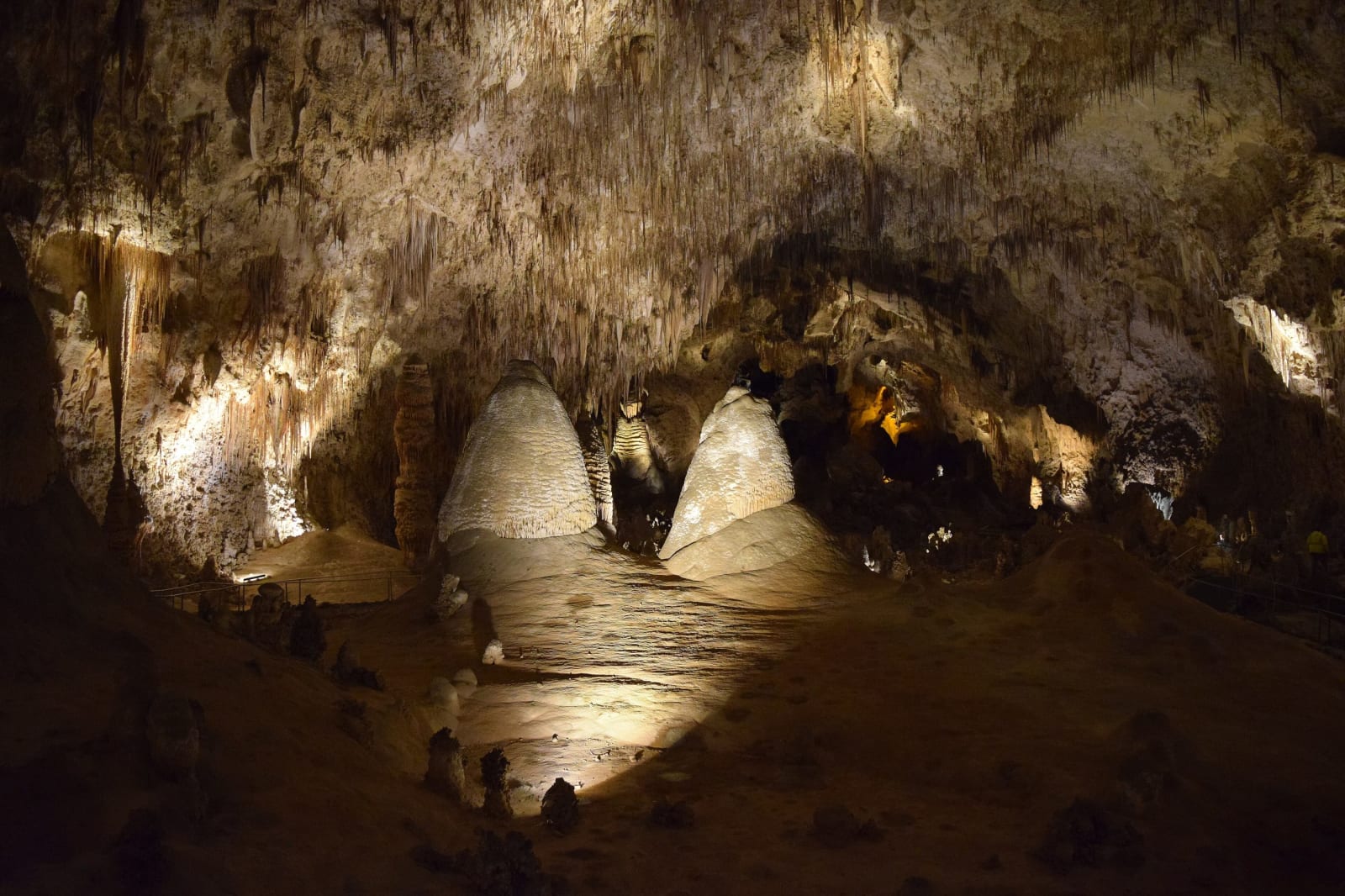
 National Park Service / public domain via Wikimedia Commons
The Story
Before Carlsbad Cavern was a park it was a mine. From 1903 men dug out the bat guano piled deep inside the entrance and hauled it up to sell as fertilizer, and Jim White, the young cowhand who explored the passages beyond, worked for years as a foreman in the guano operation. The first visitors he guided went down the way the guano came up, two at a time in a bucket lowered about 170 feet down a shaft.
Few people believed White's descriptions until Ray V. Davis photographed the cave from 1915. His pictures were shown in Carlsbad and reached the New York Times in 1923, the year the cave became a national monument. A wooden staircase through the natural entrance replaced the bucket in 1925, and in January 1932 an elevator began running 750 feet down a shaft blasted from the visitor center to the Big Room. Larger elevators were added in 1955, and since 1972 visitors have been free to walk the whole way.
Today the entrance fee is paid at the visitor center, and a separate timed-entry reservation sets the hour of going in. The Natural Entrance Trail switchbacks about a mile and a quarter and 750 feet down from the cave mouth, steep and often wet, and joins the Big Room Trail, another mile and a quarter around a chamber of 8.2 acres, the largest readily accessible cave room in North America. Most people walk down and ride the elevator back up; the Big Room is reached by wheelchair only by elevator. Ranger-led tours deeper into the cave run some years and not others.
To keep white-nose syndrome, a fungus that has killed bats by the million elsewhere, out of the cave, the park asks visitors not to bring in shoes, clothing or gear that have been in any other cave.
Visitor Info
On the Map
Nearby
The closest stops worth working into your route