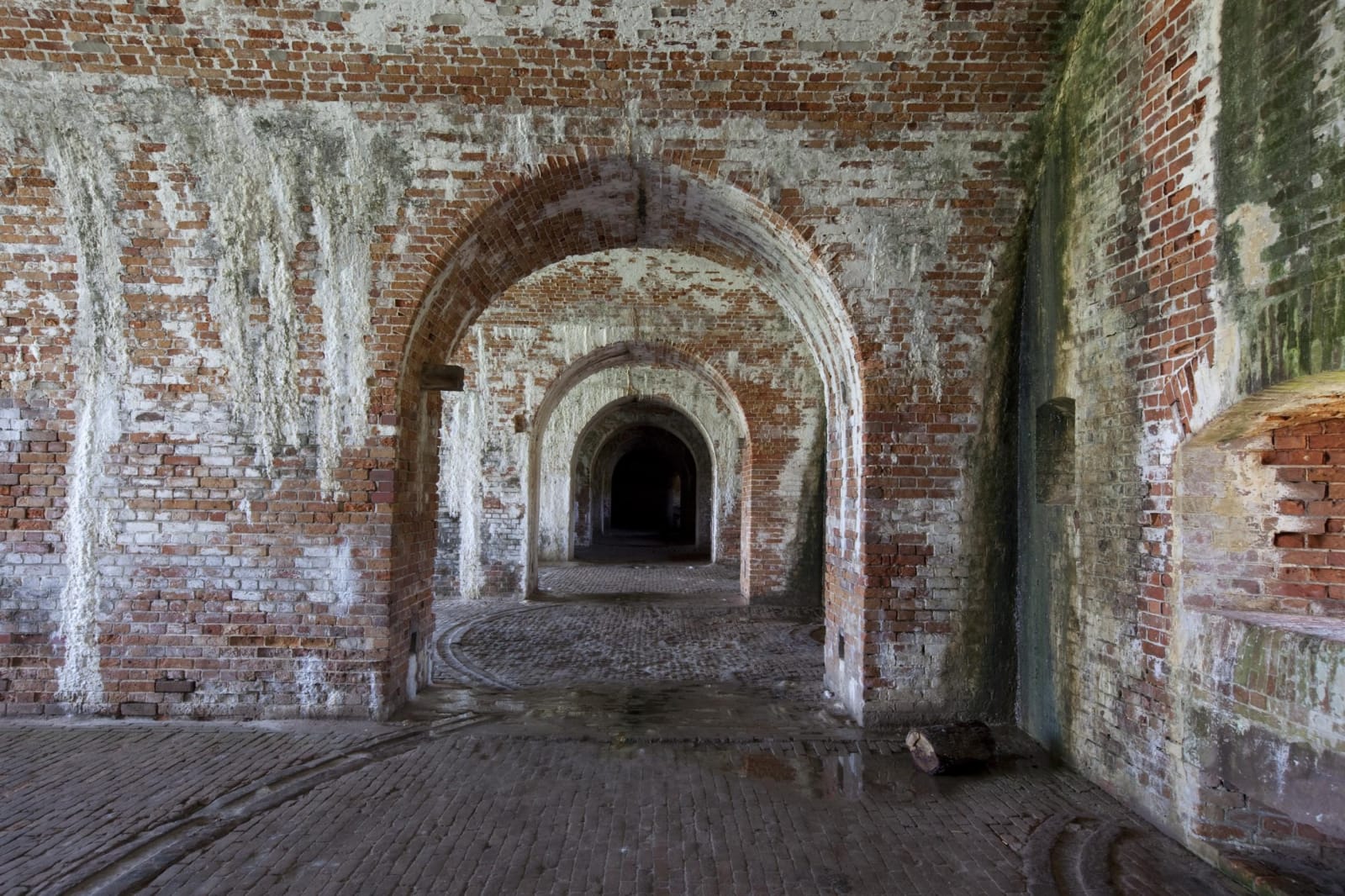
 Carol M. Highsmith / public domain via Library of Congress
The Story
Mobile Point has been fortified in six conflicts. Bernardo de Galvez put a Spanish battery here in 1778, and the sand-and-log Fort Bowyer fell to the British in February 1815. The brick fort that replaced it was designed by Simon Bernard, an engineer who had served Napoleon, and built between 1819 and 1834; after two civilian contractors died, the Army Corps of Engineers finished the job using enslaved laborers. The pentagon of five bastions was named for the Revolutionary general Daniel Morgan.
Alabama troops seized the fort in January 1861. On the morning of August 5, 1864, its guns opened on David Farragut's fleet as it ran for the bay. The monitor Tecumseh struck a mine and sank with 94 men, and Farragut is remembered for damning the torpedoes and pressing on past the fort. The Confederate ironclad Tennessee surrendered that morning, but Fort Morgan held until federal guns set the citadel on fire on August 22; Gen. Richard Page gave it up the next day. United States Colored Troops were among the soldiers who garrisoned it until 1868.
Walk the casemates, three of them furnished as soldiers' and laundresses' rooms, and climb the walls for the Sand Island lighthouse to the south. The concrete batteries of 1895 to 1908 sit inside and around the old fort, and the ten-sided museum outside holds the Sand Island lens and finds from the siege. The Mobile Bay ferry runs from here to Dauphin Island and Fort Gaines.
Visitor Info
On the Map
Nearby
The closest stops worth working into your route
Historical markers nearby
Roadside plaques and monuments within a short detour