Stand on Main Street in Ephraim and read the storefront at 96 North. Painted across the white oolite are a beehive, the words "Holiness to the Lord," and the name of a cooperative store. It takes a moment to register how strange this is. Scripture over a shop door. A store branded like a temple. The lintel is the most compact monument in Utah to a decade when the territory's leaders looked at American capitalism — arriving by rail, at speed — and decided to opt out.
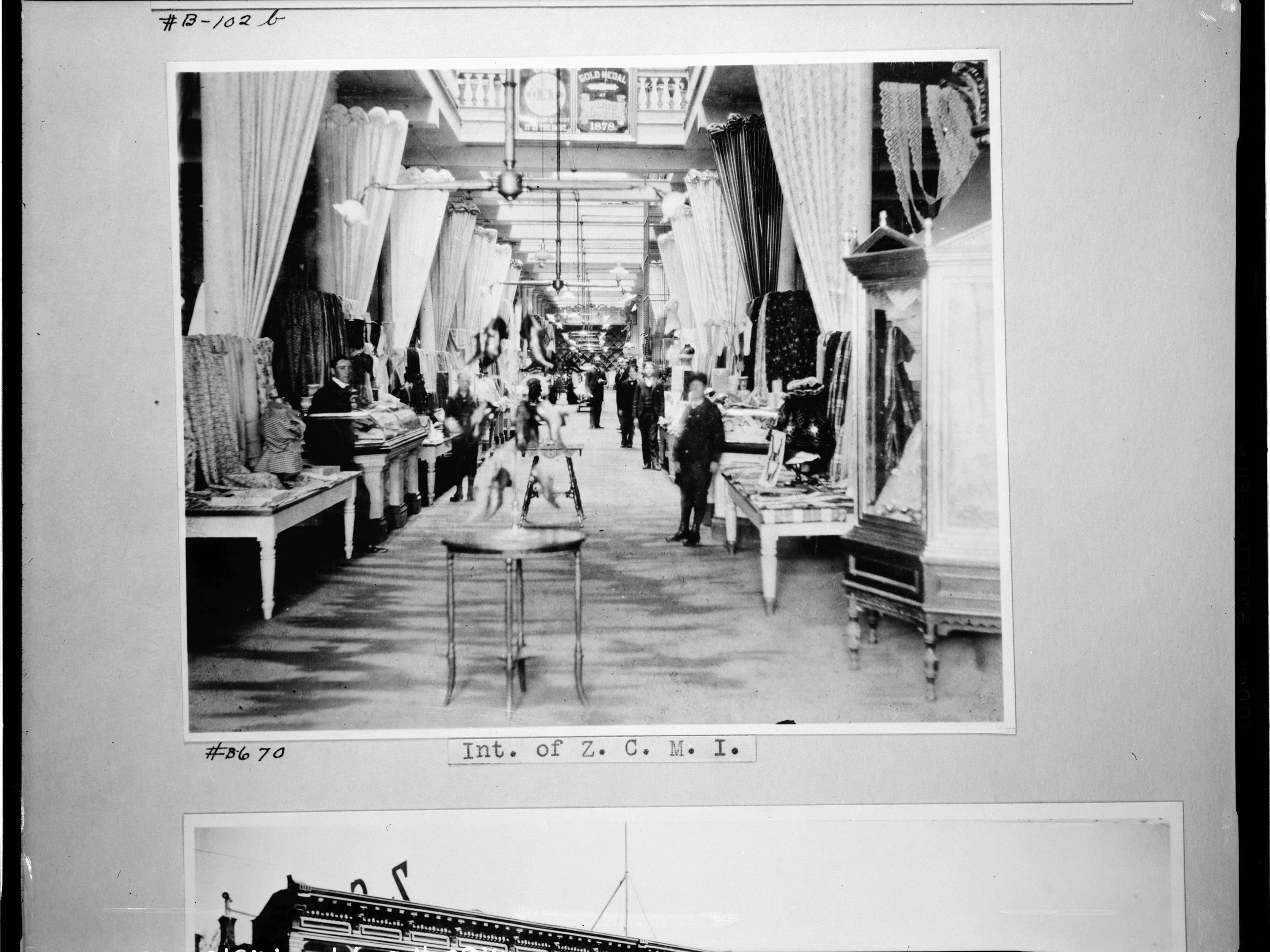
The threat had a date: May 10, 1869, when the golden spike went down at Promontory Summit and Utah was suddenly connected to everything Brigham Young had spent twenty years keeping at arm's length. He was not afraid of the trains. He was afraid of what rode in on them — outside merchants, outside credit, outside prices — and of his people becoming customers in someone else's economy. His answer came in stages. In 1865 he urged the saints to trade only with one another. In October 1868 the church organized Zion's Cooperative Mercantile Institution in Salt Lake City — ZCMI, often called America's first department store — as the parent wholesaler. And over the next ten years more than a hundred and twenty town cooperatives opened across the territory, most carrying the parent store's inscription over the door, so that a traveler could ride from Logan to St. George and never hand a dollar to a merchant the saints called a gentile.
Ephraim raised its co-op in 1871 and finished it in 1872, quarried from the cream-colored oolite that is Sanpete's signature stone, the front faced in fine-dressed blocks and the sides left coarse — a building meant to be read from the street. By 1872 the town had built a co-op store and a tabernacle a block apart on opposite sides of Main Street, and the pairing was the whole philosophy in miniature: commerce and worship as wings of the same project. Upstairs, a hall held the town's dances, theater, and Relief Society meetings. Downstairs, the shelves carried ZCMI goods and the ledgers kept Ephraim's money in Ephraim.
Then the Panic of 1873 crashed credit across the country, and Young — already under siege from federal prosecutors, briefly arrested in 1871 — decided cooperation had not gone far enough. In February 1874, at St. George, he organized the first United Order of Enoch, asking members to consecrate property and labor to a common fund and withdraw from the open market altogether. It was one of the most radical economic experiments attempted in nineteenth-century America, and it swept the territory in a single season — orders organized town after town, each one different, because Young insisted that no one be coerced and left every bishop to decide how far his congregation would go. Sanpete joined the wave: down the valley, the settlement of Mayfield was founded in 1874 as a United Order branch, and Ephraim's store became a United Order store. Its working name — Ephraim U.O. Mercantile Institution, the initials standing for United Order — was the experiment's signature, and the National Register still lists the building under it.
The collapse came nearly as fast as the launch. Many orders never got past electing officers; most that ran were finished within a season or two; by Young's death in 1877 the movement was effectively over. Historians have rendered the verdict gently — the habits of an acquisitive society proved too strong to break, and individualism won. The United Order survives in Latter-day Saint thought as a future ideal, and its principles resurfaced in the church's Welfare Plan in 1936, but as a working economy it lasted about as long as a Sanpete summer.
The building is what makes Ephraim's chapter worth telling, because the building refused to follow the experiment down. In 1888 the upper hall took in the first classes of the Sanpete Stake Academy, the school that became Snow College, so the room built for a communal economy incubated the town's future instead. In 1890 the railroad finally reached the valley, and the irony was total: the institution founded to resist the rails now stocked its shelves from them. The ground floor sold farm implements, then fixed cars, then milled flour as part of the Ephraim Roller Mill, a new addition joining it to the 1876 Relief Society granary next door — an arrangement that ground on into the 1950s. Then nothing. The mill closed, the valley's traffic drifted to the interstate, and for decades the finest storefront in town stood vacant.
The rescue came in 1989 and 1990, when the building was restored, and what moved in afterward completes the arc so neatly it reads like fiction. The granary became Granary Arts, a contemporary art center. The city took ownership of the block — co-op, granary, and the cabin of the Danish pioneer painter C.C.A. Christensen — and named it Ephraim Square. And the ground floor of the Ephraim Co-op became, of all things, a cooperative: an artists' co-op run by the volunteer Sanpete Trade Association, local makers pooling a storefront to keep their work and its proceeds in the valley. Nobody consecrates property. Nobody is seceding from anything. But a century and a half after Brigham Young tried to build an economy where neighbors traded only with neighbors, the idea is quietly working in the one building that still wears its name — at the smallest scale, which may have been the only scale it ever really fit. It waits on the US-89 Heritage Highway, half a block north of the center of town, with the old promise still over the door.