Home / Alabama / Muscle Shoals & Northwest Alabama / Colbert Ferry
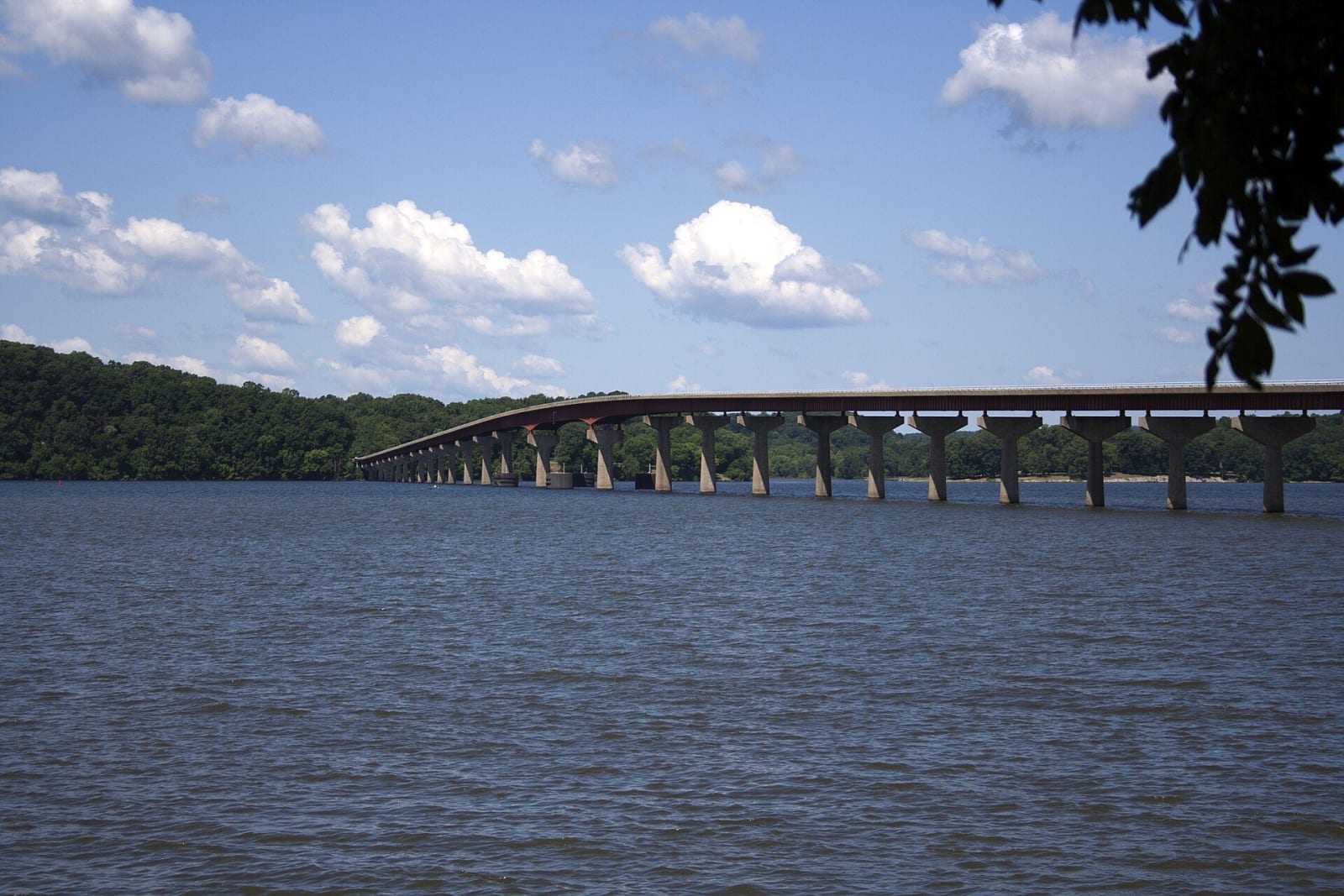
The Natchez Trace Parkway's long John Coffee Memorial Bridge crossing the wide Tennessee River at Colbert Ferry, with wooded shores beyond.NPS / public domain
🏛️Historical

Colbert Ferry

Part ofMuscle Shoals & Northwest Alabama

George Colbert's Tennessee River ferry and stand on the Natchez Trace, run by a Chickasaw businessman and worked by enslaved people, with Chickasaw Nation exhibits at the house site.

⏱
Duration
Thirty minutes to an hour.
🎟
Admission
Free.
📅
Best Season
Year round; spring and fall for the walk to the bluff.

The Story

At milepost 327.3 of the Natchez Trace Parkway, just south of the bridge over the Tennessee River, a short path climbs a ridge to where George Colbert's house stood. Colbert had a Scottish father and a Chickasaw mother, and he used both languages and both worlds to build a web of businesses in the Chickasaw Nation. By treaty right he ran the ferry here from 1800 to 1819, carrying Trace traffic across the river near the mouth of Bear Creek, and his stand beside it gave travelers between Nashville and Natchez food and a bed. A long-lived story says he charged Andrew Jackson $75,000 to ferry his army; it is told more often than it is proven.

The Colberts were one of many slaveholding planter families in the Chickasaw Nation, and the stand was also a plantation worked by enslaved African Americans. A traveler, Jacob Young, wrote that George and his brother had a large farm with about forty enslaved people working it. When Colbert went west under removal, he took the people he enslaved with him. By then steamboats and Jackson's Military Road, finished in 1820, had drawn the traffic away, and by 1830 the old Trace was mostly abandoned.

In April 2017 the Park Service, the Chickasaw Nation and the Natchez Trace Parkway Association unveiled wayside exhibits at the house site. From the ridge, a walk of about twenty minutes along the Old Trace reaches a bluff over the river. Levi Colbert's Buzzard Roost stand is remembered with an exhibit farther south on the parkway.

Visitor Info

⏱
Time Needed
Thirty minutes to an hour.
🎟
Admission
Free.
📅
Best Season
Year round; spring and fall for the walk to the bluff.
🛣️
Highway
Natchez Trace Parkway, milepost 327.3

On the Map

Nearby

The closest stops worth working into your route

cultural10 mi away
Wichahpi Commemorative Stone Wall
Tom Hendrix's dry-stacked wall near the Natchez Trace, raised by hand over three decades for a Yuchi great-great-grandmother who walked home from Indian Territory.
historical14 mi away
Tuscumbia Landing
The river landing at the mouth of Spring Creek where Cherokee and Creek removal parties left the rail cars for steamboats, now a quiet park on the Trail of Tears National Historic Trail.
cultural15 mi away
W. C. Handy Birthplace, Museum and Library
The log cabin where W. C. Handy, the Father of the Blues, was born in 1873, rebuilt in Florence beside a museum holding the piano he wrote St. Louis Blues on.
historical15 mi away
Ivy Green, Birthplace of Helen Keller
The 1820 Keller family house in Tuscumbia, with the cottage where Helen Keller was born and the pump where Anne Sullivan spelled water into her hand in 1887.
historical16 mi away
Florence Indian Mound and Museum
The largest Native earthwork in the Tennessee Valley, a Middle Woodland platform 43 feet high on the riverbank in Florence, with a city museum at its foot.
cultural16 mi away
Muscle Shoals Sound Studio
The plain building at 3614 Jackson Highway where the Swampers set up on their own in 1969 and recorded the Rolling Stones, the Staple Singers and Lynyrd Skynyrd.

Historical markers nearby

Roadside plaques and monuments within a short detour

Marker4.2 mi away
Chickasaw Indian Agency
Cherokee
Marker7.8 mi away
West End High School / "Trojans"
Oakland
Marker8.5 mi away
Trail of Tears
Waterloo
Marker12 mi away
Forks of Cypress
Florence
Marker14 mi away
Eastport
Iuka, Mississippi
Marker14 mi away
Unknown Soldiers C.S.A.
Iuka, Mississippi