Home / Alabama / Tuscaloosa & West Alabama / Pickens County Courthouse
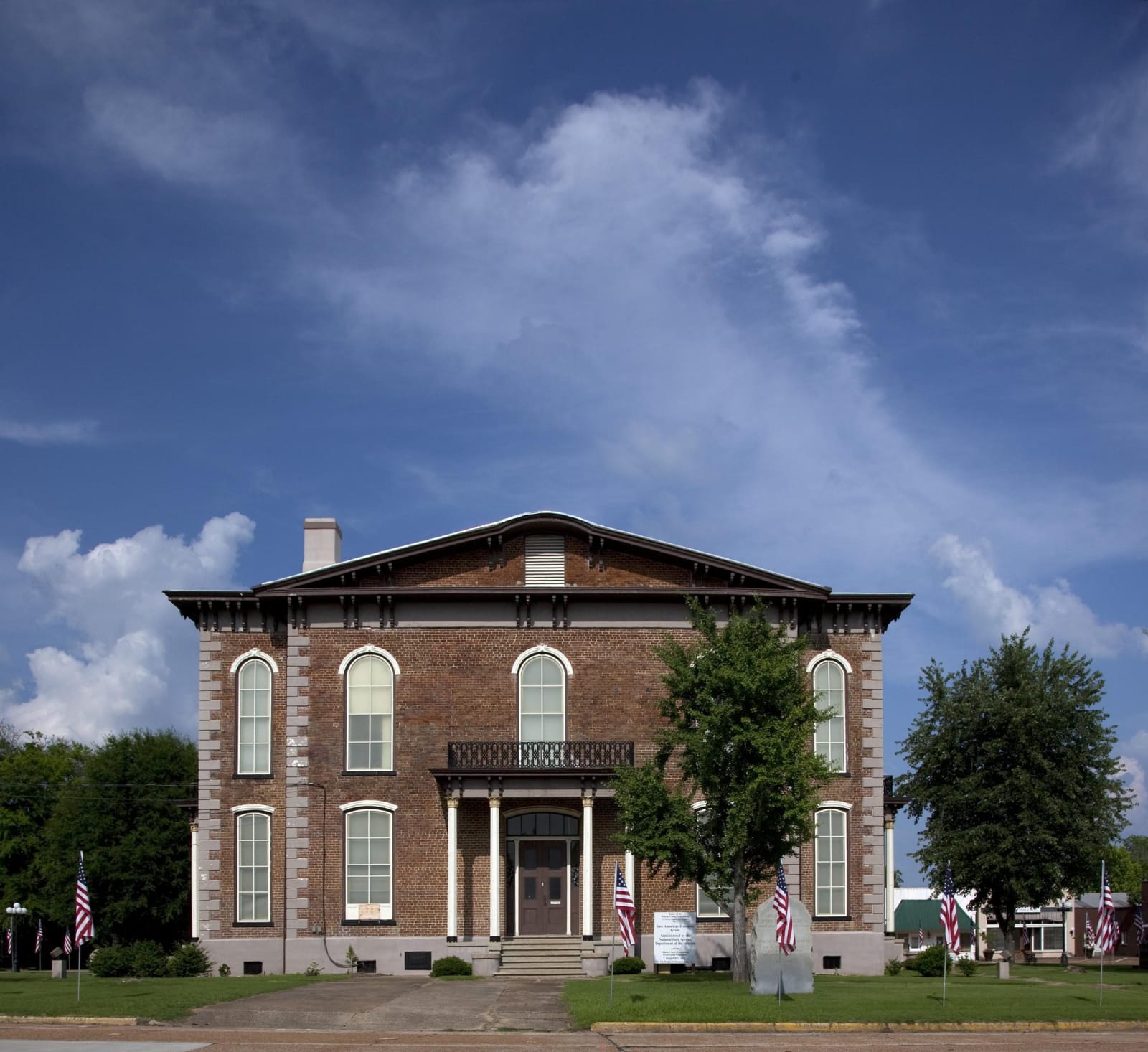
A three-story red-brick courthouse with arched windows, a small columned entrance porch and flags along the front walk.Carol M. Highsmith / public domain via Library of Congress
🏛️Historical

Pickens County Courthouse

Part ofTuscaloosa & West Alabama

Carrollton's 1877 courthouse, known for the 'face in the window' legend of Henry Wells, a freedman who died after his arrest in 1878.

⏱
Duration
Fifteen to thirty minutes.
🎟
Admission
Free; viewed from the street.
📅
Best Season
Year round.

The Story

Carrollton was laid out in 1830 on Choctaw land given over for a county seat. Union troops under John Croxton burned its first courthouse on April 5, 1865, and the second burned on November 16, 1876. The courthouse on the square went up in 1877 and 1878 and served until 1994.

People come to look at one pane in a north garret window, where a faint shape resembling a face shows from the street. The legend holds that it is Henry Wells, a freedman locked in the garret on a charge of burning the old courthouse, whose face was burned into the glass by lightning as a mob gathered outside. The record is harder. Wells was arrested in January 1878 after another man accused him of the fire; he was shot twice as he tried to run, confessed, likely under coercion, and died of his wounds days later, apparently before the garret windows were even installed. The legend grew in a county with one of the highest lynching counts in Alabama: at least fifteen Black people were lynched here between 1886 and 1917. On September 14, 1893, a white mob stormed the jail in Carrollton and shot to death Paul Archer, Will Archer, Emma Fair, Ed Guyton and Paul Hill in their cells while they awaited investigation on an accusation of burning a gin house. Two weeks earlier Joe Floyd had been lynched in the same town.

A sign points to the pane, and binoculars across the street bring it closer. The town stages a Face in the Window festival each fall.

Visitor Info

⏱
Time Needed
Fifteen to thirty minutes.
🎟
Admission
Free; viewed from the street.
📅
Best Season
Year round.
🛣️
Highway
AL 17 / AL 86

On the Map

Nearby

The closest stops worth working into your route

historical9.8 mi away
Aliceville Museum
Downtown Aliceville's museum of Camp Aliceville, Alabama's largest World War II prisoner-of-war camp, with a 1948 Coca-Cola bottling plant intact next door.
natural25 mi away
Lake Lurleen State Park
A 1,625-acre state park northwest of Tuscaloosa around a 250-acre lake, with 23 miles of shoreline and woodland trail for hikers and mountain bikers.
cultural25 mi away
Tennessee Williams Welcome Center
The 1875 Episcopal rectory where Tennessee Williams was born in 1911, moved to Main Street in the 1990s and now Columbus's welcome center and a National Literary Landmark.
historical30 mi away
Capitol Park
The ruins of Alabama's 1829 capitol in Tuscaloosa, built with enslaved labor, where the legislature sat from 1826 until 1846, and first stop on the Tuscaloosa Civil Rights Trail.
historical31 mi away
First African Baptist Church
The 1907 Tuscaloosa church where 600 marchers set out for the courthouse on June 9, 1964, and were driven back with fire hoses and tear gas on Bloody Tuesday.
architectural32 mi away
Waverley Mansion
A National Historic Landmark mansion above the Tombigbee River, home of a plantation family that enslaved more than a hundred people, left empty for half a century before a family restored it.

Historical markers nearby

Roadside plaques and monuments within a short detour

Marker8.8 mi away
Aliceville First Baptist Church
Aliceville
Marker9.5 mi away
Historic Pickensville Rosenwald School
Pickensville
Marker12 mi away
The U.S. Snagboat Montgomery
Pickensville
Marker20 mi away
Samuel Harding "Sam" Hairston
Plum Grove, Mississippi
Marker21 mi away
William Barksdale
Columbus, Mississippi
Marker24 mi away
Sandfield Cemetery
Columbus, Mississippi