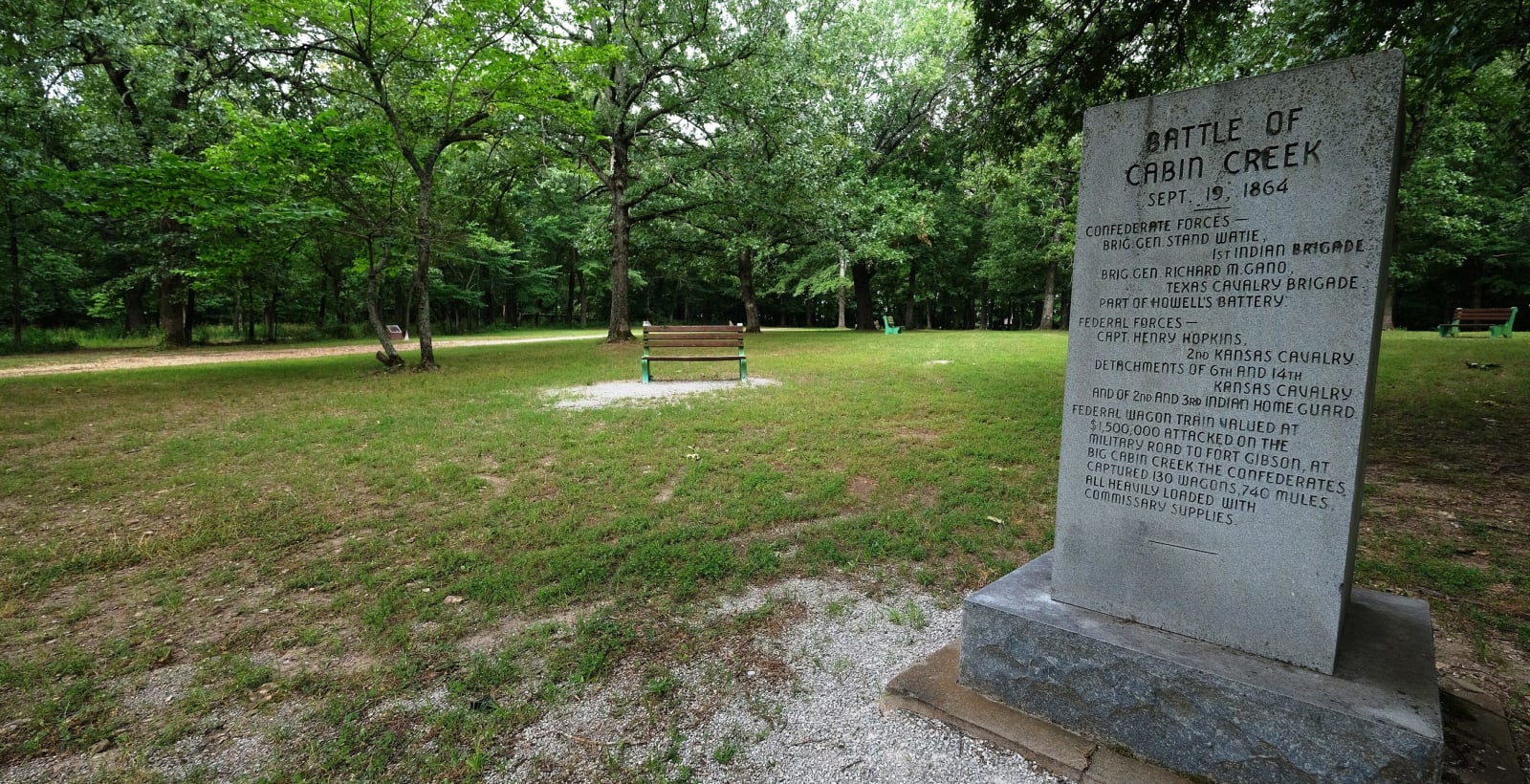
 OKJaguar / CC BY-SA 4.0 via Wikimedia Commons
The Story
The Texas Road crossed Cabin Creek here, on the ranch of Joseph Lynch Martin, a prominent Cherokee known as Greenbriar Joe, and in the Civil War the ford was the weak point in a long supply line. Wagon trains carried what the Federal garrison at Fort Gibson needed south from Fort Scott, Kansas, and the Confederates under Stand Watie twice tried to take one here.
On July 1, 1863, Colonel James Williams arrived with a train escorted by the 3rd Indian Home Guard, the 1st Kansas Colored Infantry and units from Colorado, Kansas and Wisconsin. Watie had 1,600 to 1,800 men dug into the brush on either side of the crossing, waiting for 1,500 more under General William Cabell who were held up by high water on the Grand River. With the creek shoulder-deep, Williams waited a day. On July 2, after a half-hour artillery barrage, the Home Guard failed to cross, the 9th Kansas Cavalry charged under cover of the 1st Kansas Colored's fire, and Williams led his own regiment across behind them. The train reached Fort Gibson.
The second battle went the other way. On the night of September 19, 1864, Generals Richard Gano and Stand Watie attacked the Federal camp, routed it, and took 130 wagons and 740 mules with supplies valued at about $1 million, the last major engagement in Indian Territory.
The Oklahoma Historical Society keeps the 96.5-acre site, ten acres given in 1961 and 86.5 bought in 2012. A circle drive leads to the monuments and signs.
Visitor Info
On the Map
Nearby
The closest stops worth working into your route
Historical markers nearby
Roadside plaques and monuments within a short detour