Home / Alabama / Birmingham & Central Alabama / Brierfield Ironworks Historical State Park
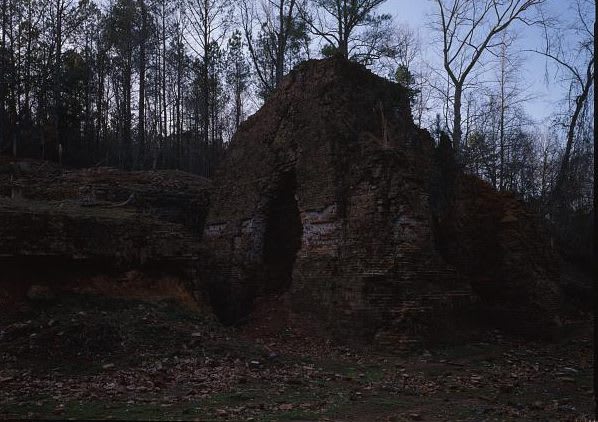
The crumbling brick ruin of a blast furnace among bare winter trees.Jet Lowe, Historic American Engineering Record / public domain via Library of Congress
🏭Industrial

Brierfield Ironworks Historical State Park

Part ofBirmingham & Central Alabama

Ruins of the only ironworks the Confederacy owned outright, bought in 1863 with nine enslaved people and burned by Wilson's raiders in 1865.

⏱
Duration
One to two hours; overnight in the cabins or campground.
🎟
Admission
Check with the Alabama Historic Ironworks Commission for current fees.
📅
Best Season
Fall through spring.

The Story

In 1862 the Bibb County Iron Company, led by Caswell Huckabee, built a 36-foot brick blast furnace here, between Centreville and Montevallo, and contracted to sell the Confederacy a thousand tons of pig iron a year and to build a rolling mill for plate armor. In 1863 the Confederate government told the company to sell it all its iron, sell or lease it the works, or have them seized. The company sold for $600,000, and the sale took in the furnace, oxen, mules, carts, tools and nine enslaved people. Brierfield became the only ironworks the Confederacy owned.

Confederate officials finished the rolling mill, added a 40-foot furnace and ran a rail line in. The iron went to the naval foundry at Selma to be cast into cannon and armor plate for a government fighting to keep people enslaved. On March 31, 1865, Union troops under James H. Wilson destroyed the works. Josiah Gorgas, the Confederacy's former chief of ordnance, tried to restart them after the war; they ran off and on until 1894, too old to compete.

Bibb County opened the 45-acre park in 1978, and the state's Alabama Historic Ironworks Commission runs it now. The two furnace ruins stand under big metal canopies, and around them are buildings moved in from the county: Mulberry Church, the Ashby post office, Adelaide Mahan's studio, log cabins and a farmhouse. The superintendent's house is the welcome center, and there are campsites, cabins and a pool.

Visitor Info

⏱
Time Needed
One to two hours; overnight in the cabins or campground.
🎟
Admission
Check with the Alabama Historic Ironworks Commission for current fees.
📅
Best Season
Fall through spring.
🛣️
Highway
Furnace Parkway

On the Map

Nearby

The closest stops worth working into your route

natural7.4 mi away
Cahaba River National Wildlife Refuge
A protected stretch of Alabama's longest free-flowing river near West Blocton, with the largest known stand of Cahaba lilies.
industrial16 mi away
Tannehill Ironworks Historical State Park
Three sandstone blast furnaces in Roupes Valley, worked mostly by enslaved men and burned in 1865, with the Iron & Steel Museum of Alabama and a village of old cabins.
natural23 mi away
Oak Mountain State Park
Alabama's largest state park, just south of Birmingham: ridges, lakes, Peavine Falls, 70 miles of trail and a wildlife center.
historical32 mi away
Rickwood Field
The nation's oldest operating professional ballpark, opened in 1910, home of the Birmingham Barons and the Negro League Birmingham Black Barons.
historical32 mi away
Vulcan Park and Museum
The 56-foot cast-iron Vulcan, made for the 1904 World's Fair from Red Mountain ore, on a 1930s WPA tower above Birmingham.
cultural34 mi away
Birmingham Civil Rights Institute
The museum and archive across from Sixteenth Street Baptist Church, beside Kelly Ingram Park, where police turned hoses and dogs on marching children in May 1963.

Historical markers nearby

Roadside plaques and monuments within a short detour

Marker5.7 mi away
Alabama Coal Mining
Montevallo
Marker6.1 mi away
Prentice High School
Montevallo
Marker6.4 mi away
Ward Chapel A.M.E. Church
Montevallo
Marker6.8 mi away
University of Montevallo National Historic District
Montevallo
Marker21 mi away
Canaan Baptist Church
Bessemer
Marker22 mi away
Shelby County Courthouse, 1854-1908
Columbiana