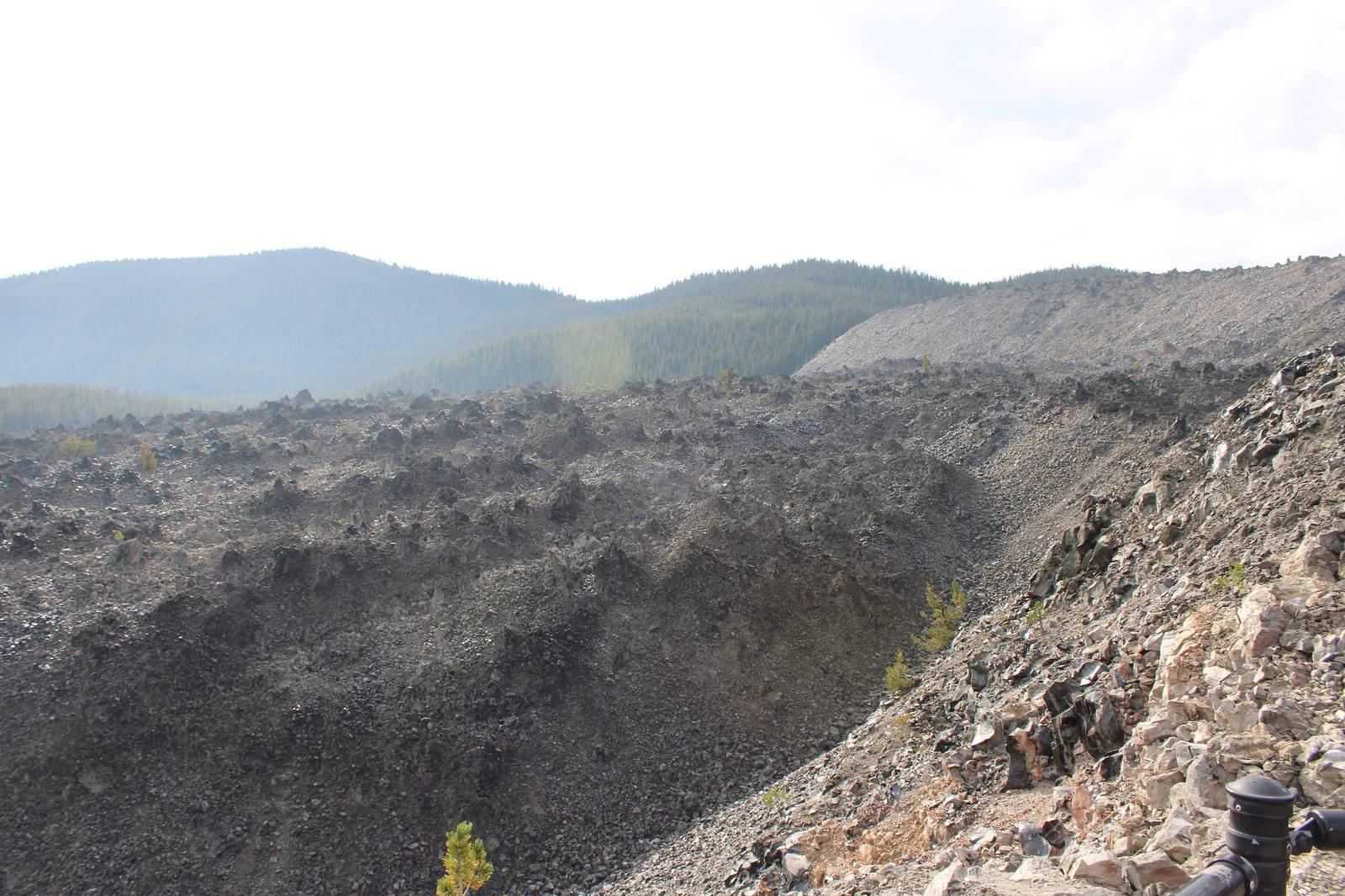
 Chris Light / CC BY-SA 4.0 via Wikimedia Commons
The Story
About 1,300 years ago a vent opened on the south side of the Newberry caldera. The eruption began with explosions that threw ash as far east as Idaho, and then a thick, silica-rich rhyolite lava oozed out and spread across some seven hundred acres before it stopped. Lava that rich in silica, cooling that fast, does not have time to crystallize; it freezes as glass. Where gas was trapped, the glass foamed into gray pumice, and the flow is a jumble of both, black obsidian blocks and pale froth, still mostly bare. It is the youngest lava flow in Oregon.
People came to the caldera for its glass long before it was a monument. Native people were living and hunting here as early as ten thousand years ago, and the obsidian flows drew them to the caldera floor to quarry stone that fractures to a razor edge, for knives, spear points and arrowheads. In the 1960s NASA brought Apollo astronauts to the Newberry country to learn volcanic rock before they went to the moon. Today taking even a chip of obsidian is forbidden.
From the trailhead off the road between Paulina and East lakes, a steep staircase climbs onto the flow, and an interpretive loop of about seven-tenths of a mile winds across the top, with views over the caldera to Paulina Peak and west to the Three Sisters. The glass edges are sharp enough to cut, so wear sturdy shoes and keep dogs off the flow. The road into the caldera is closed by snow in winter.
Visitor Info
On the Map
Nearby
The closest stops worth working into your route
Historical markers nearby
Roadside plaques and monuments within a short detour