Home / Missouri / Mark Twain Country & Little Dixie / Battle of Athens State Historic Site
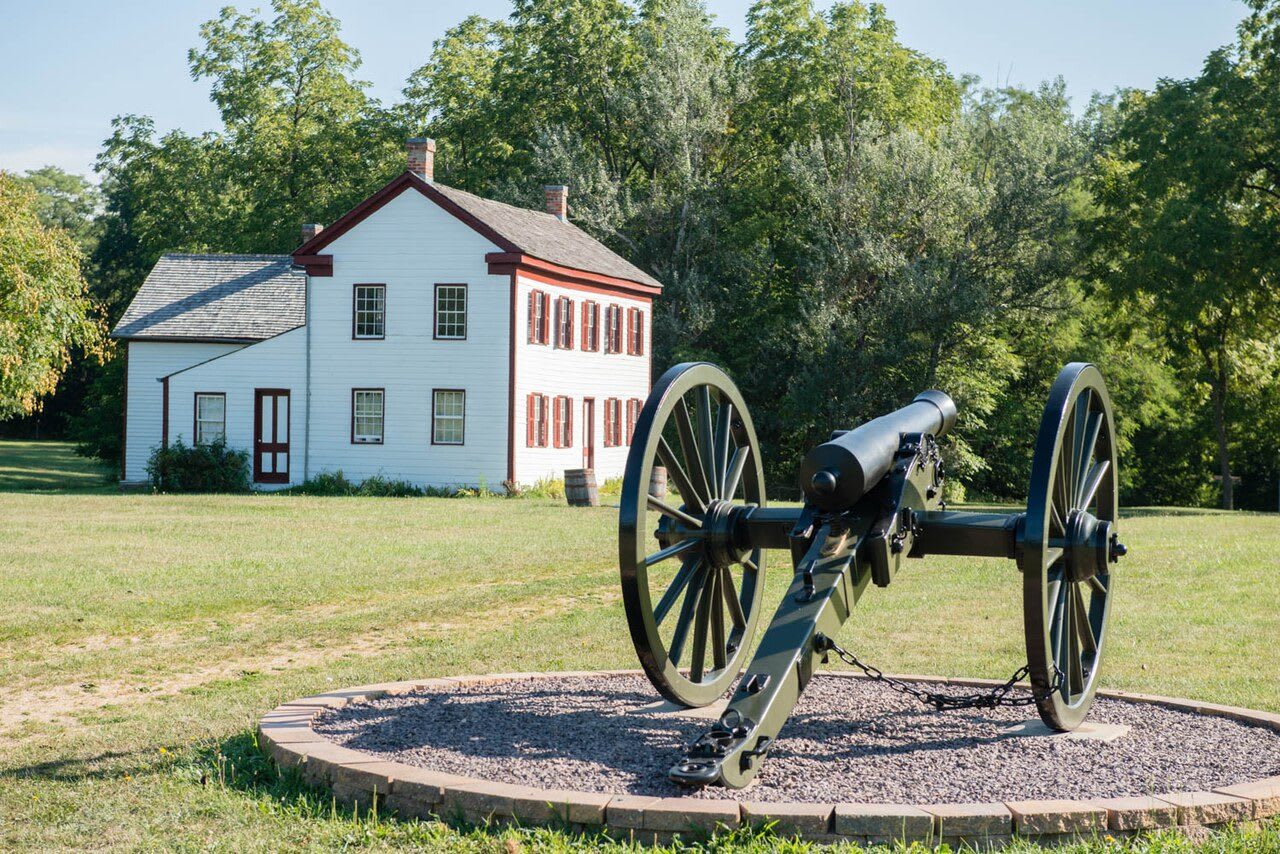
A cannon on a gravel circle before the white Thome-Benning House at Battle of Athens State Historic Site.Missouri State Parks / public domain via Wikimedia Commons
🏛️Historical

Battle of Athens State Historic Site

Part ofMark Twain Country & Little Dixie

A Des Moines River port where neighbours fought the northernmost Civil War battle in Missouri in August 1861, and a cannonball house left standing in the town it emptied.

⏱
Duration
One to two hours.
🎟
Admission
Grounds open sunrise to sunset; Thome-Benning House tours April through October.
📅
Best Season
April through October, house tours Wednesday through Sunday, 10 a.m. to 4 p.m.

The Story

In the 1850s Athens was a busy river town. A federal lock and dam on the Des Moines River, built in the late 1840s, made it a port, and it grew to about 500 people with fifty businesses, among them a large hotel, a wagon factory, a meatpacking plant and a mill that turned out flour, cornmeal, lumber and cotton and woolen goods. Its settlers came mostly from the upper South, and when the war began the county's Unionists counted it a hotbed of Southern sympathy.

On July 24, 1861, David Moore marched about 500 Union volunteers into Athens and quartered them in the homes and shops of Southern sympathizers. Col. Martin Green raised some 2,000 men to drive him out, two of Moore's own sons among them. They attacked at about five in the morning on August 5, with Moore's men on three sides and the river at their backs. Better trained and armed, the Unionists broke the attack in about two hours. At least fifty men were killed or wounded, and northeast Missouri stayed under Union control. It was the northernmost Civil War battle fought in Missouri.

The town lost. Bitterness between neighbours lasted for decades, the railroads drew trade away from the river, and by 1900 Athens was nearly gone. Local people commemorated the battle from 1868, and in 1962 they formed an association that raised money with dances, raffles and motorcycle hill climbs to buy back the ground. The Thome-Benning house still shows the two holes a cannonball made through its kitchen walls.

Visitor Info

⏱
Time Needed
One to two hours.
🎟
Admission
Grounds open sunrise to sunset; Thome-Benning House tours April through October.
📅
Best Season
April through October, house tours Wednesday through Sunday, 10 a.m. to 4 p.m.
🛣️
Highway
MO-81

On the Map

Nearby

The closest stops worth working into your route

historical13 mi away
Iliniwek Village State Historic Site
The only Illinois village found in Missouri, a town of perhaps 8,000 Peoria and Moingwena people that Marquette and Jolliet visited on the Des Moines River in 1673.
cultural54 mi away
Museum of Osteopathic Medicine
Kirksville's museum of Andrew Taylor Still, the frontier doctor who gave up drugs after losing his children and founded the first school of osteopathy here in 1892.
natural57 mi away
Thousand Hills State Park
Kirksville's reservoir park: Forest Lake, dammed in 1951 and 1952 on land given by the Laughlin heirs, in glacier-cut hills with petroglyphs under an interpretive shelter.
historical63 mi away
Jim's Journey: The Huck Finn Freedom Center
Hannibal's first African American history museum, built around Daniel Quarles, the enslaved man Clemens named as his model for Jim, and the Black town around him.
cultural63 mi away
Mark Twain Boyhood Home & Museum
The Hill Street house where Samuel Clemens lived from 1844 to 1853, and the blocks of Hannibal the town has spent more than a century arranging around his books.
architectural83 mi away
Union Covered Bridge State Historic Site
An 1871 oak bridge over the Elk Fork of the Salt River on the old Paris to Fayette road, the last Burr-arch covered bridge in Missouri, mended after a century of floods.

Historical markers nearby

Roadside plaques and monuments within a short detour

Marker11 mi away
Clark County
Marker18 mi away
Scotland County