County guide · Texas
Fayette County
6 places to stop and 71 historical markers in Fayette County, Texas.
Towns: La Grange (22), Schulenburg (11), Round Top (11), Fayetteville (11), Flatonia (3), Rutersville (3), Muldoon (3), West Point (3), Hostyn (2), Winchester (2)
Places to stop
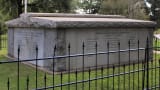
historical · La Grange
Monument Hill and Kreische Brewery State Historic Sites
A shared tomb on the Colorado River bluff for the men of the Dawson fight and the black bean lottery, beside the ruins of a German stonemason's spring-fed brewery.
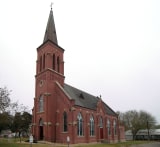
architectural · Schulenburg
Nativity of Mary, Blessed Virgin Catholic Church (High Hill)
A red brick Gothic Revival church of 1906 in a German farm settlement, where two San Antonio painters spent 1912 faking marble columns and stone vaults on wood.
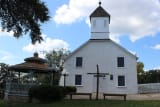
cultural · Round Top
Round Top and Festival Hill
A German village on the old La Bahía Road, named for a house tower, with an 1867 stone church, a Fourth of July kept since 1851 and a concert hall a pianist built without blueprints.
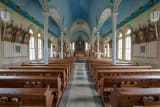
architectural · Schulenburg
Saints Cyril and Methodius Catholic Church (Dubina)
The church of Texas's first Czech settlement, under a sky-blue painted ceiling that was whitewashed in the 1950s and brought back from faint traces by its own parishioners.
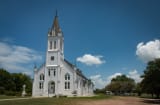
architectural · Schulenburg
St. John the Baptist Catholic Church (Ammannsville)
A wooden Carpenter Gothic church built in 1919 after storm and fire took two before it, its dusty-rose interior painted by an artist whose name was lost for decades.
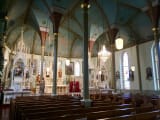
architectural · Flatonia
St. Mary's Church of the Assumption (Praha)
The mother parish of the Czech settlements around Flatonia, a stone-fronted church of 1895 whose ceiling Gottfried Flury turned into a turquoise garden, with an August 15 feast since 1855.
Historical markers
Rutersville · Erected 1973
Asa Hill of Rutersville
Hill is often confused with Abram Wiley Hill of Bastrop. He came to Texas about 1834 with a son and his nephew Isaac Lafayette Hill, bringing the rest of his family the…
Schulenburg · Erected 1969
Bermuda Valley Farm
The doctor who traced this track with his buggy went on to a long career in the Texas Senate.
Round Top · Erected 1992
Bernard Scherrer
Scherrer may have helped start the Texas cigar trade. Staying with Friedrich Ernst at Mill Creek, later Industry, he taught Ernst to roll cigars, and Ernst began a cigar…
La Grange · Erected 1983
Birthplace of the SPJST
The courtroom meeting on this plaque was a break with a national society. Texas Czechs had belonged to the C.S.P.S., founded in St.
Hostyn · Erected 1977
Brookfield-Evans-Cremer House
Before he came to this league, Musgrove Evans had already started a town. A Quaker surveyor drawn west by hopes of Michigan territorial road contracts, he platted…
La Grange · Erected 1936
Burnam's Ferry
This granite marker has traveled almost as far as the army it remembers. Set for the 1936 Centennial where local historian Houston Wade had placed Houston's crossing, it…
La Grange · Erected 1997
Cedar Cemetery
The plaque names William Lewis as one of the brothers behind the cemetery, and he is believed to lie here in an unmarked grave.
Schulenburg · Erected 1976
Col. William F. Upton
The stone sums up Upton's career; the family he married into lies beside him. On January 21, 1858, he married Mary Ann Henderson in Austin, and they had one son.
Flatonia · Erected 1994
Colony Cemetery
The settlers buried here came for cotton, and the ground let them down. The Handbook of Texas dates the community to 1880, when migrants from Mississippi arrived to farm…
Schulenburg · Erected 1965
Creuzbaur's Battery, C.S.A. "The Big Guns of Fayette"
Creuzbauer's battery, Company A of the Fifth Texas Field Artillery, was mostly German immigrants.
La Grange · Erected 1989
Czech Catholic Union of Texas
The union began as an answer to an insurance problem: many Czechs had trouble getting life insurance from eastern companies, and Father Josef Chromcik suggested a…
Fayetteville · Erected 1962
Dr. William P. Smith
The 1962 stone gives Smith a single line; his record runs much longer. Born in Tennessee on January 15, 1795, he was ordained a Methodist minister at Franklin in 1829…
Dubina · Erected 1983
Dubina
The settlers made just one bale of cotton their first year. The place was first called Navidad, then Bohemian Navidad, and for a time it became the stopover for Czechs…
Round Top · Erected 1967
Early Texas Hotels and Inns
The inn the plaque points to had a second chapter before the university took it. Joseph G.
La Grange · Erected 1936
Fayette County
Fayette County nearly held the capital of Texas. On April 11, 1838, the Second Congress approved by an overwhelming majority a proposal to locate the seat of government…
La Grange · Erected 1964
Fayette County, C.S.A
Behind the county's war was slavery's fast growth. Enslaved people in Fayette County numbered 206 in 1840, 820 in 1850 and 2,072 by 1855, and the 3,786 counted in 1860…
Fayetteville · Erected 1936
Fayetteville
The settlement went by several names before Fayetteville. In 1835 it was Wadis Post Office; it was also Alexander's Voting Place, after the revolutionary veteran Jerome…
Fayetteville · Erected 2007
Fayetteville SPJST
The headquarters on this plaque sat beside a working local lodge. The SPJST in Fayetteville was organized in 1897, and in 1911 it built a dance hall and two outbuildings…
Flatonia · Erected 1973
Flatonia
When the railroad town was laid out, the old settlement simply moved to it. Residents of the original Flatonia, a mile southeast, and of Oso, three miles northeast…
La Grange · Erected 1973
Gotcher Trace
The man behind this road appears under several names, and the record does not settle his story. The Handbook of Texas lists him as James W.
Schulenburg · Erected 1975
High Hill Cemetery
The six acres on the plaque were first meant for a school, not a graveyard. N. W. Faison conveyed two acres in 1858 and Henry Ebeling four more in 1859, intended for a…
Muldoon · Erected 1962
James Carrel Bell
Bell went into Bexar under a captain whose story ended badly. John York, born in Kentucky in 1800, had settled near the future site of Industry in 1822 and led a company…
La Grange · Erected 1985
James J. Ross
Ross's death came over a band of Tonkawas. On January 14, 1835, he was sheltering a group of them on his land when other settlers tried to remove them by force; by one…
La Grange · Erected 1962
James Seaton Lester
Lester was a Virginia lawyer, admitted to the bar in 1831, who moved to Mina, the later Bastrop, in 1834.
West Point · Erected 1936
Joseph C. Robinson
Robinson's captivity outlasted the Dawson fight by a year and a half. The prisoners were marched to Perote Castle in Mexico, where men who had surrendered as prisoners…
La Grange · Erected 2002
Kreische Complex
Kreische trained at the building-trades school in Holzminden before he emigrated, and in Fayette County he built the second county jail in 1853 and the third courthouse…
Schulenburg · Erected 1976
Lyons Family Cemetery
The boy taken in this raid came home a stranger. In 1847 Warren Lyons rode into the settlements with a Comanche trading party, and two Fayette County neighbors…
La Grange · Erected 2002
Monument Hill Tomb
Heinrich Kreische, the stonemason who later bought the bluff, built the original crypt in 1848.
Muldoon · Erected 2014
Muldoon Community
Father Muldoon served Texas only from April 1831 to August 1832, the only priest appointed to the colony's non-Hispanic settlers.
Round Top · Erected 1968
Nassau Plantation
Enslaved people worked Nassau. Count Boos-Waldeck bought slaves in New Orleans, Galveston and Houston, and they built the shops, barns, stables, kitchen, their own…
La Grange · Erected 1973
Old City Cemetery
The townswomen on this plaque took over ground that had been left to livestock. Before the 1870s the burial ground was rarely mowed, and hogs and cattle grazed among the…
Oldenburg · Erected 1990
Oldenburg
Who founded Oldenburg is not settled: the Handbook names either Gus Steenken or Johann Schmitt, and dates the founding to 1886. A post office followed in 1887.
La Grange · Erected 1974
Philadelphia Evangelical Lutheran Church
The congregation on this plaque gave a small farm town its center. Swiss Alp, eleven miles south of La Grange, was settled about 1865 by German Lutherans, and Wendish…
Fayetteville · Erected 2010
Phillip James Shaver
The town Shaver laid out soon had a school. The Fayetteville Academy opened in 1849 in a building the people of Ross's Prairie had put up the year before for church and…
La Grange · Erected 2001
Plum Grove Baptist Church and Cemetery
The congregation took its name from the community now called Plum. Tennessee families settled there on grants made to Andrew Castleman in 1828 and John Cooke in 1831…
Round Top · Erected 1995
Pochmann House
The family of cabinetmakers who lived here also produced a scholar. Henry August Pochmann, born in Round Top on January 5, 1901, was a great-grandson of the organ…
La Grange · Erected 1996
Rabb's Prairie
William Rabb's son Andrew first tried to farm this ground. He and a brother cleared land on the west side of the Colorado above the site of La Grange in 1823 and 1824…
Erected 1962
Robert Hancock Hunter
Hunter wrote one of the classic accounts of the revolution. In 1860, at Victoria, he turned his diary into a reminiscence, published in 1936 as the Narrative of Robert…
Round Top · Erected 1936
Round Top
The Townsend family arrived from Florida in 1826, and theirs was the first name tied to the site.
Round Top · Erected 1966
Round Top Community
Before it was Round Top the settlement was known by the mid-1830s as Jones Post Office, for John Rice Jones, Jr., who had settled here in 1831 and whom the provisional…
Rutersville · Erected 1972
Rutersville
John Rabb and other Methodists founded Rutersville; the site on the La Bahía Road was surveyed in 1838 and incorporated by the Republic on January 26, 1839, and on July…
Rutersville · Erected 1936
Rutersville College
Ruter first drafted the charter for a Bastrop College. The Congress of the Republic rejected it for espousing Methodist doctrine and accepted an amended charter, with no…
Round Top · Erected 2000
Samuel Knight Lewis
The stopping place the plaque mentions was also a cotton plantation, and its labor was enslaved. Lewis bought William Townsend's 145-acre homestead from Capt.
Fayetteville · Erected 1983
Sarrazin Store
The chickens on this plaque rode a railroad that was only three years old when the Sarrazins moved in.
Round Top · Erected 1995
Schiege Cigar Factory
The one-room factory outlived its trade by decades. Schiege sold his hand-rolled cigars across Texas under labels that included the Texas Star and LaRosa Suprema, and…
Round Top · Erected 1995
Schiege House
The house's second life began with a Houston preservationist who had already saved a landmark nearby.
Schulenburg · Erected 1970
Schulenburg
One of the men who gave land for the town, John Christian Baumgarten, Sr., was a Forty-eighter from Germany.
Winchester · Erected 2009
Shiloh Missionary Baptist Church
The plaque says Shiloh's members founded Center Union Baptist Church across the Bastrop County line in 1878, and that community has its own story of land.
Muldoon · Erected 1962
Simon Peter Ford
Ford's captain at San Jacinto chose the battlefield for his own grave. William Wood commanded Company A of Edward Burleson's First Regiment, which his state marker calls…
La Grange · Erected 1936
Site of a Twin Blockhouse
The granite stone marks where Moore's Fort stood, but the fort itself is no longer here.
La Grange · Erected 1990
Site of First Methodist Annual Conference in Texas
Rutersville stayed a Methodist center for more than a decade after the first conference.
Schulenburg · Erected 1972
Site of Former Town of Lyons
Lyons, also called Lyonsville, began about 1840, and a post office opened there in 1846.
Fayetteville · Erected 2012
Site of Svrcek Building
The square this building faced is best seen on Fayetteville's only Sanborn fire-insurance map, drawn in 1917.
Fayetteville · Erected 2012
Site of Svrcek Garage
Walter Meinen's dealership and Willie Svrcek's pumps marked the automobile's arrival, and the town still shows it.
West Point · Erected 1936
Site of Wood's Fort
This was not Zadock Woods's first fort. In Missouri, at the town of Woodville at present Troy, his inn and tavern had been the first stagecoach stop, and Woods' Fort…
Fayetteville · Erected 1994
St. John the Baptist Catholic Church
The plaque mentions in passing the Warrenton mission of 1886, which had an odd afterlife. Some sixty-five Czech, German and Polish families met in homes until St.
Ellinger · Erected 1986
St. Mary's Catholic Church
The parish on this plaque stands just outside a railroad town. Ellinger began as a stop on the La Grange Tap, a spur of the Galveston, Harrisburg and San Antonio, on 200…
Fayetteville · Erected 1998
St. Paul Lutheran Church
The plaque's mother church, St. John of Ross Prairie, left records before it moved. Its German-language books, with confirmations from 1852 and baptisms from 1855…
West Point · Erected 1998
St. Peter Lutheran Church and Prairie Valley Cemetery
The congregation on this plaque gathered near West Point, a railroad town that grew where the Katy crossed the Texas and New Orleans on what had been called Woods…
La Grange · Erected 1936
The First U. S. Postal Rural Mail Route in Texas
La Grange's route came less than three years after the national experiment began. Rural free delivery started on October 1, 1896, with routes out of Charles Town…
Hostyn · Erected 1936
The Oldest Czech Settlement
The Czech families of 1856 came to a place that already had a past and another name. Germans had settled Bluff, above the Colorado, in the 1830s.
Fayetteville · Erected 1994
The Rev. Jindrich Juren
Juren trained widely before he came to Texas. After a year of compulsory service in the Austrian army, he studied at Bonn and at Edinburgh and finished seminary at…
Erected 1994
The Reverend Joseph Chromcik
Chromcik came on a ticket the people of Fayetteville had paid for. Answering Bishop Dubuis's plea, he sailed by way of Cuba and New Orleans and landed at Galveston in…
Schulenburg · Erected 1996
Turner Hall
The Legion post that bought this hall in 1936 belonged to a statewide body of World War I veterans.
La Grange · Erected 1982
W. S. Robson
The plaque calls Robson a charter member of the Texas Bar Association, a voluntary forerunner of today's State Bar.
Fayetteville · Erected 1994
Waldeck Cemetery
The Long Prairie name on this plaque had a life of its own. A post office called Long Prairie opened in 1860, and at the outbreak of the Civil War the Long Prairie…
Ledbetter · Erected 2003
Waldeck Evangelical Lutheran Church
The plaque names Carl Baer as the first salaried minister; he also served longest. Born in Dresden in 1868, he trained as a typesetter, took a print-shop job at the St.
Round Top · Erected 1995
Wandke House
Wandke's name rests on a handful of instruments, and his own notebooks survive beside them.
La Grange · Erected 1962
William Gorham
The plaque gives Gorham two lines; Louis W. Kemp's biography fills in more. Born in New Haven, Connecticut, in 1798, Gorham ran away from home at fifteen and never went…
Winchester · Erected 1971
Winchester Cemetery
The Ingram Prairie families buried here took their name from John Ingram, who settled the area in 1827 and whose grant on the Colorado River is still known as Ingram's…
La Grange · Erected 2016
Yellow Fever Epidemic of 1867
An eyewitness account survives from inside the stricken town. On October 9, 1867, Livingston Lindsay, a La Grange lawyer appointed to the Texas Supreme Court that…