California 190: Across Death Valley
The road across Death Valley exists because of borax: the twenty-mule-team haul, the company that sold the scenery once the mineral ran out, and the drive from Olancha to the salt.
The Route at a Glance
Nobody built a road across Death Valley in order to look at it. The road is here because of borax, and so is nearly everything else on it.
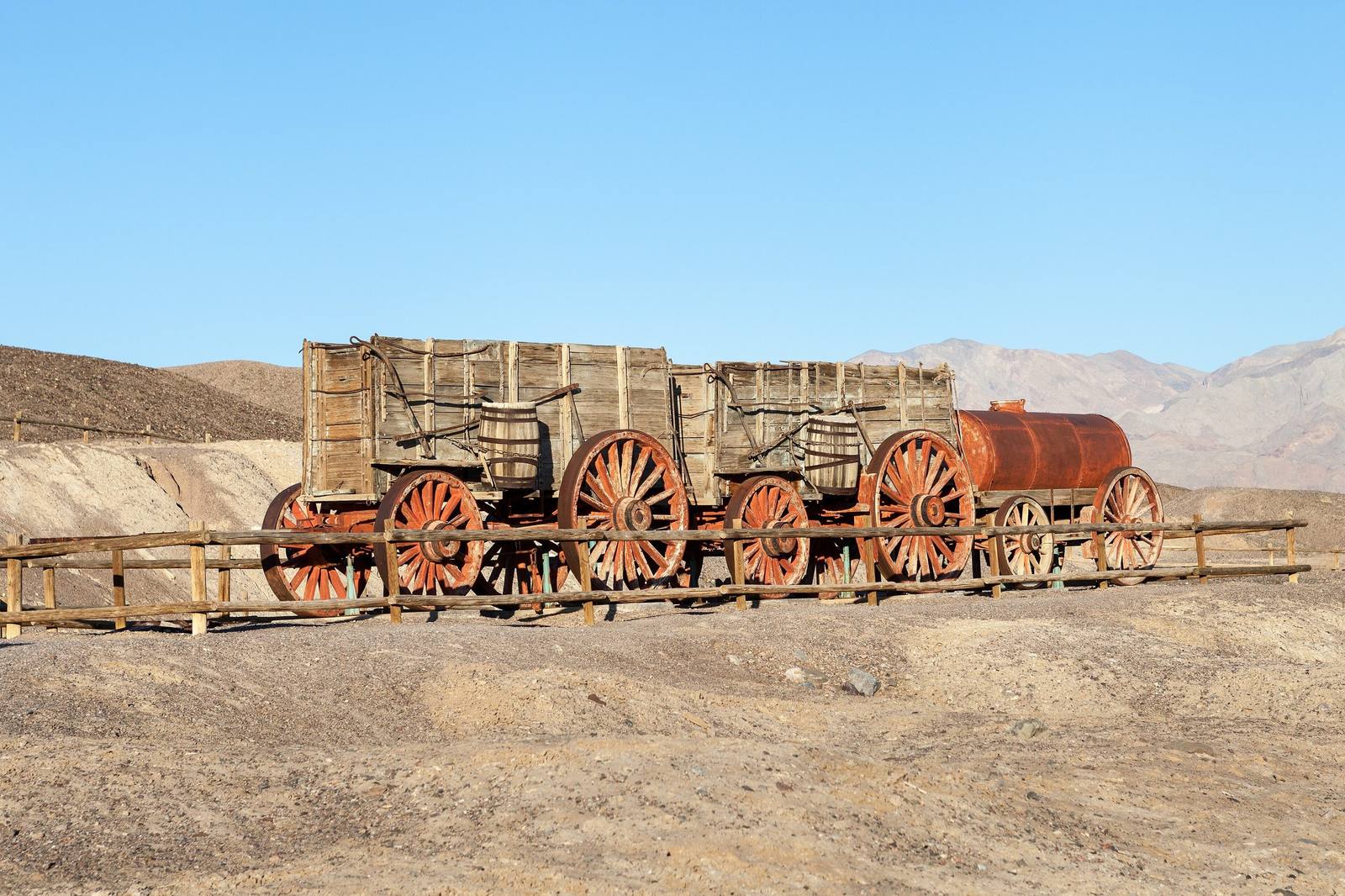
In 1883 William Coleman put up the Harmony Borax Works on the salt pan north of Furnace Creek. Crews gathered cottonball borax off the valley floor by hand, most of them Chinese laborers, and forty men boiled out about three tons a day. The mineral was never the hard part; getting it out was. The answer became the most famous freight operation in the West: eighteen mules and two horses to a wagon set built to carry ten tons, one hundred sixty-five miles to the railhead at Mojave, ten days each way across country with no water on it. Harmony lasted five years and shut in 1888. The teams ran six.
What the company did next is what paved the highway. The Pacific Coast Borax Company, holding a valley that no longer paid to mine, went into the scenery business. A private toll road came in from the west in 1926. The Furnace Creek Inn opened in February 1927 with twelve rooms. Death Valley Days went out over the radio from 1930, selling soap on the strength of the mule teams. And the company pushed hard for federal protection, which arrived on February 11, 1933, when Hoover proclaimed the national monument in one of his last acts in office. The overlook everyone photographs at sunrise, Zabriskie Point, carries the name of Christian Zabriskie, the company's vice president. Then the federal government built roads here and the state took them over, and that is the pavement you are driving.
The monument came at a cost its brochures never carried. It drew a boundary around the Timbisha homeland without the Timbisha, who would not get land back inside the park until 2000 — the account Furnace Creek gives in full.
West to east, the drive goes like this. The highway leaves U.S. 395 at Olancha, crosses Panamint Valley, and climbs Towne Pass at just under five thousand feet before dropping to sea level and past it, further and faster than the grade looks. Mesquite Flat Sand Dunes lie near Stovepipe Wells; then Furnace Creek, and two spurs worth every mile of the detour — south down Badwater Road to Badwater Basin, the lowest ground in North America at 282 feet below sea level, and east then south to Dantes View, which hangs that same salt pan a vertical mile below your boots. The road runs out at Death Valley Junction, where the borax company's own town still stands and its social hall is now the Amargosa Opera House. Come between October and April. The summers here are not a challenge to be met.
The Drive, Stop by Stop
6 stops along the route, in driving order from Olancha (U.S. 395) to Death Valley Junction. 2 of them sit off the road itself — the distance is noted on each.
- 1
- 2
- 3
- 4
- 5
- 6
That's the drive. Take your time, pull over often, and let California 190: Across Death Valley do what it does best.
← Explore more of Open Road Guide